Accra, Ghana, October 4, 2026: Women won 9.1 percent of the national officer seats the New Patriotic Party (NPP) filled at its National Delegates Conference on 3 October. Mavis Hawa Koomson took the only one, the National Women’s Organiser seat, with 783 votes. The five other women on the ballot lost.
Ghana’s Affirmative Action (Gender Equity) Act, 2024 (Act 1121) sets a 30 per cent target for women’s participation and representation in party politics for 2024 to 2026. One woman among 11 officers is the first public number against which the NPP’s progress can be read.
Six women contested and five lost
The Electoral Commission (EC) declared the official results early on 4 October. Six women were among 45 aspirants for nine offices, about 13 per cent of the field. They contested four of the nine offices.
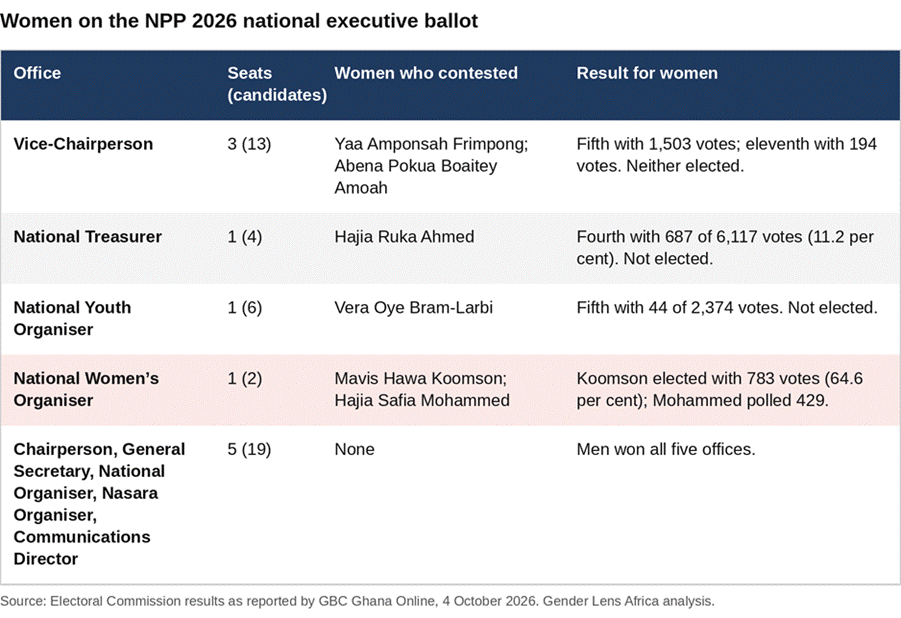
The Women’s Organiser race always had a woman winner, because both candidates were women. The open contests are the real test, and the four women who entered them all lost.
Yaa Amponsah Frimpong finished fifth for Vice-Chairperson, 1,484 votes behind the third-place candidate. Hajia Ruka Ahmed polled 11.2 per cent for Treasurer. No woman stood for Chairperson, General Secretary, National Organiser, Nasara Organiser or Communications Director.
Fewer women at the top than in 2022 and 2010
The share of women among aspirants barely moved. In 2022, six women were among 47 aspirants, about 12.8 percent. The share elected fell sharply.
In 2022, delegates elected two women among 10 officers. In 2010, three women won among 10 officers, which was 30 percent. The 2026 ballot added a Communications Director office, so 11 seats were up.
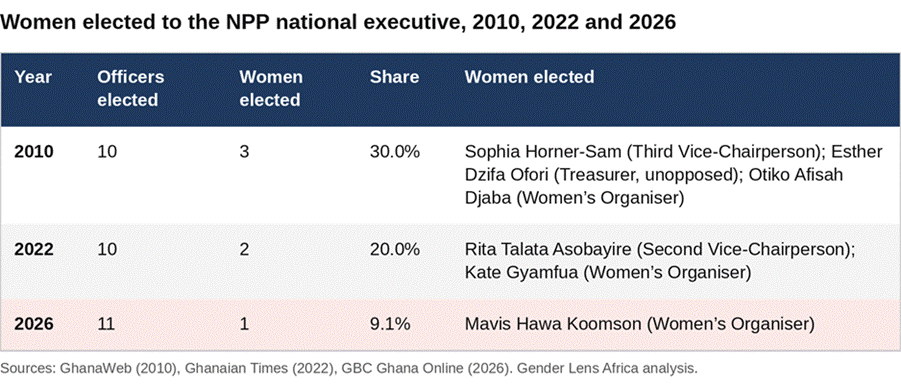
Women won two general offices in 2010 and one in 2022. In 2026 they won none. The only seat won by a woman was the Women’s Organiser position, which was contested by two women and voted on by the 1,275 delegates eligible for that race.
Female delegates voted in force
The conference had 7,163 delegates. Of those, 1,275 were eligible to vote for the Women’s Organiser, which is 17.8 percent of the total. The party’s rules let every female delegate vote in that race.
Koomson and Hajia Safia Mohammed polled 1,212 votes between them, equal to 95 percent of the eligible electorate. The same race in 2010 drew 540 votes.
Women were 17.8 per cent of delegates, about 13 per cent of aspirants and 9.1 per cent of the officers elected. Each figure counts a different group, so they do not form a like-for-like decline. They do show how women’s representation changes between the delegate pool, the candidate field and the final winners’ list.
What the frameworks say
Act 1121 is the national law. Its First Schedule sets targets of 30 per cent for 2024 to 2026, 35 percent for 2027 and 2028, and 50 percent from 2029 to 2034. Section 20 requires political parties to work towards those targets in participation and representation, to support women with information and financial resources, and to weigh the targets when they sponsor candidates and appoint or elect party officials. Parties also report each year to the EC.
The Act does not reserve 30 percent of a party’s executive seats for women. It also does not say what compliance looks like from a single ballot.
The Convention on the Elimination of All Forms of Discrimination against Women (CEDAW) is the United Nations treaty on women’s rights. Ghana ratified it in 1986. Article 7 commits states to end discrimination against women in political and public life, including the right to stand for election and hold public office.
The Maputo Protocol, formally the Protocol to the African Charter on Human and Peoples’ Rights on the Rights of Women in Africa, is the African Union’s women’s rights treaty. Ghana ratified it on 13 June 2007. Article 9 commits states to promote women’s equal participation in political life through affirmative action and legislation, and to raise women’s representation at every level of decision-making.
The Beijing Platform for Action came out of the 1995 United Nations Fourth World Conference on Women. It names women in power and decision-making as one of 12 critical areas of concern.
Measured against the 30 percent target
Thirty percent of 11 seats is just over three. The NPP elected one woman. Women were also about 13 percent of aspirants, which is below the same target.
Compliance with Act 1121 rests on more than one ballot. It also depends on the party’s support measures and its annual report to the EC. This election gives the first public number against which that report can be read.
The gap starts before the party stage
Parliament shows the same drop. Women held 41 of 276 seats, or 14.9 per cent, at the end of 2025. In the 2024 elections, 118 women contested against 682 men.
Hawa Koomson campaigned on a pledge to give women pepper spray. Gender Lens Africa tested that proposal against Ghana’s violence data in a separate analysis.
What comes next
Three numbers will show whether 2026 was a low point or a trend; the NPP’s annual gender equity report to the EC, the number of women the party backs for nominations, and the result when the National Democratic Congress (NDC) holds its own executive elections. Gender Lens Africa will keep counting.