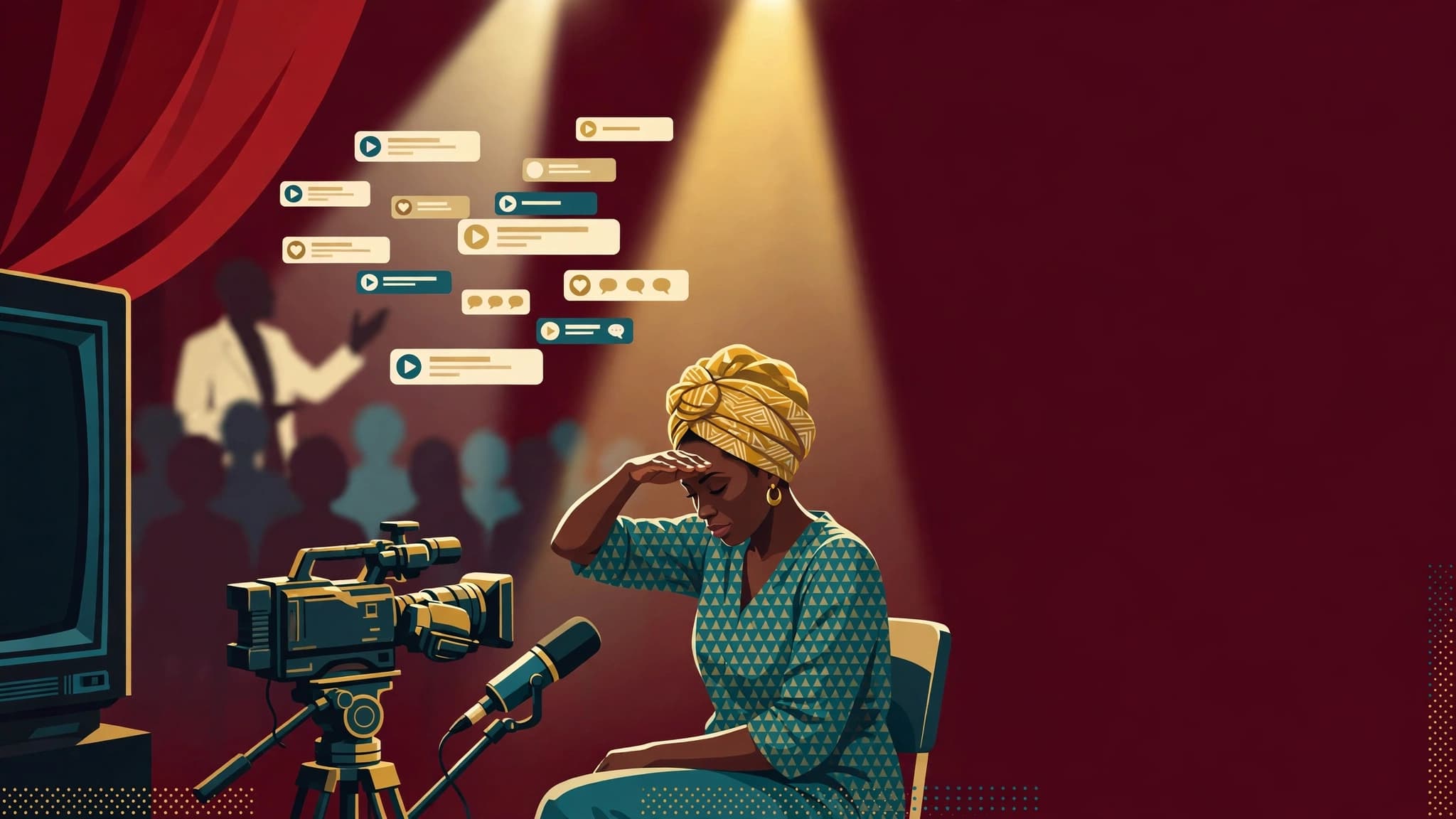
Accra, Ghana, October 5, 2026: A woman is crying on live television. She is trying to explain what happened in her marriage. Her husband is beside her, or perhaps on the telephone. A presenter interrupts, asks another question and invites the audience to decide who is telling the truth.
The discussion becomes heated. The presenter challenges the woman's account. A panellist offers a judgement. Someone in the studio laughs. The audience reacts. Clips are taken from the broadcast and shared across social media.
By the time the programme ends, a deeply personal crisis has become public entertainment.
What happens to the woman after the cameras stop recording? Who considers the possibility that she may be experiencing abuse? Who asks whether she freely agreed to discuss intimate details in front of thousands of viewers? Who takes responsibility if the broadcast exposes her to further humiliation, threats or violence?
These questions should be central to any media organisation reporting on domestic abuse, sexual violence and family conflict.
But too often, the immediate concern appears to be whether the discussion will attract attention.
In Ghana, media platforms play an important role in bringing violence against women and girls into public conversation. They expose abuse, challenge silence, provide information and sometimes compel institutions to respond.
That role matters. But there is a difference between reporting violence and turning the people experiencing it into entertainment.
When women's pain becomes a ratings opportunity, the media risks reproducing the very humiliation, intimidation and power imbalances it should be challenging.
When radio and television presenters become judges
There is a growing need to examine the way some broadcast programmes handle marital and relationship disputes.
Presenters sometimes invite people experiencing relationship problems into studios or onto live telephone discussions. The conversations can involve allegations of infidelity, abandonment, financial neglect, domestic abuse, sexual relationships and disputes over children.
Some programmes position themselves as places where people can resolve personal problems. Others allow presenters and panellists to interrogate the parties, assess their behaviour and deliver verdicts.
But a radio or television studio is not a court, a counselling centre or a specialist domestic violence service.
A presenter may be skilled at interviewing politicians, moderating public debates or entertaining an audience. That does not automatically equip them to assess a survivor's account of abuse, recognise coercive control, identify risks of retaliation or determine whether a person is safe to return home.
A marital dispute involving violence is not simply a disagreement between two people who need to communicate better.
Where abuse is involved, inviting both parties to confront each other publicly can create additional risks. A survivor may be pressured to disclose details, defend their actions or face an alleged perpetrator without adequate preparation or protection.
The studio audience may see a dramatic exchange. The person at the centre of it may leave with the consequences.
This is not an argument against discussing marriage, relationships or family life on radio and television. Nor does it mean that presenters cannot facilitate public conversations about harmful relationship practices.
It means that media organisations must understand the limits of their role. They should not turn potentially dangerous situations into public adjudication without appropriate safeguards.
Sexual violence is not entertainment
The reporting of sexual violence presents another serious challenge.
Sexual abuse and harassment deserve public attention. Survivors should be able to speak, institutions should be held accountable, and perpetrators should not be protected by silence or influence.
But coverage can become harmful when the focus shifts from the abuse and the systems that enabled it to the survivor's personal life, appearance, behaviour, relationships or sexual history.
A woman reporting abuse may find herself subjected to public interrogation. Audiences may debate whether she is telling the truth, why she did not report earlier, what she was wearing or whether her behaviour was appropriate.
Her account can become a spectacle in which everyone has an opinion except the person responsible for the abuse.
The problem is not limited to television and radio. Videos, photographs, screenshots, voice recordings and personal information can circulate rapidly across social media. Content that was never intended for public consumption can be copied, reposted and discussed long after the original incident.
When media organisations reproduce such material without considering consent, privacy, safety and public interest, they risk extending the harm.
The fact that an image or video is already circulating online does not make it ethical to broadcast. The fact that a person is a public figure does not remove their right to dignity. And the fact that an audience wants to see something does not establish a legitimate public interest in showing it.
A survivor's suffering is not evidence to be displayed for entertainment.
What Ghanaian research tells us about media coverage of violence against women
The concerns are not simply matters of personal opinion.
A study published in the BMC Public Health journal examined Ghanaian media coverage of violence against women and girls. It found that reports often treated incidents as isolated events rather than sustaining attention on the wider problem.
The researchers argued that media coverage could do more to inform prevention and public health efforts by incorporating expert voices, statistics and information that helps audiences understand violence beyond individual incidents.
This distinction matters.
When a media organisation reports that a woman has been assaulted, it has an opportunity to investigate the circumstances, examine institutional responses, explain the law, identify available support and ask what must change to prevent another incident.
But when coverage concentrates on shocking details, emotional confrontation and the identities of the people involved, the larger public-interest questions can disappear.
Who had previously received complaints? Were the police notified? Did the institution respond? Were protective measures available? What do the laws provide? What services can survivors access?
These questions may not produce the same immediate excitement as a heated studio confrontation. But they are far more important to preventing violence and holding institutions accountable.
A story should not end when the audience stops watching.
Children must never become content
The ethical responsibilities become even more serious when children are involved.
Children who experience sexual abuse, domestic violence, exploitation or neglect may be unable to understand the long-term consequences of appearing in a news report or viral video.
Their names may be withheld, but their faces, schools, neighbourhoods, family relationships or other identifying details may still reveal who they are.
The consequences can follow them into school, their communities and adult life.
The Ghana Journalists Association's Code of Ethics requires journalists to protect the rights of minors, respect privacy and human dignity, and avoid identifying victims of sexual assault.
These principles should apply across television, radio, online publications and social media accounts operated by media organisations.
A child should not have to carry a public record of abuse because an adult decided that the footage would attract attention.
Nor should a child be made to recount traumatic experiences repeatedly for cameras or microphones when the information is not necessary to serve a legitimate public interest.
The media must ask whether a child's participation is necessary, whether their identity can be protected and whether the reporting could expose them to stigma, retaliation or further distress.
The absence of a visible face is not always sufficient anonymity. A combination of details can identify a child even when their name is not published.
The attention economy rewards outrage
The commercial pressures examined in the first part of this series also matter here.
Media organisations compete for audiences, advertising and digital engagement. Television clips are shared online. Radio discussions are turned into short videos. Headlines are designed to attract clicks. Presenters and content creators compete to become part of the conversation.
In this environment, outrage can become commercially valuable.
A confrontation may attract more attention than a careful investigation. A woman's emotional breakdown may generate more shares than a detailed examination of the institutions that failed to protect her. A sensational headline may travel further than a report explaining the legal and social context of abuse.
But audience engagement is not a measure of journalistic quality.
A programme can trend online and still be irresponsible. A video can attract thousands of views and still violate someone's privacy. A presenter can become popular for confronting guests while causing harm to people who are already vulnerable.
There is also a responsibility on audiences. People who share, comment on and circulate humiliating footage help extend its reach. The media cannot be held responsible for every individual action online, but media organisations should not use public curiosity as an excuse to publish material that has no legitimate editorial purpose.
The question is not simply whether people are watching. It is what they are being encouraged to watch, and at whose expense.
When a survivor becomes the subject instead of the abuse
One of the most damaging patterns in reporting violence against women is the tendency to scrutinise the survivor more closely than the person accused of harming her.
The questions can be revealing.
Why did she stay? Why did she return? Why did she not report earlier? Why was she with him? Why did she share the video? Why did she agree to meet him?
Some questions may be relevant in a properly conducted investigation. But when they are asked without context or sensitivity, they can reproduce the assumptions that make survivors afraid to speak.
Abuse does not always involve visible injuries. A person may remain in an abusive relationship because of financial dependence, threats, fear for their children, social pressure, isolation or a lack of safe alternatives.
A survivor may delay reporting because of shame, fear of retaliation, distrust of institutions or concern that their account will not be believed.
These circumstances deserve explanation, not ridicule.
The media should also be careful about treating allegations as established facts. Responsible reporting requires verification, fairness and an opportunity for people facing allegations to respond. Protecting survivors does not mean abandoning accuracy or due process.
It means reporting in a way that does not turn the person who speaks about abuse into the person placed on trial.
What does the law and professional ethics require?
Ghana's Constitution protects the right to privacy, while also providing for freedom of speech and expression and freedom of the media. These rights must be considered together when reporting on private lives and matters of public interest.
The Ghana Journalists Association's Code of Ethics provides further guidance. It requires journalists to respect privacy and human dignity, avoid unnecessary intrusion into private grief or distress and protect the identities of victims of sexual assault.
Ghana's broadcasting regulatory framework also requires broadcasters to exercise special care in matters involving privacy, dignity and reputation, with particular attention to children and other vulnerable groups.
The public-interest exception is important. Journalists may need to report on private conduct when it reveals abuse of power, corruption, danger to the public or serious institutional failures.
But public interest is not the same as public curiosity.
Showing an intimate image, identifying a survivor or broadcasting a person's distress must be justified by a genuine public-interest purpose. The fact that material is dramatic or likely to attract attention is not enough.
A media organisation should be able to explain why the material was necessary, whether less intrusive alternatives were available and what steps were taken to minimise harm.
The media needs a trauma-aware approach
Trauma-aware reporting does not mean avoiding difficult stories or treating survivors as incapable of speaking for themselves.
It means recognising that the way journalists gather and present information can affect people who have experienced violence.
It requires journalists to explain how an interview will be used, obtain informed consent, avoid unnecessary repetition of traumatic details and respect a person's decision not to answer a question.
It also requires editors to consider whether images, audio, headlines and captions expose people to further harm.
A survivor should not be pressured into a live interview because the programme needs a compelling guest. A child should not be asked to describe sexual abuse for entertainment. A person in immediate distress should not be expected to make decisions about public disclosure without adequate support.
Gender Lens Africa has developed a Ghana-focused trauma-aware reporting guide for newsrooms, bloggers, content creators and members of the public. It sets out practical principles for reporting domestic violence, including protecting identities, avoiding victim-blaming and considering the consequences of publication.
The guide is not a substitute for law, specialist safeguarding services or professional training. It is a practical resource for anyone producing or sharing content about violence.
Media organisations should develop and enforce their own editorial safeguards, train presenters and producers, and establish procedures for handling sensitive interviews and allegations of abuse.
Who is missing from the conversation?
There is another question about power in media coverage: who gets to explain violence against women and girls?
Survivors should have the right to speak about their experiences if they choose. But they should not be expected to carry the burden of explaining the causes, consequences and solutions to violence.
Newsrooms need more sustained engagement with women’s rights organisations, gender specialists, legal practitioners, social workers, child-protection professionals and researchers.
Too often, public discussions about women's lives are dominated by political commentators, religious leaders, relationship experts and other familiar voices, while specialist knowledge is brought in only after a particularly shocking incident.
A media organisation that wants to report responsibly should ask whose expertise is missing, whose perspective is being treated as authoritative and whether women are being invited to speak as experts rather than merely as victims or subjects of controversy.
Women should be part of the conversations that shape public understanding of violence, justice, relationships and social policy.
Their experiences matter. Their expertise matters too.
The responsibility does not end when the programme goes off air
Media organisations must be prepared to answer difficult questions about their editorial decisions.
Who approved the broadcast? Was the person interviewed adequately informed? Was the possibility of retaliation considered? Were children's identities protected? Was an intimate image necessary to the story? Was the presenter equipped to handle allegations of abuse? Were support services provided where appropriate?
Where a media organisation has caused harm, it should not simply delete a clip and move on. It should acknowledge the problem, correct the record where necessary, remove harmful material where appropriate and review the editorial decisions that led to publication.
The National Media Commission, the Ghana Journalists Association and broadcasters themselves have roles to play in strengthening professional accountability. But regulation alone cannot replace the everyday judgement of editors, producers and presenters.
The media must be willing to hold itself to the same standards it demands of public institutions.
A woman's pain is not a programme format
Ghana needs media organisations that investigate violence, challenge impunity, expose institutional failures and give survivors the opportunity to be heard.
It needs journalists who can report difficult stories without humiliating the people at their centre. It needs presenters who understand that not every personal crisis belongs on live television. It needs editors who recognise that a viral clip is not necessarily a public service.
Most importantly, it needs a media culture that understands the difference between giving someone a voice and using their suffering to attract an audience.
A woman who speaks about abuse should not have to defend her entire life before the public. A child who experiences sexual violence should not become a recognisable face in a news report. A family crisis should not automatically become a public trial.
There is a public interest in exposing violence. There is no automatic public interest in exposing a survivor.
The media's responsibility is not simply to tell the story. It is to consider what telling that story will do to the people living it.
When women's pain becomes prime-time entertainment, the media is no longer simply reporting harm. It risks becoming part of it.
This is the third part of Gender Lens Africa's series, The Fourth Estate on Sale?, examining media ownership, commercial influence, political pressure, newsroom conditions and the public's right to independent journalism.