Accra, Ghana, 6 November 2026: Women hold about 27 per cent of parliamentary seats in sub-Saharan Africa. Across Africa, they hold just 9 per cent of the top posts in the main political parties. That gap explains why more women in office has not meant more women in charge.
The 9 per cent figure counts three posts, leader, secretary-general and deputy secretary-general, in each country’s ruling party and main opposition party. It does not measure every place where decisions are made. It matters because parties choose the candidates who fill every other place.
The Women in Politics 2026 map from the Inter-Parliamentary Union (IPU) and UN Women shows the wider pattern: women hold 22.4 per cent of cabinet posts worldwide, down from 23.3 per cent in 2024.
Ghana shows where the filter sits. Women were 14.9 per cent of parliamentary candidates in 2024 and won 14.5 per cent of the seats declared. Once on the ballot, women won about as often as men.
Women in African parliaments: seats rise, slowly
Sub-Saharan Africa ranks third among world regions, with women holding 27.1 per cent of parliamentary seats on 1 January 2026, behind the Americas at 35.6 per cent and Europe at 32.3 per cent. Worldwide, women hold 27.5 per cent of seats across both houses, up 0.3 points from 27.2 per cent a year earlier.
Country figures vary wildly. Rwanda leads the world, with women in 63.8 per cent of lower-house seats. Cabo Verde stands at 45.8 per cent, South Africa at 44.8 per cent and Namibia at 42.3 per cent. Nigeria sits at 4.2 per cent.
The International Institute for Democracy and Electoral Assistance (International IDEA) tracks the continental trend. Women gained one percentage point in three years, its Africa Barometer 2024 found. At that rate, African parliaments reach gender parity in 2100.
Political party leadership: where decisions begin
Parties write the candidate lists. The people who lead a party decide who stands, who gets a safe seat and who gets funding. In plain terms, a party leader holds the gate that every candidate must pass.
International IDEA’s barometer counts the top three posts in each ruling and main opposition party it covers: the leader, the secretary-general and the deputy secretary-general. Women held 9 per cent of those posts in 2024, down from 12 per cent in 2021.
Over the same period, women’s share of cabinet rose from 22 to 24 per cent and top executive posts from 7 to 13 per cent. The party posts recorded the biggest fall, and they are the posts that shape the candidate lists.
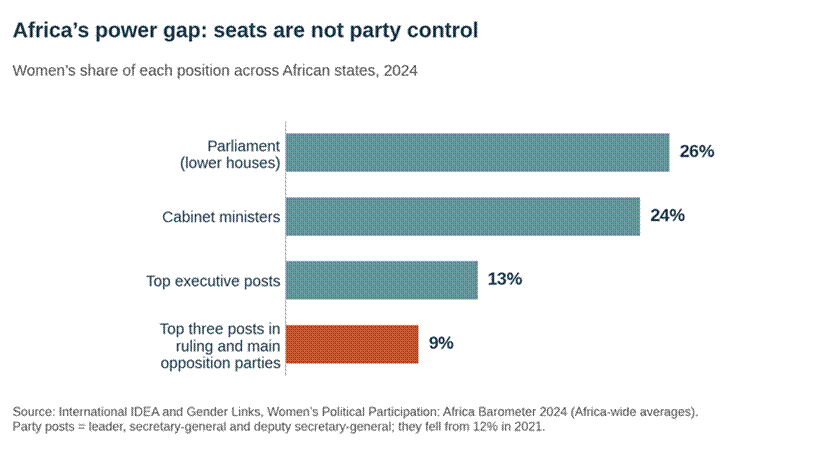
Infographic 1. Women’s share of each position across African states, 2024. Source: International IDEA and Gender Links, Africa Barometer 2024.
Hostility also screens women out. In five national case studies, in Argentina, Benin, Italy, Malaysia and the Netherlands, 76 per cent of women MPs reported exposure to violence from the public, online or offline, against 68 per cent of men. Benin is the only African case. The IPU says that hostility deters women from seeking office.
The top of the ladder shows how much one post matters and how little it guarantees. Women lead governments in Namibia and Tanzania as heads of state and government, and in the Democratic Republic of Congo and Tunisia as heads of government, the IPU and UN Women map shows. Namibia ranks first in the world for women ministers, with nine of 14. Tanzania has five women among 23 ministers, or 21.7 per cent.
Both presidents climbed the party and executive ladder first. Samia Suluhu Hassan became president as vice-president after John Magufuli’s death in 2021. Netumbo Nandi-Ndaitwah was Namibia’s vice-president before she won the presidency. Their routes fit the pattern: the way to power runs through the party.
Cabinet portfolios: women lead gender ministries, men lead the money
Worldwide, the IPU and UN Women map shows women lead 90 per cent of gender equality ministries and 73 per cent of ministries for family and children’s affairs. Men almost exclusively lead defence, home affairs, justice, economic affairs, health and education. These are global figures, not African ones.
A portfolio is the policy area a minister runs. It matters because budgets, security forces and courts sit in some portfolios and not others. A woman at the gender ministry speaks for women. A man at finance sets the budget that ministry works with.
African cabinets show that big parliamentary shares do not translate automatically into executive posts. Women hold 63.8 per cent of Rwanda’s lower house but 5 of 19 ministries, or 26.3 per cent. Cabo Verde has 45.8 per cent women in parliament and 2 of 16 ministers, or 12.5 per cent.
South Africa shows the pattern moving in both directions. Women held 50 per cent of ministerial posts in 2019 and 44 per cent after the 2024 elections, and deputy ministers fell from 46 to 40 per cent, a Gender Links audit found. Women lead the Justice and Defence ministries there, yet men still run Finance, Public Works and Science and Technology.
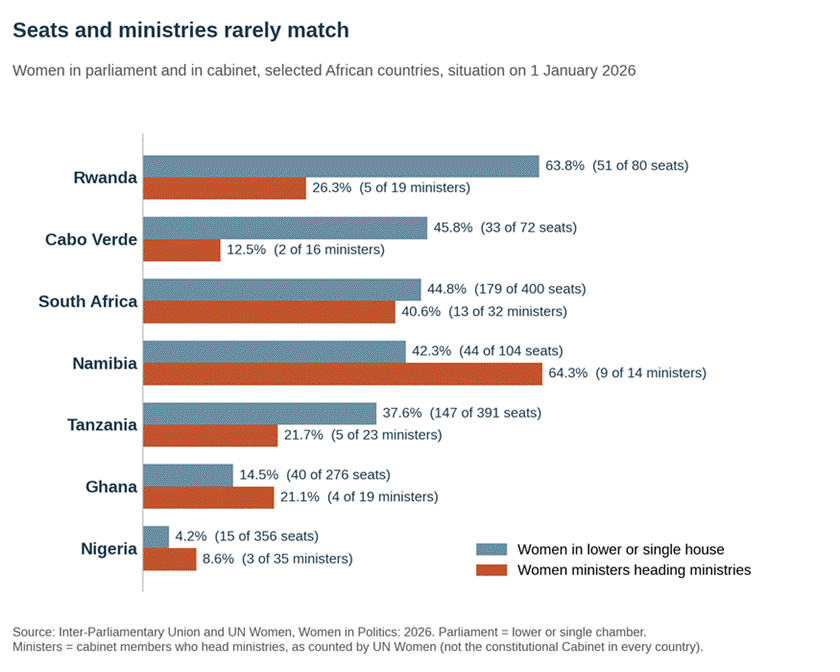
Infographic 2. Women in parliament and among ministers heading ministries, 1 January 2026. Source: IPU and UN Women, Women in Politics: 2026.
Ghana women in politics: 14.5 per cent of seats, few top posts
Ghana ranks 149th in the world for women in parliament, with 40 women among 276 MPs, or 14.5 per cent, the IPU map shows. The 2025 Status of Women Report counts 41 women, or 14.9 per cent. The two counts come from different sources, not from one dataset. This article uses the IPU figure.
President John Dramani Mahama promised at the NDC Women’s Manifesto launch in September 2024 that 30 per cent of his cabinet would be women. In February 2025 he named 19 ministers to the constitutional Cabinet, two of them women, or 10.5 per cent: Elizabeth Ofosu-Adjare at Trade, Agribusiness and Industry, and Dr Agnes Naa Momo Lartey at Gender, Children and Social Protection. Men took Finance, Interior, Defence, Foreign Affairs, Justice, Energy, Education and Health.
The Constitution also seats the President and the Vice-President, Professor Naana Jane Opoku-Agyemang, the first woman to hold the office. Counting them, three of the Cabinet’s 21 members are women, or 14.3 per cent.
The IPU and UN Women count a third group: ministers who head ministries. On 1 January 2026 they counted four women among 19, or 21.1 per cent. In plain terms, the three figures measure different groups on different dates: ministers in the constitutional Cabinet in February 2025, all Cabinet members including the President and Vice-President, and ministers heading ministries in January 2026.
None of the three reaches the 30 per cent that Mahama promised. In his first term, he named six women among 19 cabinet ministers.
Speaker Alban Bagbin told an International Women’s Day event in Parliament that anything below 30 per cent is unacceptable. Inside the House, four women chair major committees. Abena Osei-Asare is the first woman to chair the Public Accounts Committee. Helen Adjoa Ntoso chairs Gender, Children and Social Welfare, Queenstar Pokua Sawyerr chairs Local Government and Rural Development, and Dr Zanetor Agyeman-Rawlings chairs Security and Intelligence.
A committee chair leads the committee’s inquiries into ministries and agencies. The Public Accounts Committee scrutinises how ministries spend public money, so that chair holds real power. Isaac Adongo chairs the Finance Committee.
Women fare worst at the local level. Only 4.1 per cent of those elected to district assemblies in 2023 were women. The Status of Women Report found women fill less than 20 per cent of substantive ministerial appointments.
Ghana political parties: who decides who runs
The results suggest that the problem begins before voters reach the ballot box. The IPU’s record of the December 2024 election lists 801 candidates for Parliament: 119 women and 682 men. Women were 14.9 per cent of candidates.
Forty women won, a success rate of 33.6 per cent. Men won 235 seats, a success rate of 34.5 per cent. Those are the 275 seats filled when the IPU recorded the result. On the same record, women who reached the ballot won about as often as men.
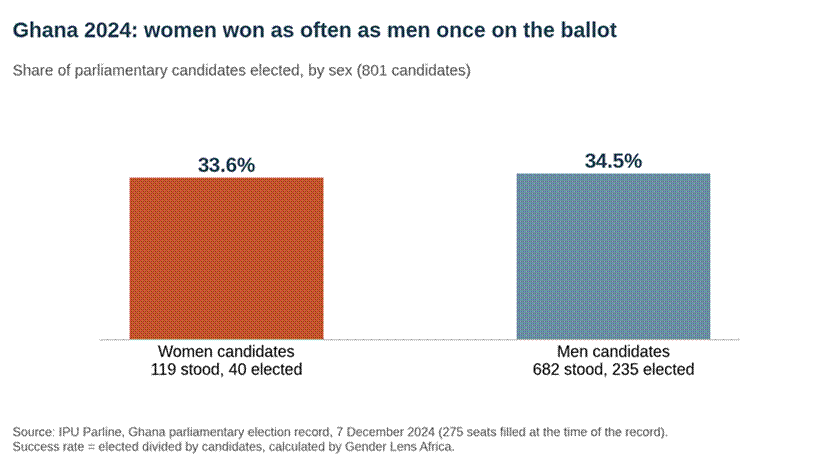
Infographic 3. Ghana 2024 parliamentary success rate by sex. Source: IPU Parline election record, 7 December 2024. Calculation by Gender Lens Africa.
Primaries explain more. A primary is the internal vote a party holds to choose its candidate. About 11 of the 40 sitting women MPs lost their party primaries to men before polling day, the Ghana News Agency reported.
Political scientists Gretchen Bauer and Akosua Keseboa Darkwah say primaries are not open to most voters and are often subject to manipulation. They add that campaign costs, insults and electoral violence deter women. In their 2024 survey, 95 per cent of candidates reported degrading talk and false rumours, and both women and men said they would still stand.
Affirmative Action Act: Ghana has the law, not the compliance
The Affirmative Action (Gender Equity) Act, 2024 (Act 1121) was passed in July 2024 and assented to in September 2024. Its First Schedule sets targets for women’s share of appointments: 30 per cent for 2024 to 2026, 35 per cent for 2027 and 2028, and 50 per cent from 2029 to 2034, according to the Affirmative Action Law Coalition’s section-by-section summary.
In plain terms, the Act sets targets and names who must meet them. Section 14 directs the President to pursue the targets when appointing ministers, the Council of State, independent constitutional bodies, governing bodies of State institutions, the Public Service, District Assemblies and any other office the President fills. Section 18 applies them to leadership positions and committees of Parliament.
Section 19 requires ministries, departments, agencies and district assemblies to include a budget line for gender issues. Section 20 requires political parties to factor the targets into candidate sponsorship and the choice of party officials. It also requires each party to file an annual gender equity report with the Electoral Commission, which must publish it in the Gazette.
The Women’s Manifesto Coalition’s 2025 Status of Women Report, presented by convenor Hamida Harrison in December 2025, says government appointments have not met Section 14. The coalition reads the section as a 30 per cent minimum in each category of public appointment. It says government grouped all appointments, presidential staffers included, instead of applying the threshold by category.
The President’s own figure is an aggregate. In his 2025 State of the Nation Address, Mahama said women made up 23.21 per cent of all appointments. The Affirmative Action Law Coalition said on the Act’s first anniversary that the 30 per cent minimum remains unmet.
On budgets, the Status of Women Report raised concerns about the lack of gender-responsive budgeting, although Section 19 requires ministries, departments, agencies and district assemblies to include budget lines for gender issues. Bauer and Darkwah noted that the law gives no guidance on sanctions if parties miss their goals. The Affirmative Action Law Coalition adds that the Gender Equity Committee is under-resourced and the Legislative Instrument is delayed.
What would shift power in Africa’s politics
Counting seats is the start. Four changes would move the count to where decisions sit.
Publish party data. International IDEA can report that women hold 9 per cent of top party posts because researchers counted them. Section 20 already requires every registered party to file a gender equity report with the Electoral Commission. Ghana’s parties and the Commission should publish those reports, officer by officer.
Apply the threshold by category. Ghana should apply the 30 per cent minimum to each appointment category, as the coalition reads Section 14, and publish the results ministry by ministry.
Open the safe seats. Bauer and Darkwah propose that parties nominate women for constituencies they know they will win. Roba Sharamo, International IDEA’s regional director for Africa and West Asia, recommends gender-targeted funding and penalties for parties that do not prioritise women.
Carry parity from the list to the cabinet table. Cabo Verde’s 2016 Parity Law requires balanced candidate lists, yet women held 2 of 16 ministries on 1 January 2026. Sierra Leone paired a 30 per cent quota with proportional representation in 2023, and women held 28.2 per cent of seats and 33.3 per cent of ministries by 1 January 2026, the IPU map shows.
Count the seats. Then count who holds the pen.