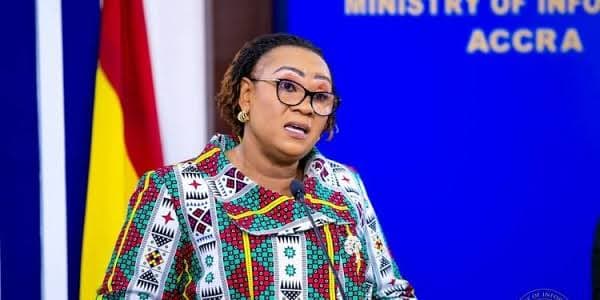
Accra, Ghana October,3 :Delegates of the New Patriotic Party (NPP) are voting in Kumasi today, and one candidate has made an unusual promise to women. Hon. Hawa Koomson, a former Member of Parliament (MP) and Minister for Fisheries and Aquaculture Development, says she will give every woman in the party a pepper spray and train them to use it if she wins the post of National Women’s Organiser.
The pledge is easy to laugh at. It also touches a fear many Ghanaian women know. The country’s latest national survey found that one in three women has experienced physical violence since the age of 15, and that among those women the person responsible was most often a current or former husband or partner, not a stranger.
Results had not been announced when this article was published. Hawa Koomson’s rival is Hajia Safia Mohammed, the party’s Deputy National Women’s Organiser. The question the pledge raises will outlast the vote; what does a country owe women who are afraid?
What Hawa Koomson promised
In a video that circulated before the conference, Hawa Koomson told women delegates that carrying pepper spray is about protection, not picking fights. She said women should have basic self-defence tools and training in responsible use, and she promised to teach them to be “impregnable”.
She built the pledge on her own experience. Hawa Koomson says the spray saved her life during the Ablekuma North parliamentary rerun, and she described a woman in an Uber in Accra who, she said, was saved the same way. She gave no name or date for the Uber account, and we could not confirm it.
What happened in Ablekuma North
The rerun took place on 11 July 2025 across 19 polling stations. At the St Peter’s Methodist Church polling station, videos showed Koomson using pepper spray as a group advanced on her. She was then beaten, along with two other NPP members, Chris Lloyd Nii Kwei and Majeed Mohammed Saana.
Eight men later pleaded guilty at the Accra Circuit Court to conspiracy to commit assault and three counts of assault. The court fined each man GH¢6,000, with 24 months in jail in default.
Hawa Koomson says she acted in self-defence and has carried pepper spray since her son was stabbed during an earlier election. The footage shows she was forced to the ground after using it. An NPP colleague who visited her relayed Hawa Koomson’s account that the spray slowed the attackers’ charge.
Her carrying the spray divided opinion. A member of the National Democratic Congress legal team, Victor Kwadjoga Adawudu, condemned the assault but questioned why she took pepper spray to a polling station, citing her political record. In 2020, Hawa Koomson admitted firing a gun at a voter registration centre in her constituency. She described it as a warning shot in self-defence. That history bears on the political debate about carrying weapons. It does not change the separate question of whether women should have access to lawful means of personal protection.
The convictions concern the men who attacked her. They do not settle whether a politician should carry a spray to a polling station, and they are no reason to dismiss her experience.
Who hurts women in Ghana
The best national evidence comes from the 2022 Ghana Demographic and Health Survey (GDHS), run by the Ghana Statistical Service (GSS). It interviewed 15,014 women aged 15 to 49 across the country.
The survey found that 33.2 percent of women had experienced physical violence since age 15, and about 14 percent had experienced sexual violence. Among women who had ever had a partner, 41.6 percent reported emotional, physical or sexual violence from that partner. Researchers call this intimate partner violence (IPV).
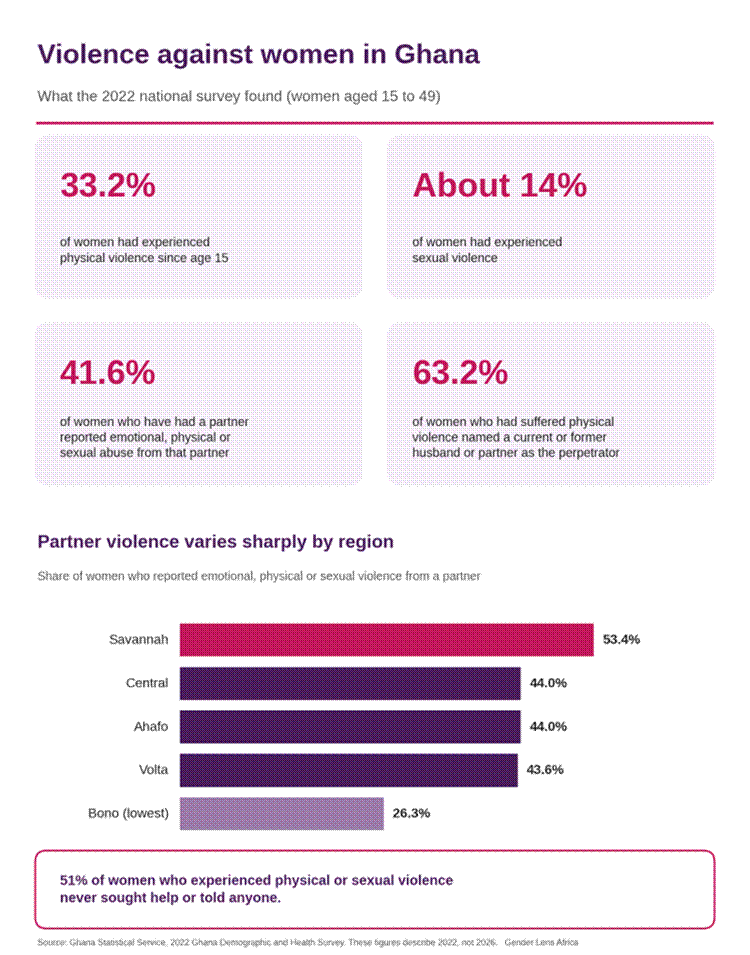
Graphic: Gender Lens Africa, using Ghana Statistical Service data from the 2022 Ghana Demographic and Health Survey.
Violence is not evenly spread. Partner violence reached 53.4 per cent in the Savannah Region and 44 percent in the Central and Ahafo regions, against 26.3 per cent in Bono. The Central Region also recorded the highest share of physical violence since age 15, at 44.6 per cent.
Why the attacker is often someone she knows
Among women who had experienced physical violence, 63.2 percent named a current or former husband or partner as the perpetrator. Fathers, mothers and siblings came next, each named by about one in ten.
The pattern holds for sexual violence. The GSS reports that 54 percent of women who experienced it named a current husband or partner. Just over half of women who experienced physical or sexual violence (51 per cent) never sought help or told anyone.
That is the limit of any personal safety tool. A spray in a handbag may help a woman get away from an attacker she does not know. It does far less for a woman whose attacker shares her home, knows her routine and controls her money.
Progress is slow. Between 2008 and 2022, physical violence since age 15 fell from 36.6 to 33.2 percent and sexual violence fell from 18.8 to about 14 per cent. Physical violence during pregnancy rose from 5.2 to 6.8 per cent. The data do not show violence rising in general. They do not show it falling fast enough.
Ghana is not an outlier. The World Health Organization (WHO) estimates that about one in three women worldwide experiences physical or sexual violence. The definitions differ, so the figures are not like for like, but the scale is similar.
Cases that reach court can stall. Daniel Tuffuor, a Kwame Nkrumah University of Science and Technology student accused of murdering fellow student Joana Yabani in February 2025, remains in custody while the case moves through repeated adjournments. He has not been convicted. Reports say the delays have deepened her family’s anguish.
What pepper spray can and cannot do
The best-known test comes from the United States. In a 1993-94 field trial published by the National Institute of Justice, Baltimore County police used pepper spray in 174 confrontations. The person was subdued in 156 of them, or 90 percent.
The study has clear limits. It was not a test of women using pepper spray. Trained officers, not members of the public, used it, and some of the 18 people it did not subdue appeared to be on drugs or mentally disturbed. It says little about how a woman would fare with a can and limited training. We found no comparable Ghanaian research.
Hawa Koomson’s own case shows both sides. By her account, the spray bought her time. The footage shows it did not stop the attack.
What Ghana’s law says
The Ghana Revenue Authority lists weapons designed to discharge noxious liquids or gas among goods that need a licence from the Minister for the Interior to import. The list covers imports, and it leaves classification to the Commissioner-General’s opinion. It does not say whether a woman may carry such a spray.
In the speech as reported, Koomson did not say where the party would source the spray, who would pay, or what permit it would seek. Those answers matter more than usual because her own example comes from an election. A party that hands out the devices would answer for how they are used. Any training should stress escape and calling for help, not confrontation.
Is Hawa Koomson right about Europe?
Hawa Koomson said pepper spray is given out free in Europe. We could not find a national programme that does this. The United Kingdom treats pepper spray as a prohibited firearm, while France, Germany and Italy allow it with conditions such as age limits, permits or labelling for use against animals. In countries cited, where pepper spray is permitted, its sale or use is subject to conditions.
The state still owes women more than a can of spray
The WHO’s RESPECT framework sets out seven strategies to prevent violence against women: strengthening relationship skills, empowering women, providing services, reducing poverty, making environments safe, preventing child and adolescent abuse, and changing attitudes and norms. None involves equipping women with weapons.
That does not make self-defence worthless. It shows where the evidence-based effort lies, and Ghana’s services are thin. The Domestic Violence Act, 2007 (Act 732) created a fund for survivors. The International Federation of Women Lawyers Ghana (FIDA-Ghana) and other groups reported in October 2025 that the fund’s 2025 allocation fell 87.66 per cent from 2024, with nothing set aside for building shelters.
The 2026 budget gave the fund GH¢1 million, down from GH¢2.7 million in 2024, according to Savelugu MP Hajia Fatahiya Abdul Aziz, who criticised the figure during the budget debate.
A fair test for the next organiser
None of this argues against a woman owning a self-defence tool where the law allows it. Hawa Koomson’s fear comes from real violence, and a court has convicted men for it. The sound reading of her pledge is that it addresses one narrow risk, an attack by a stranger in public, inside a much larger problem.
Whoever wins in Kumasi can put the pledge to three tests. Is the spray legal and licensed? Does the training teach women to escape and call for help? And does the women’s wing press its own MPs to fund shelters and prosecutions?
Pepper spray may give a woman another option in a dangerous moment where the law allows it. But it cannot address the larger pattern in Ghana’s data, where much of the violence women experience comes from people they know.
About the data
All survey figures in this article describe 2022, not 2026. The partner-violence and regional figures are from the Ghana Statistical Service's preliminary findings for the 2022 Ghana Demographic and Health Survey, released in November 2023.The GSS reported sexual violence as 14.1% in those preliminary findings and as 14% at the final dissemination. This article uses "about 14%". Hawa Koomson's account of the Ablekuma North attack and the Uber incident is hers. The eight men convicted over the Ablekuma North attack pleaded guilty. Daniel Tuffuor is accused and has not been convicted.