Accra, Ghana, October 7, 2026: Within hours of hospital footage of actress and fashion personality Nana Akua Addo reaching social media, the comment sections had a verdict. Many had a punchline too.
On October 6, her lawyers asked the media and the public to stop sharing the videos, especially footage showing a minor. She says the footage was leaked without her consent. Her husband's lawyers deny the assault allegation and link the injury in the footage to a 2021 incident. Those claims are untested.
Police and the courts will weigh both accounts. A comment section cannot. What we can decide is how we behave while the system works, and right now we are failing.
Why the comment section matters
Ghanaian women already stay silent. The 2022 Ghana Demographic and Health Survey found that one in three women aged 15 to 49 has experienced physical violence since age 15. Among women who experienced physical or sexual violence, 51 percent never sought help and never told anyone.
Attitudes explain part of that silence. The same survey found that 19 per cent of women and 16 per cent of men say a husband is justified in hitting his wife, for reasons such as burning food. A woman deciding whether to speak watches what happens to the next woman who does. If she sees mockery and speculation about motives, she learns that speaking costs more than staying quiet.
Why "why did she not leave?" is the wrong question
The question treats leaving as a single, simple act. Research shows that separation raises the risk of escalating violence and femicide, and that economic need is one reason women return to abusive partners. Fear, family pressure and housing weigh on the decision too.
The law does not ask for a video either. The Domestic Violence Act, 2007 (Act 732) says a single act can amount to domestic violence and that a victim, or anyone with information, may complain to the police. Yet a coalition of rights groups has argued that the framework remains ineffective on the ground, and one of its members sued for the Victims of Domestic Violence Support Fund to be activated.
The child in the footage
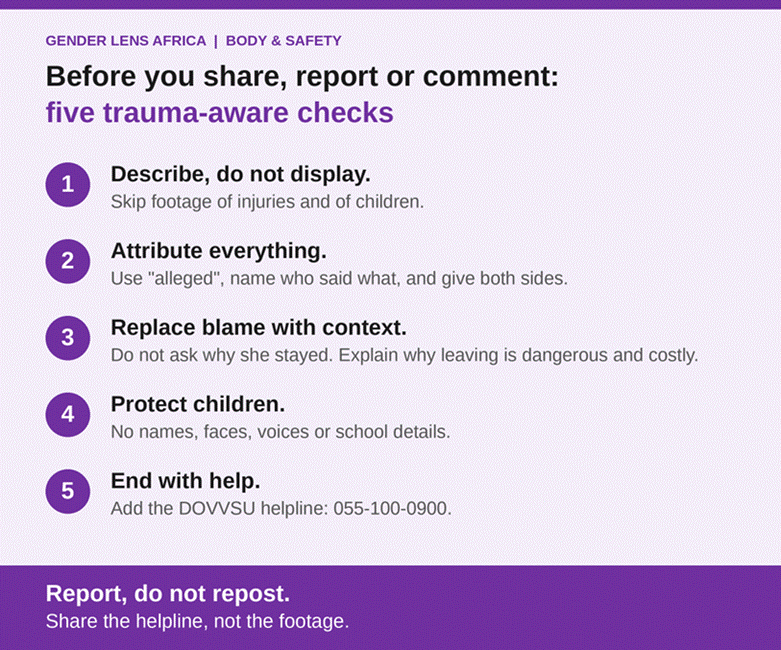
Her lawyers describe one video as showing violence involving a minor. Sharing it does not protect that child. The Children's Act, 1998 (Act 560) makes a child's best interest paramount and requires anyone with information on child abuse to report it to the district Social Welfare and Community Development Department. Reporting is not reposting.
UNICEF's principles for reporting on children tell journalists to change the name and obscure the visual identity of children at risk. A child who has been hurt should not be turned into a trending clip, and once footage is online, its spread is hard to control.
What trauma-aware reporting asks of us
Trauma-aware reporting is not soft reporting. It is accurate reporting that avoids causing further harm. The SAMHSA framework for a trauma-informed approach names six principles: safety, trustworthiness and transparency, peer support, collaboration, empowerment and choice, and attention to cultural and gender context. For a newsroom, that means asking whether a detail serves the public or only the click, and giving people a say in how their story is told.
Context is the other half. The Dart Center for Journalism and Trauma cites a University of Hartford study of US newspaper articles in which 99 of 100 stories on intimate partner violence carried no statistics. Ghanaian scholar Professor Audrey Gadzekpo has made a similar point at home; coverage often treats violence as an individual issue rather than a societal problem.
Fairness runs both ways
Trauma awareness is not a verdict. The husband is entitled to the presumption of innocence, and his lawyers' statement belongs in any fair report, clearly attributed. What trauma awareness rules out is spectacle for either side; replaying injuries, digging through the couple's past, or ranking who looks more believable.
What happens next
Three things can start now. First, every newsroom, blog and content page can adopt a one-page protocol like the checks above, and editors can hold their teams to it.
Second, Ghana needs regular trauma-aware reporting training for journalists, bloggers and content creators. The Ghana Journalists Association and the gender ministry have run workshops on the ethics of reporting domestic violence before. The next round should be practical, repeated and open to the creators who shape what Ghanaians see first.
Third, the Victims of Domestic Violence Support Fund and the shelters and services that Act 732 provides for need real money, so that "just leave" becomes an option a woman can afford.
If a woman with fame, followers and a lawyer on call can be mocked from a hospital bed, what happens to the trader in Kasoa with a cracked phone and nobody to call? She is watching. Report, do not repost. Share the helpline, not the footage.
If you or someone you know is in danger: call 112. The Domestic Violence and Victims Support Unit (DOVVSU) helpline is 055-100-0900, and the Ghana Police Service can be reached on 191 or 18555. The Ark Foundation offers counselling and shelter on +233 243 777 773.