
About this guide
This guide translates established trauma-informed journalism and child-protection principles into practical guidance for reporting and discussing domestic violence in Ghana. It is an editorial resource, not legal advice.
It is written for three groups: newsrooms, bloggers and content creators, and individuals who share or comment. It applies to any report of domestic violence, with or without a court case.
Why it matters
The 2022 Ghana Demographic and Health Survey found that one in three women aged 15 to 49 has experienced physical violence since age 15, and that 51 per cent of women who experienced physical or sexual violence never sought help and never told anyone. How the public treats one woman who speaks affects every woman deciding whether to speak.
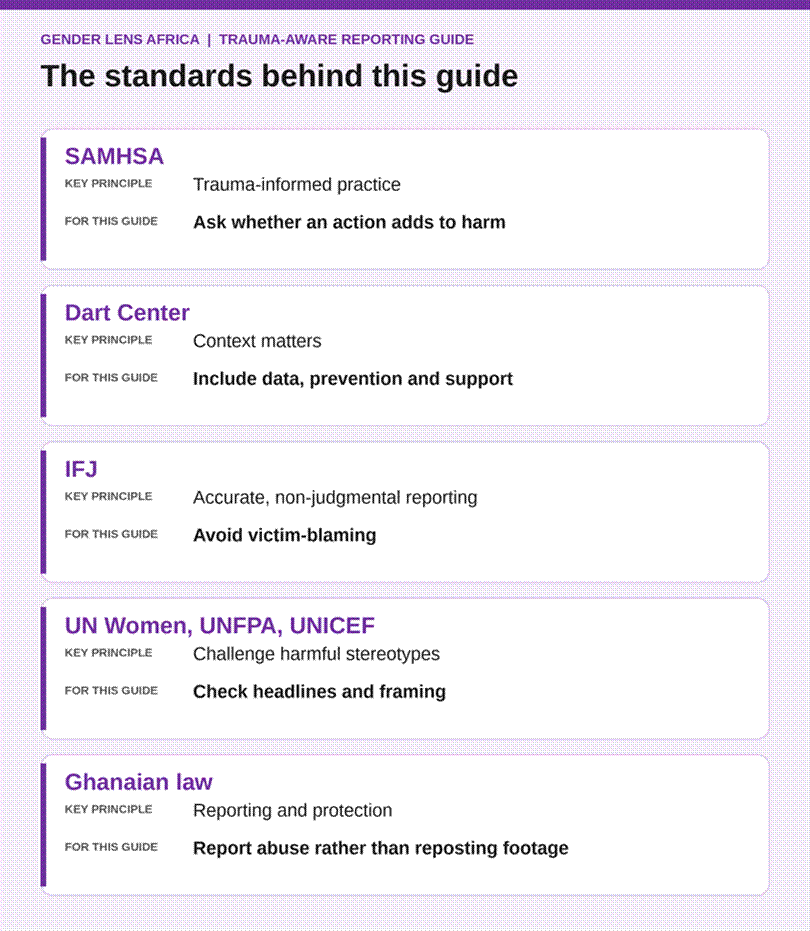
The standards behind this guide
In more detail
This guide draws on established trauma-informed, journalism, child-protection and Ghanaian legal frameworks. Together, they provide a practical basis for reporting domestic violence without increasing harm.
SAMHSA: Trauma-informed practice
The Substance Abuse and Mental Health Services Administration (SAMHSA) identifies six principles for a trauma-informed approach: safety; trustworthiness and transparency; peer support; collaboration; empowerment, voice and choice; and attention to cultural, historical and gender issues.
For reporting, the central question is whether our actions protect people from further harm and retraumatisation.
Read the SAMHSA framework https://youth.gov/feature-article/samhsas-concept-trauma-and-guidance-trauma-informed-approach
Dart Center for Journalism and Trauma: Context and interviewing*
The Dart Center emphasises the importance of context when reporting intimate partner violence. Coverage should look beyond the incident itself to patterns of power and control, prevention, available services and the wider social context. Its guidance also addresses how journalists should approach interviews with people affected by trauma.
Read the Dart Center guidance https://gcjt.org/node/18553
International Federation of Journalists: Reporting violence against women
The IFJ calls for accurate, non-judgmental reporting and warns against language or framing that blames survivors or exposes them to further harm.
For journalists, this means reporting what is known, attributing allegations carefully and avoiding stereotypes that shift responsibility for violence onto the person experiencing it.
Read the IFJ guidelines https://endfgm.eu/resources/tools-and-training-resources/ifj-guidelines-for-reporting-on-violence-against-women/
UN Women: Media and violence against women
UN Women’s media handbook addresses the ways media coverage can reinforce or challenge violence against women. It calls for reporting that challenges victim-blaming and harmful gender stereotypes rather than reproducing them.
Read the UN Women media handbook https://www.unwomen.org/en/digital-library/publications/2019/12/handbook-to-address-violence-against-women-in-and-through-the-media
UN guidance: Responsible representation and reporting
UN Women, UNICEF and UNFPA guidance on responsible reporting focuses on how violence against women and children is represented in the media. It emphasises accuracy, dignity and protection from harmful or stereotypical portrayals
Read the joint UN guidance https://asiapacific.unwomen.org/en/digital-library/videos/2021/01/responsible-representation-and-reporting-of-violence-against-women-and-children
UNICEF: Reporting on children
UNICEF's principles for reporting on children call on journalists to protect children's identity, dignity and best interests, particularly when children are at risk of harm or exploitation.
For this guide, that means not publishing or circulating identifying images, names, voices or other details that could expose a child to further harm.
Read UNICEF's reporting principles https://www.unicef.org/media/reporting-guidelines
Ghana's Domestic Violence Act, 2007 (Act 732)
Ghana's Domestic Violence Act provides the legal framework for addressing domestic violence. It recognises that a single act can constitute domestic violence and allows a victim or a person with information to make a complaint to the police.
For the purposes of this guide, the important point is simple: reporting violence to the authorities is different from reposting footage of it.
Read the Domestic Violence Act https://ghalii.org/akn/gh/act/2007/732/eng@2007-05-04
Ghana's Children's Act, 1998 (Act 560)
The Children's Act places the best interests of the child at the centre of decisions affecting children and provides for reporting child abuse to the appropriate authorities.
For journalists, bloggers and members of the public, protecting a child means reporting suspected abuse through the proper channels rather than circulating footage that may expose the child to further harm.
Read the Children's Act https://www.ecoi.net/en/file/local/1158191/1504_1217427520_children-s-act.pdf
Part 1: Rules for newsrooms
1.Do not publish or embed footage of injuries or of children. Describe what is relevant in a sentence. Ask: would the story lose anything if the image were removed?
2.Attribute every claim. Use "alleged" and name who said what. Give the other side a fair, clearly labelled place in the report.
3.Respect the court process. Do not predict outcomes or rank credibility while a matter is before the police or courts. Take legal advice on sub judice risk. Under section 25 of Act 732, reports of criminal proceedings must protect the victim's identity, and other proceedings under the Act cannot be reported without the court's leave.
4.Lead with the issue, not the spectacle. Add the data, the law, the services available and the helpline. The Dart Center calls context the most important element of insightful reporting on intimate partner violence.
5.Never imply the survivor caused the violence. Leave out her clothes, career, past relationships and social life unless they are directly relevant and verified.
6.Do not ask or answer "why did she not leave?" Explain instead the risks and costs of leaving. Research shows that separation raises the risk of escalating violence and femicide.
7.Protect children. No names, faces, voices, schools or neighbourhood details. Follow UNICEF principles even where the law is silent.
8.Interview with consent and control. Explain how the person will be identified and what happens next. Let them choose the time and setting and bring a friend. Do not say "I know how you feel", as the Dart Center advises.
9.Consult local experts. Speak to DOVVSU, shelters, lawyers and counsellors, as the IFJ guidance recommends.
10.Look after reporters. Covering violence is draining. Offer debriefs and rotate assignments. The Dart Center's reporting tipsheet points to its self-care resources.
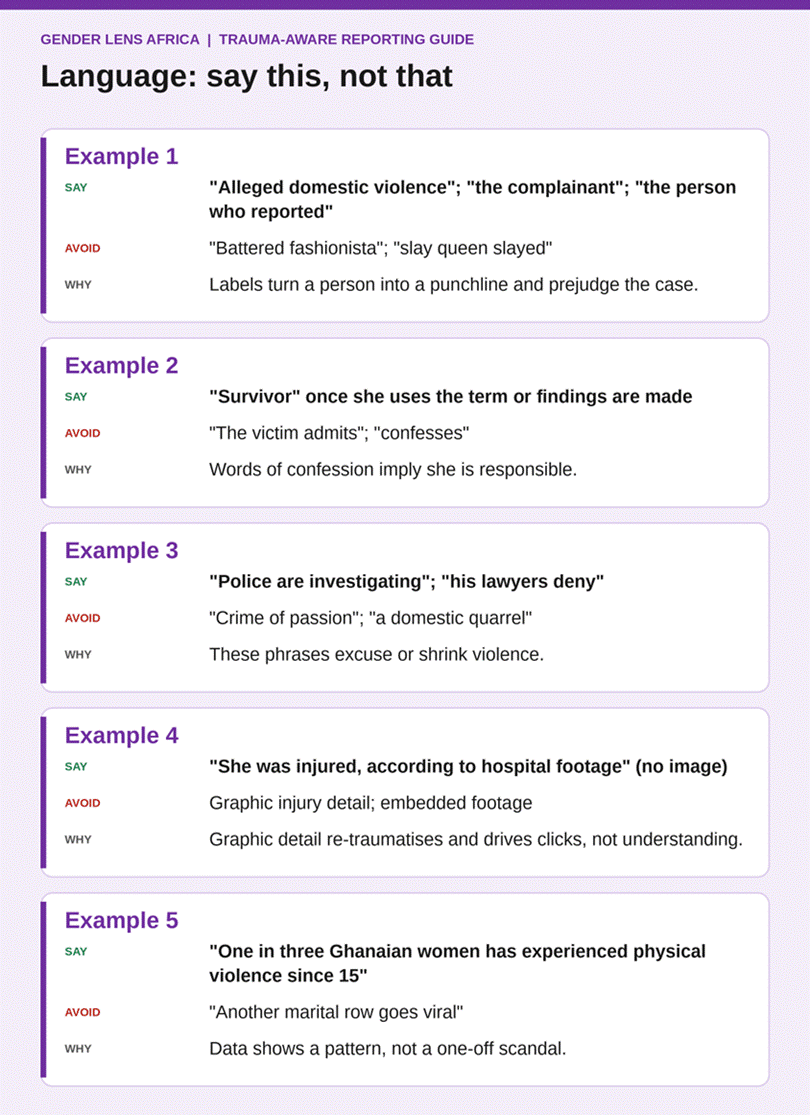
Language: say this, not that
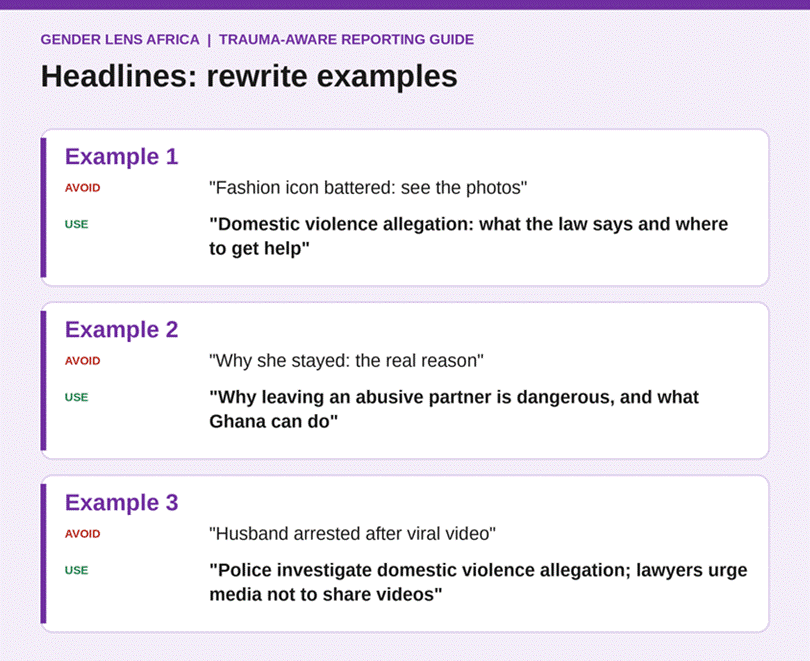
Headlines: rewrite examples
Part 2: Rules for bloggers and content creators
• Do not repost, stitch, duet, screenshot or "react" to footage of injuries or children, even to condemn it.
• Do not use injury images as thumbnails or cover art. Do not monetise abuse content.
• Verify before you post. Name your source. Correct errors quickly and visibly.
• Moderate your comments. Delete mockery, blame and speculation about the survivor or the child.
• Report videos of child abuse to the platform and to the authorities. Do not forward them.
• Add the DOVVSU helpline, 055-100-0900, to every post on the subject.
• Treat both parties fairly. A presumption of innocence applies to the accused, and respect applies to the person who reported.
Part 3: Rules for individuals
• Pause before you share. Ask whether sharing helps the person or only feeds the story.
• Do not comment on her motives, money, marriage or appearance.
• Do not pass on videos of children. Passing them on is not reporting them.
• If you have information about violence, report it. Under Act 732, anyone with information may complain to the police.
• If someone you know is being hurt, believe them first. Offer practical help such as a safe place, transport to a hospital or company at the police station.
Where to get help in Ghana
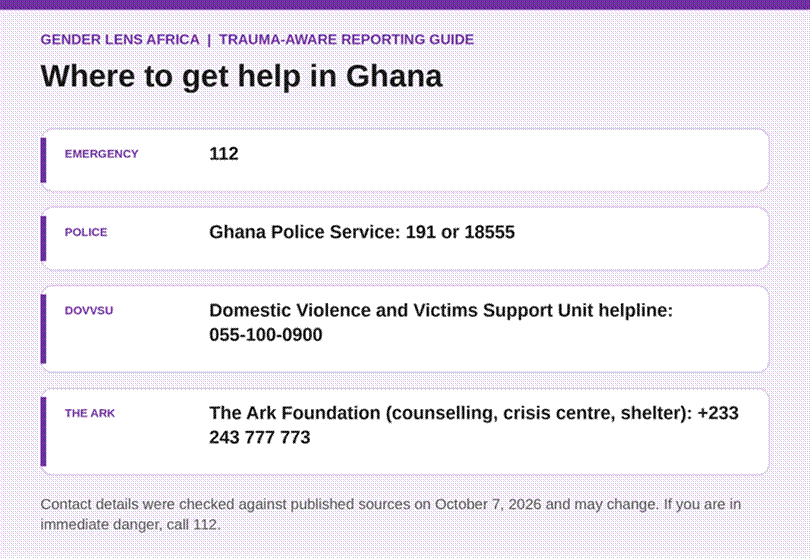
Emergency: 112. Ghana Police Service: 191 or 18555. DOVVSU helpline: 055-100-0900. The Ark Foundation: +233 243 777 773.
Contact details were checked against published sources on October 7, 2026 and may change. If you are in immediate danger, call 112.
Sources and links
• SAMHSA trauma-informed approach: https://youth.gov/feature-article/samhsas-concept-trauma-and-guidance-trauma-informed-approach
• Dart Center, writing with context: https://gcjt.org/node/18553
• Dart Center, the legwork and self-care: https://gcjt.org/node/18555
• Dart Center, advice on reporting on violence: https://www.imediaethics.org/dart-center-advises-on-reporting-on-violence/
• IFJ guidelines on reporting violence against women: https://endfgm.eu/resources/tools-and-training-resources/ifj-guidelines-for-reporting-on-violence-against-women/
• UN Women media handbook: https://www.unwomen.org/en/digital-library/publications/2019/12/handbook-to-address-violence-against-women-in-and-through-the-media
• UNFPA, UNICEF and UN Women responsible reporting guidance: https://asiapacific.unwomen.org/en/digital-library/videos/2021/01/responsible-representation-and-reporting-of-violence-against-women-and-children
• UNICEF principles for reporting on children: https://www.unicef.org/media/reporting-guidelines
• Domestic Violence Act, 2007 (Act 732): https://ghalii.org/akn/gh/act/2007/732/eng@2007-05-04
• Children's Act, 1998 (Act 560): https://www.ecoi.net/en/file/local/1158191/1504_1217427520_children-s-act.pdf
• Ghana Demographic and Health Survey 2022, physical violence: https://www.graphic.com.gh/news/general-news/41-of-women-aged-15-to-49-have-been-victims-of-intimate-partner-violence-in-ghana.html
• Ghana Demographic and Health Survey 2022, help-seeking: https://gna.org.gh/2024/03/gdhs-report-child-neglect-is-reason-for-spousal-beating/
• Research on separation and risk: https://pmc.ncbi.nlm.nih.gov/articles/PMC9709555/
• DOVVSU: https://police.gov.gh/en/index.php/domestic-violence-victims-support-unit-dovvsu/
• Police numbers: https://www.pulse.com.gh/story/8-things-to-do-if-you-are-experiencing-domestic-violence-and-who-to-call-for-help-2026100612304601691
• The Ark Foundation: https://arkfoundationghana.org/site/programs/
END