Accra, Ghana, October 19, 2026: Perimenopause can affect periods, sleep, mood, work and daily life, yet many women struggle to recognise the symptoms or access care. Drawing on Ghanaian research and international clinical evidence, this guide examines what women need to know, what treatment can help and where the gaps in healthcare and workplace support remain.
A qualitative study of women across Ghana, published in BJOG in 2026,found that menopause symptoms could disrupt women's income generation, caregiving and daily activities in Ghana. The findings offer a glimpse of what can happen when women have limited information about the transition and little flexibility at work. For a trader, farmer or other worker who depends on daily earnings, managing symptoms can carry a financial cost as well as a physical one.
Perimenopause affects women during the years leading up to menopause, but its duration and symptoms vary. Many women reach this stage without clear information about what to expect or where to seek help. World Menopause Day, held on 18 October each year, provides an opportunity to start that conversation. For the 2026 focus on chronic pain at midlife, read Gender Lens Africa's analysis of menopause in Ghana.
What is perimenopause, and how is it different from menopause?
Perimenopause is the transition before menopause, when hormone levels fluctuate, periods change and symptoms can begin years before periods stop.
The World Health Organization (WHO) describes perimenopause as the period from the first changes in the menstrual cycle until one year after the final menstrual period. Menopause itself is identified retrospectively, after 12 consecutive months without a period when there is no other explanation. Post-menopause refers to the stage that follows. These distinctions matter because symptoms can begin well before periods stop.
Hormone levels do not fall in a neat line. They swing. That is why NICE guidance does not use blood tests to diagnose perimenopause in otherwise healthy women aged 45 or over: the numbers fluctuate, so the diagnosis rests on symptoms and changes in the cycle.
At what age does perimenopause begin?
There is no single age. Studies measure the age at the final period, which is not the same as the age perimenopause begins. In the UK, the average age at menopause is around 51.In the US Study of Women's Health Across the Nation (SWAN), the median age at the final menstrual period was 52.5. These figures describe the age at menopause, not when perimenopause begins.
Ghanaian studies report lower figures. Researchers in Akosombo found a mean of 48 among 123 women analysed in 1993. A 2024 study in Accra's Okaikwei North reported a mean of 49.5, and a Ghanaian cohort study had a median of 48.
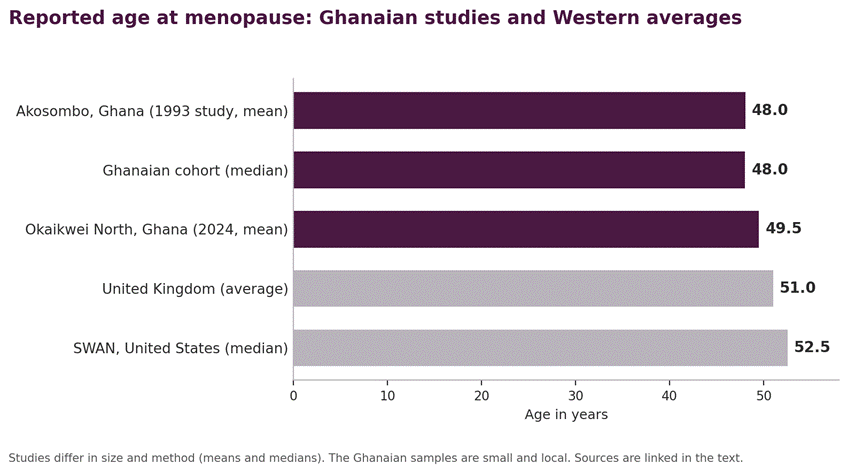
These samples are small and local, and they used different methods, so they cannot show that Ghanaian women generally reach menopause earlier than women in the UK or US. They are a signal worth testing. A WHO-published paper on the global picture of perimenopause notes that age is a poor guide to who is perimenopausal, and that early or premature menopause is more common in low- and middle-income countries.
Start age also shapes how long the transition lasts. In SWAN, the median transition ran 4.4 years for women who started latest and 8.6 years for those who started earliest.
What are the first signs of perimenopause?
The first sign is usually a change in your period. Cycles become irregular, lighter or heavier. Pregnancy is still possible while periods continue, even irregularly, so contraception still matters.
The National Institute for Health and Care Excellence (NICE), which sets clinical standards in England, says doctors should identify perimenopause in otherwise healthy people aged 45 or over from symptoms alone. The follicle-stimulating hormone (FSH) test can look normal during perimenopause, as the WHO paper explains, so a normal result does not rule it out. NICE guidance applies in England, not Ghana, so ask your own clinician which guidance they follow.
That does not make all blood tests unnecessary. A doctor may still test for other causes of symptoms, for anaemia when bleeding is heavy, or for thyroid problems. Guidance differs below 45. NICE says to consider an FSH test when menopause is suspected under 40, or in the 40 to 45 group with symptoms, and suspected premature ovarian insufficiency under 40 needs specialist assessment.
What symptoms have Ghanaian women reported?
The NHS list of common symptoms includes mood changes, anxiety, brain fog, palpitations, muscle and joint pain, vaginal dryness, sleep trouble and weight gain. You may have several or none. Hot flushes and night sweats have a clinical name, vasomotor symptoms, and reported rates vary from 3% to 86% in a systematic review of 66 papers from every continent.
In a survey of 280 menopausal women in Accra, night sweats topped the list at 83.2%, followed by hot flushes (76.4%), mood swings (72.5%) and vaginal dryness (71.4%).
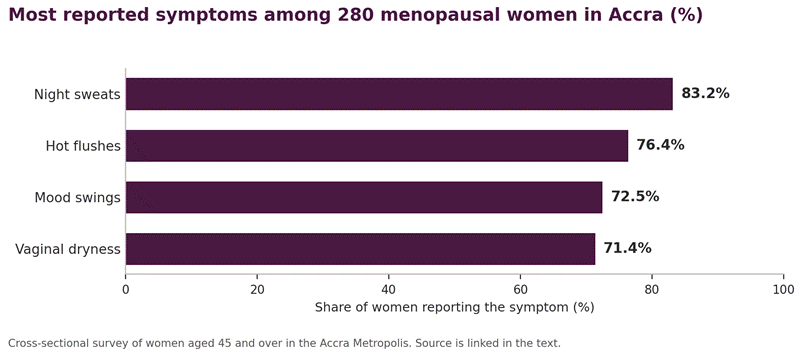
Older data show a different mix. Among 123 women in Akosombo in 1993, tiredness (79.9%), sleeplessness (71%) and palpitations (63.7%) outranked hot flushes (56.5%). Yet 85.6% of the women who had hot flushes called them the most unpleasant symptom.
The 2026 study of Ghanaian women's experiences adds depth, not a national estimate. As a qualitative study, it documents participants' accounts rather than measuring how common each experience is across Ghana. The research describes emotional distress, barriers to healthcare and the effects of symptoms on daily life. These accounts also raise questions about whether women receive clear explanations from health professionals and whether the cost of seeking care leaves some to manage symptoms alone. Read the published study in BJOG.
A woman describing a racing heart or a heavy mood may never use the word perimenopause. A doctor who listens only for hot flushes can miss the rest. Practitioners interviewed in a study in England said cultural ways of describing symptoms made it harder to join the dots.
How long does perimenopause last?
Longer than most women are told, at least for hot flushes and night sweats. Older clinical guidance suggested six months to two years. In a 2015 analysis of 1,449 SWAN women with frequent symptoms, the median total duration was 7.4 years. "Median" means half of the women had symptoms for less time and half for longer.
Women who start early suffer longest. Those with frequent symptoms while still premenopausal or in early perimenopause had a median of more than 11.8 years. African American women reported the longest duration of any group, a median of 10.1 years, against 6.5 years for non-Hispanic white women.
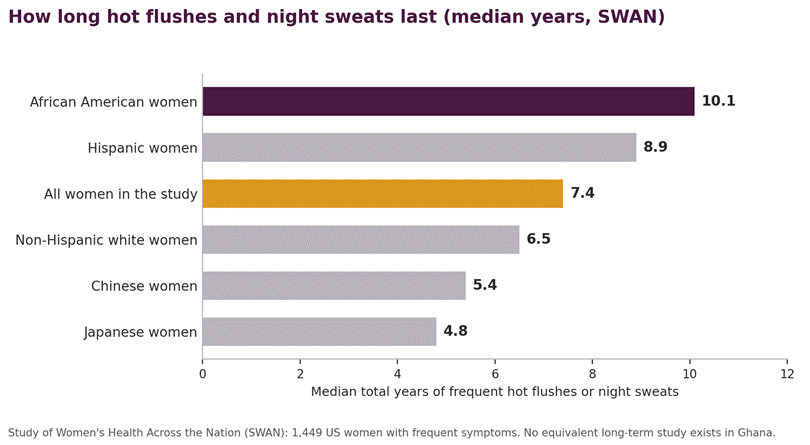
SWAN is a US study, and Ghana has no long-term equivalent. The WHO paper calls for similar studies in lower-income settings. Until they exist, Ghanaian women should read these figures as a reason not to wait it out in silence.
Perimenopause and mental health
Low mood, anxiety and mood swings sit on the NHS list of common symptoms. They are not a sign of weakness. In the 2026 Ghanaian study, psychological burden was widespread but often concealed because of stigma.
If you are in distress or have thoughts of ending your life, you do not have to manage them alone. Ghana's Mental Health Authority lists a toll-free helpline, 0800 678 678, available 24 hours a day. If you are in immediate danger or may act on thoughts of self-harm, seek urgent help at the nearest hospital and, if possible, ask someone you trust to stay with you. Low mood deserves attention, and effective treatment is available.
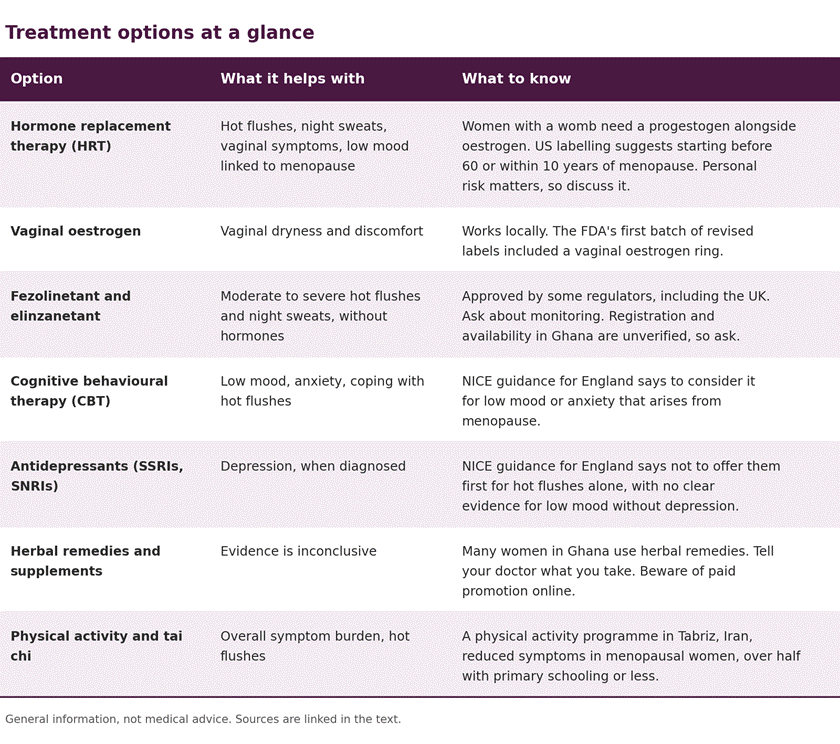
Treatment choice matters. NICE guidance for England advises doctors to consider hormone replacement therapy (HRT) or cognitive behavioural therapy (CBT) for low mood that arises from menopause. It also says there is no clear evidence that antidepressants ease low mood in menopausal women who have not been diagnosed with depression. Women with diagnosed depression may still need them.
A survey by a UK menopause clinic found that 39% of respondents were offered antidepressants instead of HRT as the first course of treatment. Treat that figure with care. It comes from a self-selected survey run by a clinic that treats menopause, not from a population study. Even so, it is a fair prompt to ask why a particular medicine is being suggested.
The WHO paper also cites studies in which women who entered perimenopause with more negative expectations were more likely to have troublesome symptoms. That is an association, not a cause. It does not make women responsible for their symptoms. It does suggest that clear information helps.
Perimenopause, heart health and heavy bleeding
Changes in menstrual bleeding are common during perimenopause, but heavy or prolonged bleeding should not automatically be attributed to hormonal changes. Heavy menstrual bleeding can contribute to iron-deficiency anaemia, and persistent fatigue may warrant investigation.
Two Ghanaian figures sit beside that, and neither measures perimenopause. Among 244 women referred for abdominal scans, 36.9% had fibroids, and the share rose with age. Those women were referred patients, not a representative sample. In the 2022 Ghana Demographic and Health Survey (GDHS), 40.4% of non-pregnant women aged 15 to 49 were anaemic. That group is not specifically perimenopausal, and fatigue alone does not show the cause.
So the link between perimenopause, bleeding and anaemia in Ghana is a question for research, not a finding. A woman in her 40s with heavy bleeding and constant tiredness still deserves a blood count, not just reassurance. See a doctor about bleeding between periods, bleeding that will not stop, or bleeding after sex. Any bleeding after periods have stopped for a year needs checking, even if it happens once and is only a spot.
The transition is also a window for your heart and bones. A scientific statement from the American Heart Association (AHA) says there is growing evidence that cardiovascular risk accelerates during the menopause transition, and names high blood pressure as the most prominent risk factor women can change. It links a later age at natural menopause with higher bone density. Ask for a blood pressure check in your 40s, and ask about bone health if menopause came early.
What treatments are available for perimenopause?
Treatment depends on your symptoms, medical history and whether you still have a womb. NICE guidance for England asks doctors to take an individualised approach at every stage, and to explain symptoms, lifestyle changes and the benefits and risks of each treatment.
For troublesome hot flushes and night sweats, hormone replacement therapy (HRT) is the most effective treatment option in current guidance. It does not suit everyone, and the choice depends on a woman's symptoms, medical history and preferences. Women who still have a womb generally need a progestogen alongside systemic oestrogen to protect the womb lining. Vaginal oestrogen is a separate option for genitourinary symptoms, including vaginal dryness, and its use differs from systemic HRT. Treatment decisions should be made with a qualified clinician.
Hormone therapy has been the subject of debate over its benefits and risks for more than two decades. In February 2026, the US Food and Drug Administration (FDA) approved revised labelling for six menopausal hormone therapy products, removing statements about cardiovascular disease, breast cancer and probable dementia from the boxed warning. The changes followed an FDA review initiated in November 2025.
The decision changed how certain risks are presented on US product labels. It does not establish that hormone therapy is risk-free, nor does it prove that it prevents heart disease or dementia. Some risk information remains elsewhere in the prescribing information, and the warning relating to endometrial cancer remains for systemic oestrogen-only products. The implications for an individual woman depend on factors including her age, medical history, the formulation used and whether she needs a progestogen to protect the womb lining.
Women considering hormone therapy should discuss its likely benefits, risks and alternatives with a qualified clinician. The FDA's decision concerns US product labelling. It is not a treatment guideline for Ghana. Read the FDA's announcement.
Cost and availability are separate problems. The 2026 Ghanaian study identifies barriers to healthcare, but this guide could not verify how many hormone therapy products are registered or stocked in Ghana, or what they cost. If HRT is right for you, ask a gynaecologist what is available and what it will cost.
Women who cannot or prefer not to take hormones now have non-hormonal options. The UK's medicines regulator approved elinzanetant (Lynkuet) on 8 July 2025 for moderate to severe hot flushes and night sweats, and fezolinetant (Veoza) is another non-hormonal option approved in some countries. Approval in the UK or US does not establish that either medicine is registered or available in Ghana. This guide could not verify their current Ghanaian registration or availability. Ask a qualified clinician about locally available options, the monitoring each medicine requires and the total cost before considering treatment.
CBT and exercise also have evidence. The WHO paper cites some evidence that tai chi and CBT reduce hot flushes, and a physical activity programme in Tabriz, Iran, that cut symptoms among women, more than half with primary schooling or less. It says herbal and traditional remedies studied elsewhere have inconclusive or incomplete evidence. Participants in the Ghanaian study used herbal remedies, so tell your doctor what you take.
How does perimenopause affect women at work?
Start with the women the research centres on. Many Ghanaian women approaching menopause work in informal trade, farming and caregiving. The published abstract says symptoms disrupted income generation and caregiving in a setting shaped by informal trade, caregiving and gendered work roles.
Workplace support looks different in different jobs. A woman in an office may be able to ask for a fan or flexible hours. A trader may have to choose between resting and earning.
Evidence from other countries suggests that menopause symptoms can also affect women in formal employment, although the findings cannot be assumed to apply directly to Ghana. In a UK survey of 4,014 women aged 45 to 55, only 30% of those who took time off work disclosed the real reason to their employer. A US study by Mayo Clinic found that 13.4% of respondents reported at least one adverse work outcome associated with menopause symptoms, while 10.8% had missed work in the previous year. The authors estimated that lost workdays cost the US economy US$1.8 billion annually. These findings point to a workplace issue that deserves investigation in Ghana, not a measure of its local scale.
The same UK survey produced a famous headline: one in ten women who worked during menopause left a job because of symptoms. Treat it with care. An economist who examined it for BBC Radio 4's More or Less pointed out that it covered only women who had symptoms, and that "left a job" could mean moving jobs, not leaving work. Her own analysis of labour force data suggested the true figure is lower. UNFPA's claim that as many as 8 in 10 women report no menopause-specific support at work traces to the same UK survey, not to a global count.
What helps? UNFPA's case study finds that small, employee-led efforts, such as menopause cafes, can shift workplace culture without big budgets. In a parliamentary debate on World Menopause Day, a UK MP listed flexible working, manager training, cool spaces and clear policies. A workplace that takes symptoms seriously gives women a better chance of getting the support they need to stay. Our analysis of menopause care in Ghana sets out what health services, employers and policymakers can change.
How can women find reliable perimenopause advice online?
Celebrity disclosures changed the conversation. When TV presenter Davina McCall released her 2021 documentary on menopause, women flooded social media with their own stories, and reports at the time described a "Davina effect", with GPs hearing from women who wanted whatever she was having.
Oscar winner Halle Berry has said she spent about 10 years in perimenopause without knowing it, and a doctor told her she had herpes, which she did not. In 2024 she joined US senators to back a bill that would put $275 million into menopause research. "The shame has to be taken out of menopause," she said. In 2025 she told Maine lawmakers that none of her doctors had ever raised it.
Michelle Obama described a hot flush on Marine One as feeling like a furnace switched on in her core, and said on her podcast that she began hormone therapy while in the White House. She also spoke about working in a suit through menopause, drenched in sweat in a freezing office and still having to change and fix her hair. These women had money, fame and doctors on call, and their stories still include misdiagnosis and silence.
Social media has given women a place to compare experiences, but it has also created a market for products promising relief. A content analysis of 1,000 Instagram posts using menopause-related hashtags found that 661 promoted branded supplements. Only 18.3% of those supplement posts were authored by credentialed clinicians. A separate study of #womenshealth posts found that health claims were common, while only 7% of posts referred to scientific evidence. That study covered women's health posts broadly, not menopause alone. The WHO paper also warns about misleading menopause tests and dubious supplements.
Before buying a product, ask three questions. Who is selling it? What evidence supports the claims? Could it interact with medication or be unsuitable for your health history? Discuss supplements with a qualified clinician, particularly if you take other medicines.
What can women do now?
Track your symptoms. For two to three months, note period dates, changes in flow, hot flushes, sleep, mood and pain. A note on your phone or a small diary can help.
Check your health. Ask about a blood pressure check, and seek assessment for heavy bleeding or persistent fatigue. A clinician may recommend a blood count to investigate possible anaemia.
Describe what you experience. Use the words that feel natural to you, including local expressions. Explain how symptoms affect your sleep, work, relationships and daily activities.
Ask about your options. Could the symptoms be related to perimenopause? What else needs to be ruled out? Which hormonal and non-hormonal treatments are available? What are their risks, and what will they cost?
Review contraception. Pregnancy remains possible during perimenopause. Ask a qualified clinician how long you need contraception and which method is appropriate for you.
Check online claims. Find out who is behind the advice, whether it is supported by evidence and whether the person selling a product stands to profit from it.
Talk to someone you trust. A friend, sister, partner or daughter may be a useful source of support. Sharing reliable information can also help other women recognise symptoms and seek care.
For partners and managers, listen and respond. Practical changes such as a fan, reasonable flexibility or a confidential conversation may help. Ask what the person needs rather than assuming every woman experiences perimenopause in the same way.
Perimenopause care in Ghana: what needs to change
The authors of the 2026 Ghanaian study describe menopause as a neglected occupational and sociocultural health issue and point to the need for integrated menopause care and further research. These are responsibilities for health services, employers and policymakers, not demands that women simply cope better.
Ghana also needs research that examines how symptoms, treatment access and working conditions differ by region, occupation and income. International evidence can help identify questions to investigate, but it cannot substitute for data about women's lives in Ghana.
Women need reliable information, clinicians who take their symptoms seriously and treatment options they can afford. Employers need to recognise that midlife health can affect working life, including in the informal economy. Policymakers need evidence to determine where support is most urgently needed.
Perimenopause is a normal life transition, but women should not have to navigate it without information or appropriate care.
This guide provides general information and does not replace individual medical advice.
Sources and further reading
· BJOG: Menopause as an Embodied and Occupational Disruption, a qualitative study of women's experiences in Ghana (abstract)
· WHO-published paper on the global picture of perimenopause
· NICE guideline NG23 on menopause and the NICE quality statement on diagnosis
· SWAN analysis of how long hot flushes last and the SWAN analysis of transition length
· American Heart Association statement on the menopause transition
· FDA news release on revised hormone therapy labels, 12 February 2026, the November 2025 announcement, summarised and the critique of the change
· Mental Health Authority of Ghana
· UNFPA case study on menopause-friendly workplaces
· Fawcett Society: Menopause and the Workplace and the economist's critique of the one-in-ten figure
· MHRA announcement on elinzanetant
· Instagram menopause supplement content analysis and the #womenshealth content analysis
· Gender Lens Africa: Menopause in Ghana
· Mayo Clinic study on menopause and work
· Ghanaian studies on age at menopause, symptoms in Accra and Okaikwei North