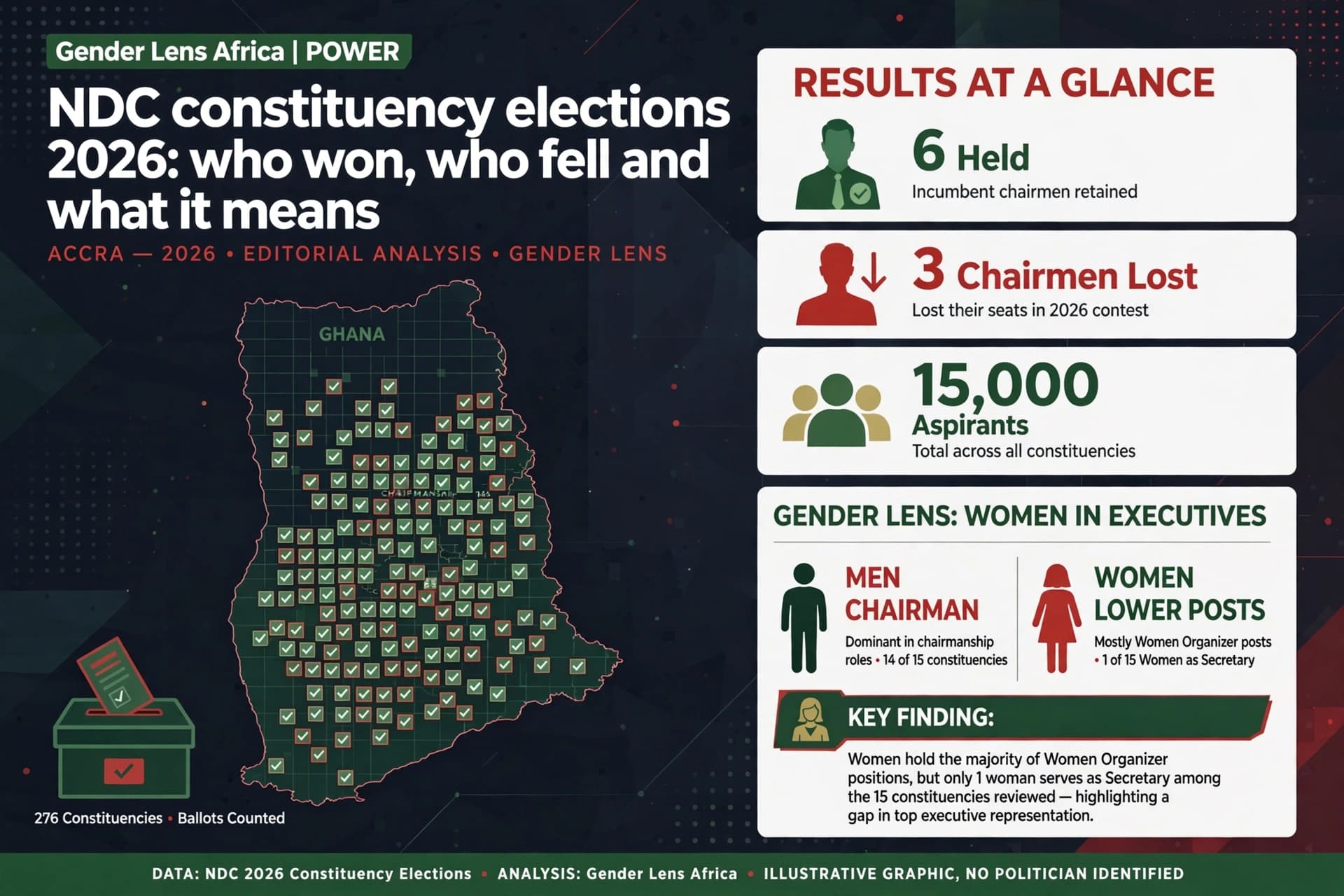
Accra, Ghana, October 26, 2026: Delegates of the National Democratic Congress (NDC) voted out sitting chairmen in at least three constituencies this weekend, and kept six others in office. The party held executive elections on Saturday 24 and Sunday 25 October across its 276 constituencies, and about 15,000 aspirants were expected to contest.
The NDC has not published a consolidated list of winners. What follows comes from media reports and results sheets published on 24 and 25 October. It is partial, and some figures may change when the party certifies them.
NDC constituency election results: who won the chairmanship
The party elected executives for chairman, vice-chairman, secretary, treasurer, organiser, communications officer, women’s organiser and youth organiser, among other posts. The Electoral Commission ran the polls and the police provided security.
The table below lists the chairmen whose results I could confirm, with vote counts. Pulse Ghana’s breakdown of winners and Graphic Online’s list of new executives carry further slates.
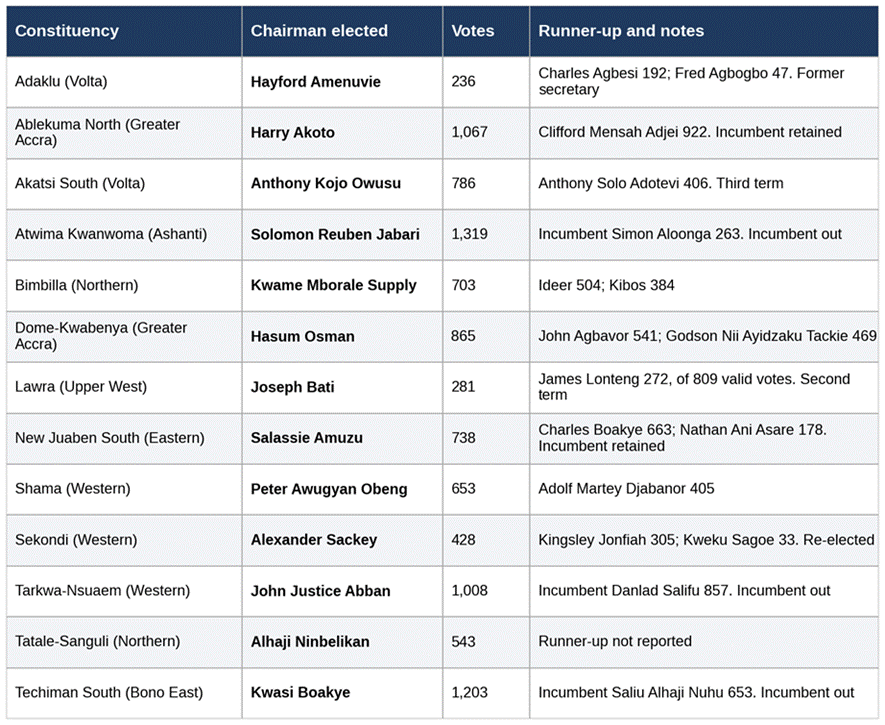
Sources: media reports published 24 and 25 October 2026, linked in the text. Partial list. Vote counts as reported.
Graphic Online also lists these chairmen: Paul Oblie Laryea in Odododiodio, Frank Gavor in Ayawaso West Wuogon, Haruna Abukari in Salaga North and Ahorlu Ferguson Kwabla in Ketu South. Nayi Alhassan was re-elected in Tamale North and Prince Succeed Fiagadzi won in Nkwanta South.
Which NDC chairmen lost their seats
In Techiman South, Kwasi Boakye beat incumbent chairman Saliu Alhaji Nuhu by 1,203 votes to 653. Several other sitting executives fell with him, including the communications officer, Hassan Balluka, who lost to Baba Issah, 1,296 to 894.
In Atwima Kwanwoma, retired army captain Solomon Reuben Jabari beat incumbent Simon Aloonga by 1,319 votes to 263. In Tarkwa-Nsuaem, former parliamentary candidate John Justice Abban defeated incumbent Danlad Salifu, 1,008 to 857.
Incumbents held on elsewhere. Harry Akoto kept Ablekuma North. Anthony Kojo Owusu won a third term in Akatsi South. Salassie Amuzu retained New Juaben South, and Alexander Sackey was re-elected in Sekondi.
The pattern is mixed. Where delegates wanted change, they voted for it by wide margins. Where they did not, incumbents survived by a few hundred votes.
Close races, a tie and a legal dispute
The closest chairmanship race I found was in Lawra. Joseph Bati won a second term with 281 of 809 valid votes, against 272 for James Lonteng. In the same constituency, two candidates tied on 230 votes for communications officer. The matter goes to party headquarters.
In Dome-Kwabenya, Hasum Osman took the chair with 865 votes. In the same constituency, Wisdom Kwashie Amegbezi won vice-chairman by three votes, 745 to 742, and the treasurer’s race was decided by 12 votes.
In Nkwanta North, a High Court in Dambai restrained the party from holding its election and from using a delegates list compiled after the June and July branch elections. The party said it had not been served and would proceed regardless. I found no report of the outcome.
Ho Central: a chairman, a vice-chairman and conflicting reports
Ho Central produced the weekend’s most discussed result for women. Graphic Online reports that Mawunyo Agbe, Presiding Member of the Ho Municipal Assembly, won the chairmanship and that the vice-chairman post went to a Ho trader, Sena Setordzi Dorvlo. Margaret Akua Dzogbewu kept the women’s organiser post.
Adom Online reported the same vote differently, calling Setordzi the first female chairperson and saying Agbe Mawunyor became chairman after rival Franklin Gedzia withdrew. Graphic says he beat four contestants. Before the vote, Setordzi told the Ghana News Agency she was standing for vice-chairperson because no woman had done so in the constituency.
Two reports agree that she contested vice-chairperson, and Graphic says she won it. Her victory is still a first for the constituency. The title matters, and the party should confirm it.
Women in NDC constituency executives: what the results show
Graphic Online’s published slates cover 15 constituencies. Every chairman is a man. A woman holds the secretary post in one, Ablekuma North, where Nadia Gifty Tetteh was re-elected with 1,562 votes against 405.
Women are treasurers in Sekondi, Ayawaso West Wuogon and Ketu South. Women also hold deputy and assistant posts, such as assistant secretary in Adaklu and deputy communications officer in New Juaben South. Women’s organiser and deputy women’s organiser posts went to women in each slate.
Women also lost races for senior posts. In Tarkwa-Nsuaem, Anita Fiagbenui polled 788 votes for vice-chairman and lost to Wilberforce Essien, who got 1,071.
These are small samples chosen by the media, so they cannot show the national picture. They do show where women appear in the results and where they do not. Only the party can publish the full count by sex and position.
What happens next in the NDC elections
The NDC holds regional executive elections on 14 and 15 November, and its national congress is on 19 December. Pulse Ghana reports that 137 aspirants have picked forms for 14 national positions.
National Chairman Johnson Asiedu Nketiah urged aspirants to accept the results and unite. He said he stayed away from constituency elections to avoid influencing delegates.
Commentary: what these results tell us
Three things stand out. Delegates punished incumbents in some places and rewarded them in others, so local politics decided these races, not a national trend. Several margins were slim enough that certification and appeals will matter.
The party’s own records are the weakest link. Results arrived as scattered sheets, with different vote totals and different accounts of the same race. A party preparing for a national congress should publish one certified list, by constituency and post, with the sex of every winner.
That list would settle the Ho Central question in a line. It would also let Ghana count how many women won, which post they won and what each post can decide.
Counting who won is the first job. Counting who holds power comes next.