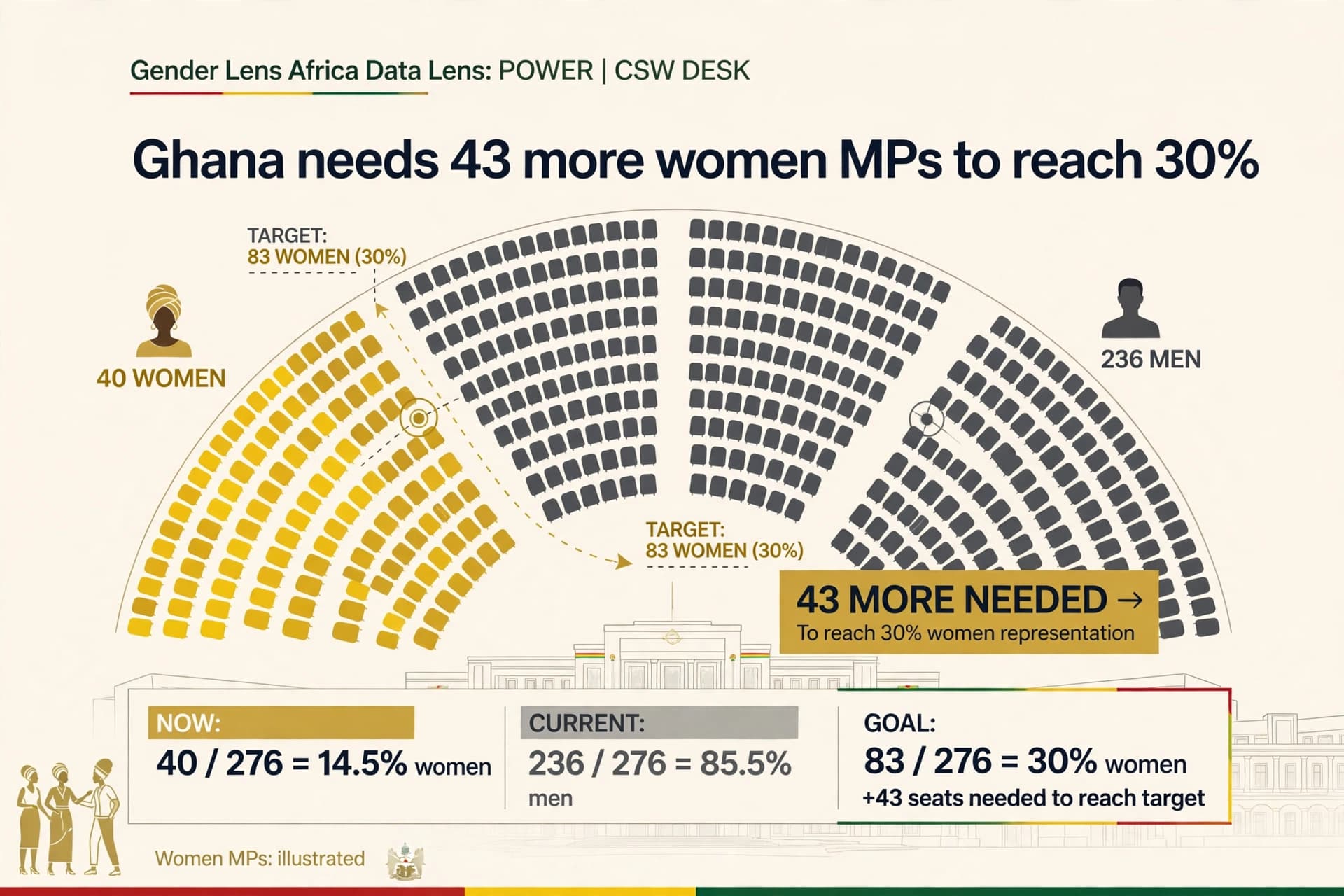
Accra, Ghana, October 25, 2026: Women who contested Ghana’s 2024 parliamentary elections were about as likely as men to win a seat. Roughly one in three women candidates was elected, a rate comparable to that of men. The shortfall begins earlier, in the number of women political parties nominate and the constituencies in which they field them.
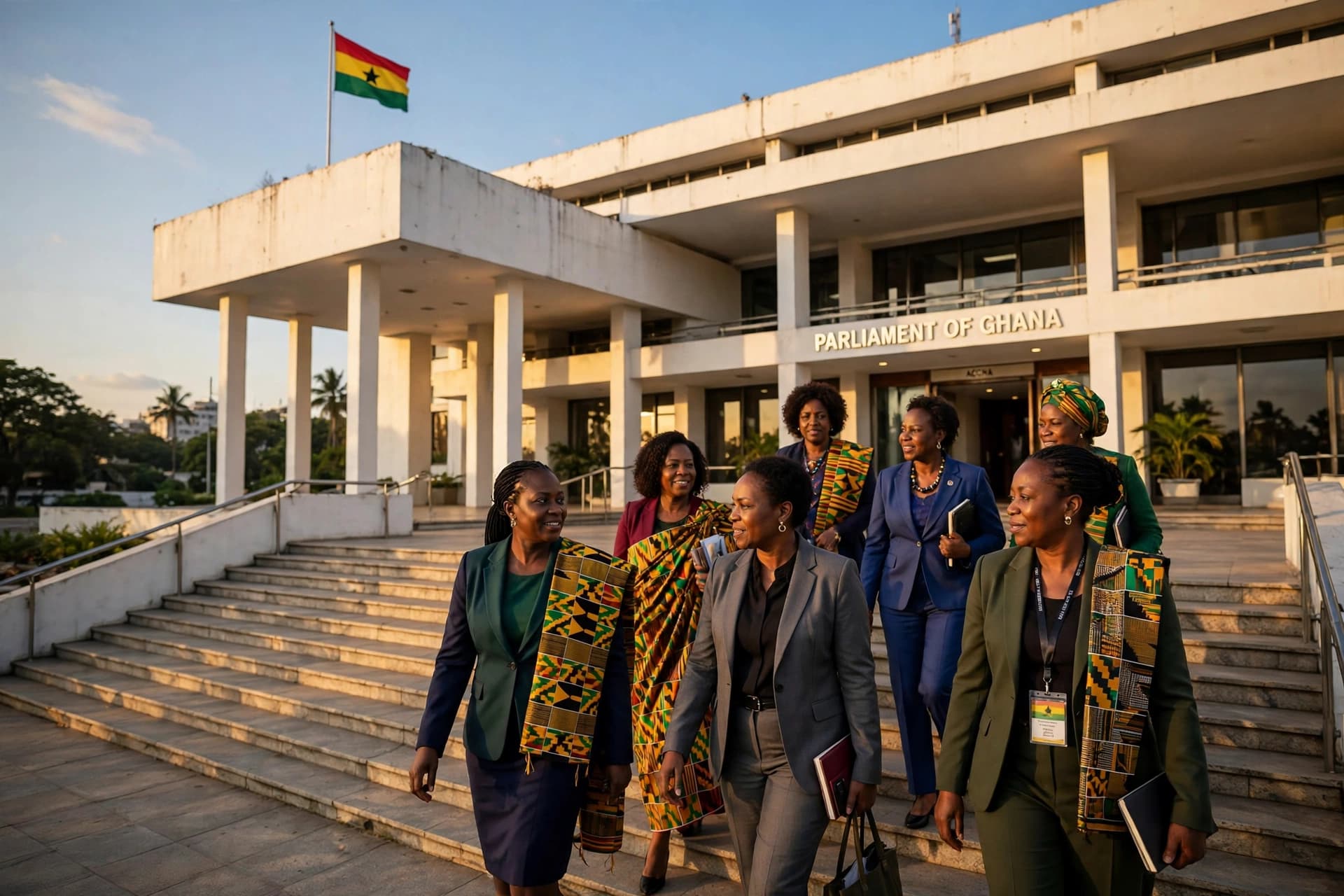
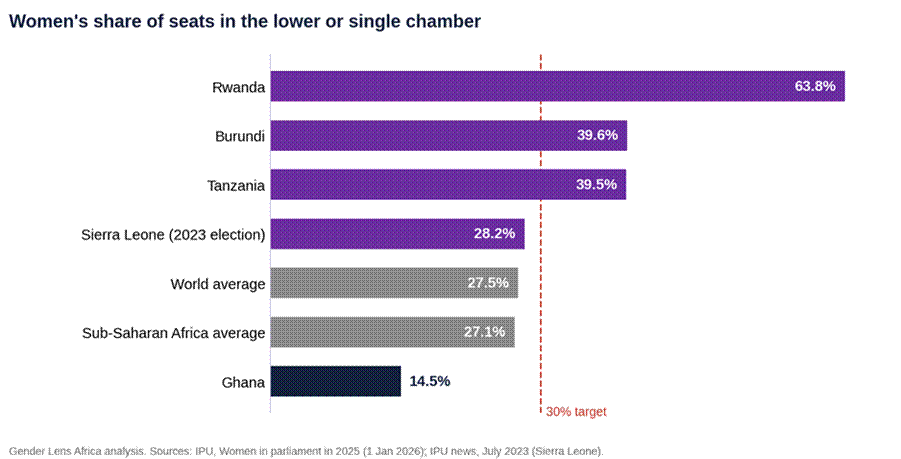
Parliament now has 40 women among its 276 members, or 14.5 per cent, according to the Inter-Parliamentary Union (IPU). That is about half the global average of 27.5 per cent and well below the Sub-Saharan Africa average of 27.1 per cent, the IPU reports. To reach 30 per cent, Ghana needs 83 women MPs. That is 43 more than today.
What the Act’s targets mean in seats
The Affirmative Action (Gender Equity) Act, 2024 (Act 1121) sets national targets of 30 per cent for 2024 to 2026, 35 per cent for 2027 and 2028, and 50 per cent for 2029 to 2034, as summarised for Parliament by the Affirmative Action Law Coalition. The Act applies those targets to public appointments and requires political parties to factor them into how they sponsor candidates. It does not reserve seats in Parliament, so the figures below are a yardstick, not a legal guarantee.
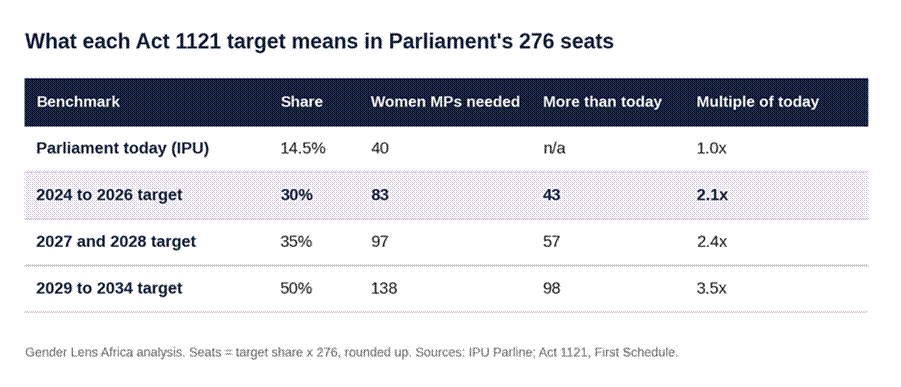
Meeting 30 per cent would more than double the number of women MPs. The 35 per cent target needs 97 women, and 50 per cent needs 138, or three and a half times today’s count.
The timetable adds pressure. Ghana’s next general election is due in December 2028. Parties will pick their candidates while the 35 per cent target applies, and the Parliament those candidates form will sit from January 2029, when the 50 per cent period begins.
Women win elections at the rate men do
A total of 801 candidates contested the 2024 parliamentary elections, and 119 of them were women. Women won 40 seats, 30 for the National Democratic Congress (NDC) and 10 for the New Patriotic Party (NPP). Men won the other 235.
That works out to about one in three for each group. Women were 14.9 per cent of candidates and 14.5 per cent of winners. The numbers show no vote penalty for women who reach the ballot.
The limit sits before election day. Ghana elects each MP in a single-member constituency under a first-past-the-post system, where the candidate with the most votes wins and no second list balances the result. It has no quota for parliamentary candidates. When a party does not nominate a woman, voters in that constituency have no woman to choose.
Where parties place women candidates
Nomination is only half the test. Placement is the other half. An analysis in Graphic Online before the 2024 vote counted how many women stood in each party’s strongholds, meaning seats the party usually wins.
Only 13 of the NPP’s 36 women candidates (36 per cent) stood in strongholds. For the NDC, the figure was nine of 39 (23 per cent). Across both parties, 22 of 75 women candidates stood in seats their party usually wins.
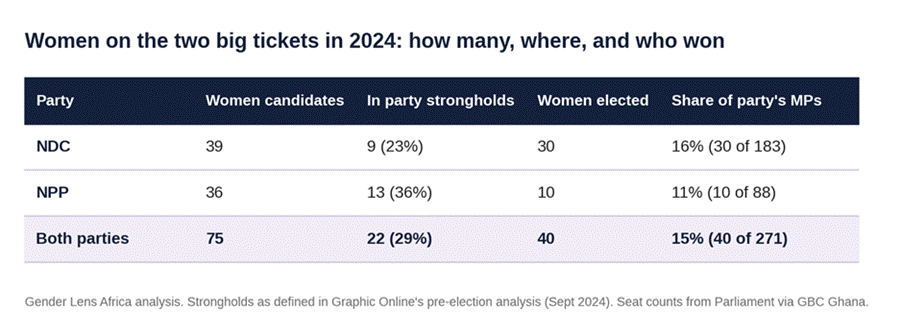
The NDC’s landslide hid the problem. Thirty of its 39 women candidates won, which means at least 21 won outside its strongholds. The NPP returned 10 of its 36.
No party can count on a landslide every time. A plan to reach 83 women has to start with seats parties expect to win.
What raised women’s numbers elsewhere
The IPU found that chambers elected under some form of quota chose 30.9 per cent women in 2025, against 23.3 per cent where no quota applied. Proportional and mixed systems elected 31.1 per cent women. Plurality and majority systems elected 25.5 per cent. Ghana sits in the second group.
Sierra Leone offers the closest West African test. Women held 12.3 per cent of seats there in January 2023. A new law then reserved 30 per cent of constituency seats in each district for women candidates and let the Electoral Commission reject any party list that missed the mark. After the June 2023 elections, women held 28.2 per cent of seats and had won 41 of the 135 contested seats.
Sierra Leone also moved to proportional representation in the same cycle, so the quota did not work alone. Critics, including the 50-50 Group Sierra Leone, say parties found ways around its design. The IPU warns that quotas can harden into ceilings when parties meet them only just.
Elsewhere in Africa, Burundi (39.6 per cent) and Tanzania (39.5 per cent) both use legislated quotas and sit near 40 per cent. Rwanda leads the world at 63.8 per cent.
Three numbers to track before 2028
Act 1121 already gives parties tasks that produce checkable numbers. Section 20 requires every registered party to file an annual gender equity report with the Electoral Commission, which must publish it in the Gazette. The Seventh Schedule requires each party to keep a database of female aspirants and to run mentoring programmes for women candidates. Both duties appear in the Coalition’s summary of the Act.
Gender Lens Africa will track three numbers. First, how many women each party fields in its 2028 primaries. Second, how many of them contest seats the party won in 2024. Third, whether the Section 20 reports reach the Gazette.
These numbers will matter at the 71st session of the UN Commission on the Status of Women (CSW71), which meets in New York from 8 to 19 March 2027 to negotiate agreed conclusions on accelerating gender equality under the 2030 Agenda. The 30 per cent benchmark itself comes from a target endorsed by the UN Economic and Social Council for 1995. At the current global pace, the IPU estimates that parity is 75 years away. Ghana’s own timetable is far shorter.
Ghana’s women candidates are not losing at the ballot box. The test for 2028 is whether parties nominate enough of them, in seats they can win.
Gender Lens Africa’s Policy Tracker examines whether laws, policies and public commitments are producing measurable changes in the lives of women and girls.
Data note
Seat targets multiply each percentage by 276 constituencies and round up. Win rates divide women’s 40 seats by 119 women candidates and men’s 235 seats by 682 men candidates. Candidate counts were reported as results came in, and the Electoral Commission issued writs for 275 of the 276 constituencies, so the rates are approximate. Strongholds follow Graphic Online’s pre-election definition.
Sources
Inter-Parliamentary Union: Ghana, women in parliament
Inter-Parliamentary Union: Women in parliament in 2025 (March 2026)
Affirmative Action Law Coalition and ACEPA: Act 1121 summary for Parliament
Graphic Online: Have women lost out in parliament?
GBC Ghana: Parliament records 115 first-term MPs in 9th Parliament
Graphic Online: Empowering women, a push for increased female MPs
Nordic Africa Institute: Ghana’s democracy stress-tested
Citi Newsroom (The Conversation): Ghana’s election system keeps women out of parliament
Inter-Parliamentary Union: Record number of women MPs elected in Sierra Leone
Inter-Parliamentary Union: Sierra Leone opens door for more women in parliament
Inter-Parliamentary Union Parline: Sierra Leone 2023 election
allAfrica: Sierra Leone passed a law to put women in power
UN Division for the Advancement of Women: Equal participation of women and men in decision-making