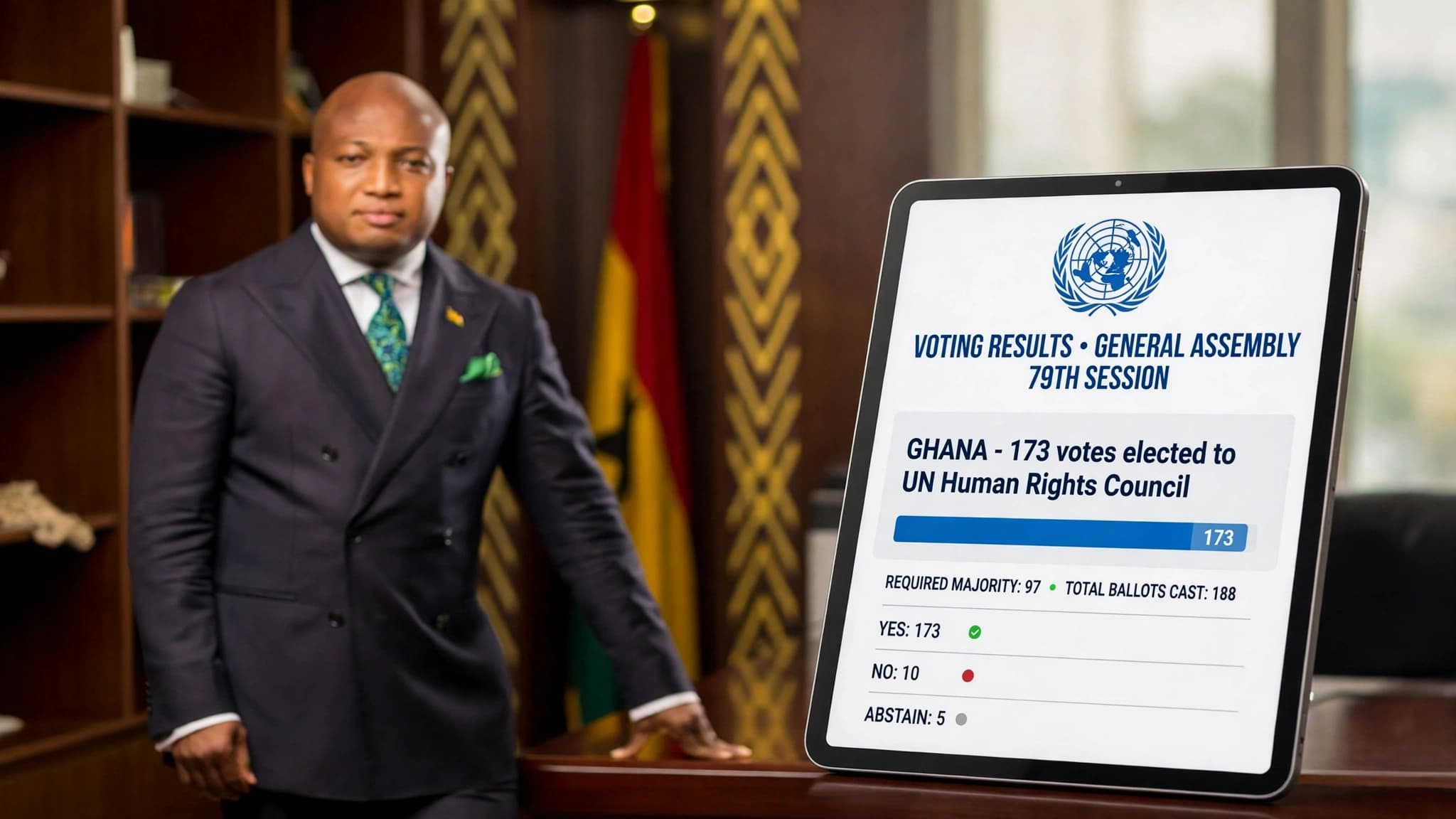
Accra, Ghana, October 17, 2026: Ghana won 173 votes for a second consecutive term on the UN Human Rights Council on 13 October 2026. As it prepares to serve from 2027 to 2029, its record on gender equality, violence against women and domestic accountability offers a starting point for judging what the renewed mandate delivers.
Ghana has just won another three years of votes on how the world protects women and girls. Its first term gives the country a record to be judged against. Its positions on specific resolutions and protection mandates show how prominently women's rights have featured in its diplomacy.
The UN General Assembly elected Ghana to the 47-member UN Human Rights Council (HRC) on 13 October 2026. Ghana received 173 of 181 valid votes, and its term runs from 1 January 2027 to 31 December 2029. President John Mahama commended Foreign Affairs Minister Samuel Okudzeto Ablakwa for the result, and said Ghana must uphold human rights and international law.
That is the diplomatic story. The gender story is about what Ghana will do with the vote.
What a Council seat does and does not do
The Council is the UN's main human rights body. Its members vote on resolutions, set up investigations and decide which mandates continue, including the Special Rapporteur on violence against women and girls.
A seat does not change a single Ghanaian law. It changes what Ghana can be asked to defend. Under General Assembly resolution 60/251, members must uphold the highest human rights standards and cooperate fully with the Council's mechanisms.
In plain terms, candidates can make voluntary pledges when they run. These are written promises about what they will do with the seat. The UN election page links pledge documents for Germany, Ireland, Japan, Jordan, Kuwait and Uruguay. As of 17 October 2026, it links no voluntary pledge document for Ghana. Ghana may have made commitments elsewhere.
The race itself offered no contest. Four African candidates ran for four African seats, so the vote confirmed Ghana rather than chose it. Members also cannot be re-elected immediately after two consecutive terms. The next three years are Ghana's last consecutive run.
What Ghana's first term shows, and what it leaves open
When Ghana joined the Council in January 2024, its Geneva mission said it would use the seat to push racial justice and to protect Africans and people of African descent from excessive force by law enforcement.
Coverage of the re-election points to the same record. Ghana sponsored resolutions on racism and, for the African Group, texts on technical assistance for Mali and South Sudan. Neither source names women and girls as a priority. That is not a full audit of Ghana's three years, but it is the public record a reader can check today.
Ghana has backed gender texts before. In 2017 it co-sponsored a Council resolution on engaging men and boys to end violence against women. Co-sponsorship signals support, but recorded votes offer a clearer account of a state's position.
Where Ghana's position shows, and where it hides
On 7 July 2025, Ghana abstained on resolution A/HRC/RES/59/5, which renewed the mandate of the UN Independent Expert on protection against violence and discrimination based on sexual orientation and gender identity. The Foreign Ministry said the vote concerned protection against violence and discrimination, not support for LGBTQ+ rights. Whatever readers think of that position, it is a documented vote, and it shows where Ghana's gender stance is tested in public: votes on protection mandates.
Many gender texts never reach a vote. They pass by consensus, which means adoption without a tally. States can explain their positions during negotiations or make statements when a resolution is adopted. Without a public explanation, however, it can be difficult to establish how a government approached the talks.
On 7 July 2026, the Council adopted by consensus a resolution on women and girls in humanitarian situations that, according to the International Planned Parenthood Federation (IPPF), names reproductive violence for the first time in a negotiated UN text. We found no public statement of Ghana's position on it.
The pressure on gender language is real. At the 70th Commission on the Status of Women in March 2026, states adopted agreed conclusions on access to justice by 37 votes to one, with six abstentions, after the United States broke consensus. A Council seat puts Ghana in the room for the next such fight.
What Ghana must answer for at home
A seat on the Council invites a comparison between what Ghana says in Geneva and what it does in Accra. The 2022 Ghana Demographic and Health Survey (GDHS) gives the baseline. These are survey findings from 2022, not estimates for 2026. Among women aged 15 to 49, 33.2% had experienced physical violence since age 15, and 14.1% had experienced sexual violence. Among women who had ever had a partner, 41.6% reported emotional, physical or sexual violence from that partner.
One indicator worsened between the two surveys. Physical violence against pregnant women rose from 5.2% in 2008 to 6.8% in 2022.
Funding for survivors tells a similar story. A civil society mid-term report to the UN, citing the Ministry of Finance's 2025 budget estimates, says the Domestic Violence and Victims Support Fund's allocation fell by 87.66% in 2025 compared with 2024. It adds that no money was set aside for building or maintaining shelters.
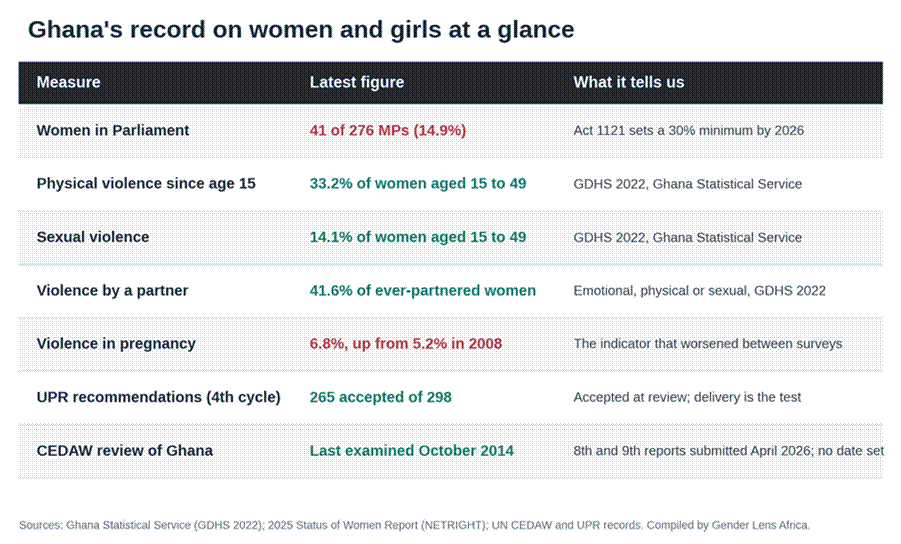
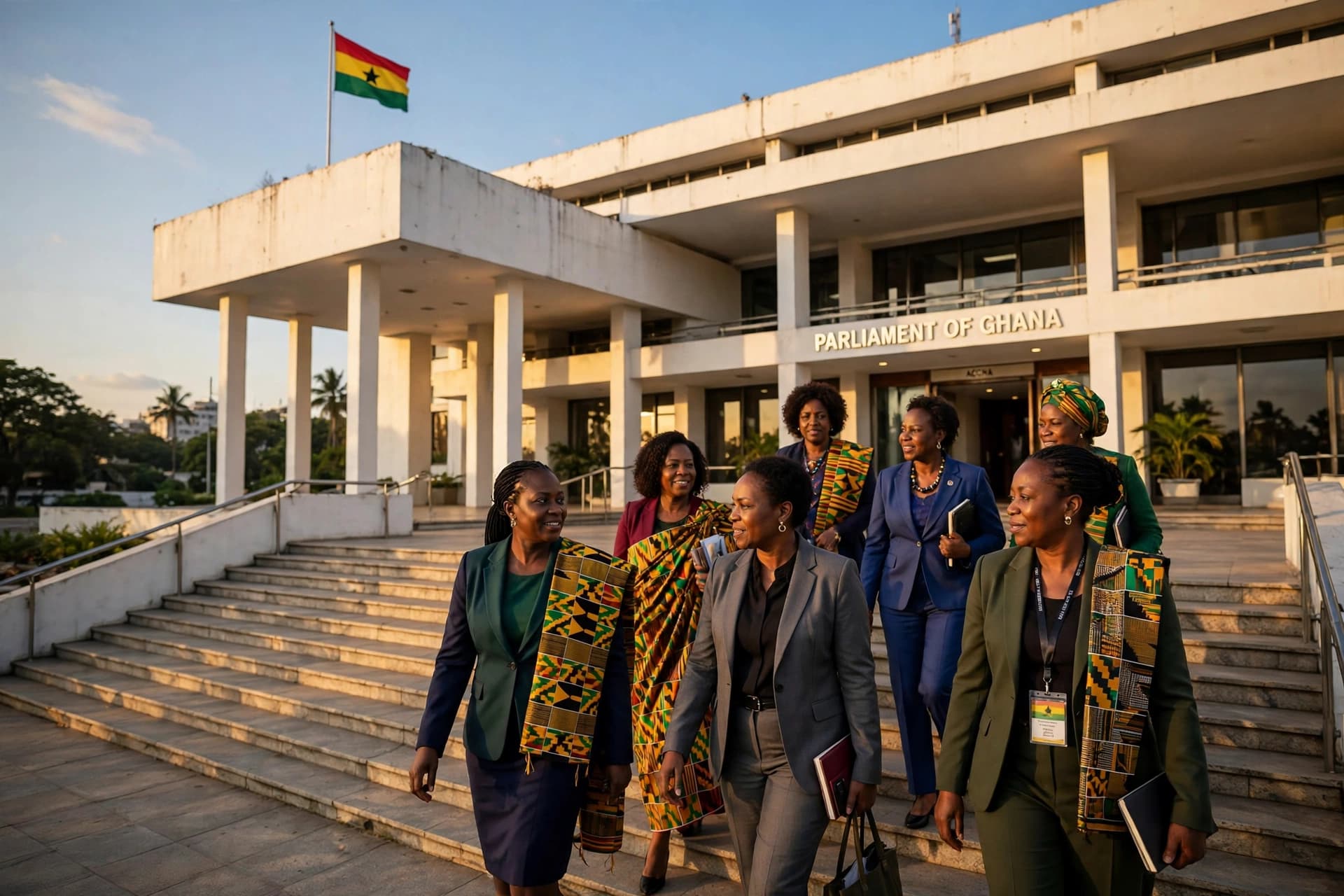
Power tells the same story. Women hold 41 of 276 seats in Parliament (14.9%), according to the 2025 Status of Women Report. Women won only 4.1% of the assembly seats in the 2023 to 2024 district elections. The same source notes that Ghana now has its first woman Vice President, Naana Jane Opoku-Agyemang.
The Affirmative Action (Gender Equity) Act, 2024 (Act 1121) requires a minimum of 30% women in public appointments from 2024 to 2026. The Status of Women Report found that government appointments have not met the 30% minimum in each category under Section 14. The first target period ends in 2026, the same year as Ghana's first Council term.
Promises made to the UN, and promises kept
The Universal Periodic Review (UPR) is the Council's peer review of every UN member state's record. States accept or note each recommendation. In the fourth cycle, Ghana received 298 recommendations and accepted 265. Accepting a recommendation starts the work. It does not finish it. A civil society mid-term report tracks what has happened since.
The Convention on the Elimination of All Forms of Discrimination against Women (CEDAW) is the UN treaty on women's rights. Its Committee last examined Ghana in October 2014. According to the UN treaty body records, Ghana submitted its combined eighth and ninth periodic reports on 1 April 2026.
Submission is not review. The Committee's 93rd session, from 5 to 30 October 2026, is reviewing eight other states, and Ghana is not among them. We found no announced review date.
In plain terms, a shadow report is civil society's alternative account for the Committee. WiLDAF Ghana convened women's rights groups to prepare one for these reports.
Six questions Ghana should answer
The seat is only worth what Ghana does with it. Citizens, Parliament and the media can start with six questions.
- Will Ghana publish voluntary pledges for 2027 to 2029, and will ending violence against women and girls be one of them?
- Will Ghana co-sponsor and vote for the Council's resolutions on violence against women and girls, and explain any abstention in public?
- Now that Ghana has submitted its combined eighth and ninth CEDAW reports, when will the Committee review them, and how will civil society take part?
- Will government meet the 30% minimum under Act 1121 before 2026 ends, and publish the appointment data to prove it?
- Will the Foreign Ministry report to Parliament and civil society after each Council session on how Ghana voted and why?
- Will government restore funding for the Domestic Violence and Victims Support Fund, including shelters, in the 2027 budget?
What to watch in 2027
The Council meets three times a year. Its June to July session has regularly taken up violence against women and girls, as in July 2023. That session is Ghana's first chance in 2027 to show where it stands.
Ghana won its seat without a rival. A seat won that way is a mandate to be judged. Ghana has three years, and no second consecutive chance, to show women and girls what it was for.
The wider accountability framework
Sustainable Development Goal (SDG) targets: 5.1, 5.2 and 5.5 (ending discrimination and violence, and women's leadership) and 16.b (non-discriminatory laws).
Beijing Platform for Action areas: violence against women (D), women in power and decision-making (G), and human rights of women (I).
CSW link: the 70th Commission on the Status of Women (March 2026) took access to justice for all women and girls as its theme.
Ghana policy commitments: Act 1121 (30% minimum by 2026), 265 of 298 accepted UPR recommendations, and the combined eighth and ninth CEDAW reports submitted in April 2026.
Watch next: Ghana's voluntary pledges for 2027 to 2029, a CEDAW review date, and the Council's June to July 2027 session.