Accra Ghana, 16 November 2026: In New York on 12 March, Ghana's Minister for Gender, Children and Social Protection, Dr Agnes Naa Momo Lartey, told a high-level meeting on violence against women and girls at the 70th session of the Commission on the Status of Women (CSW70) that the Domestic Violence Victim Support Fund provides financial assistance to survivors and supports their rehabilitation and reintegration.
Eight months later, the Fund has a new number. The 2027 Budget, presented by Finance Minister Dr Cassiel Ato Forson on 12 November, proposes GH¢10 million for the Domestic Violence Fund and another GH¢10 million for the Child and Human Trafficking Fund.
That is ten times the GH¢1 million the Fund received in 2026. It is the largest allocation in the Fund's recent history. It is also still a proposal, and this Fund has a long record of money promised on paper and never reaching survivors.
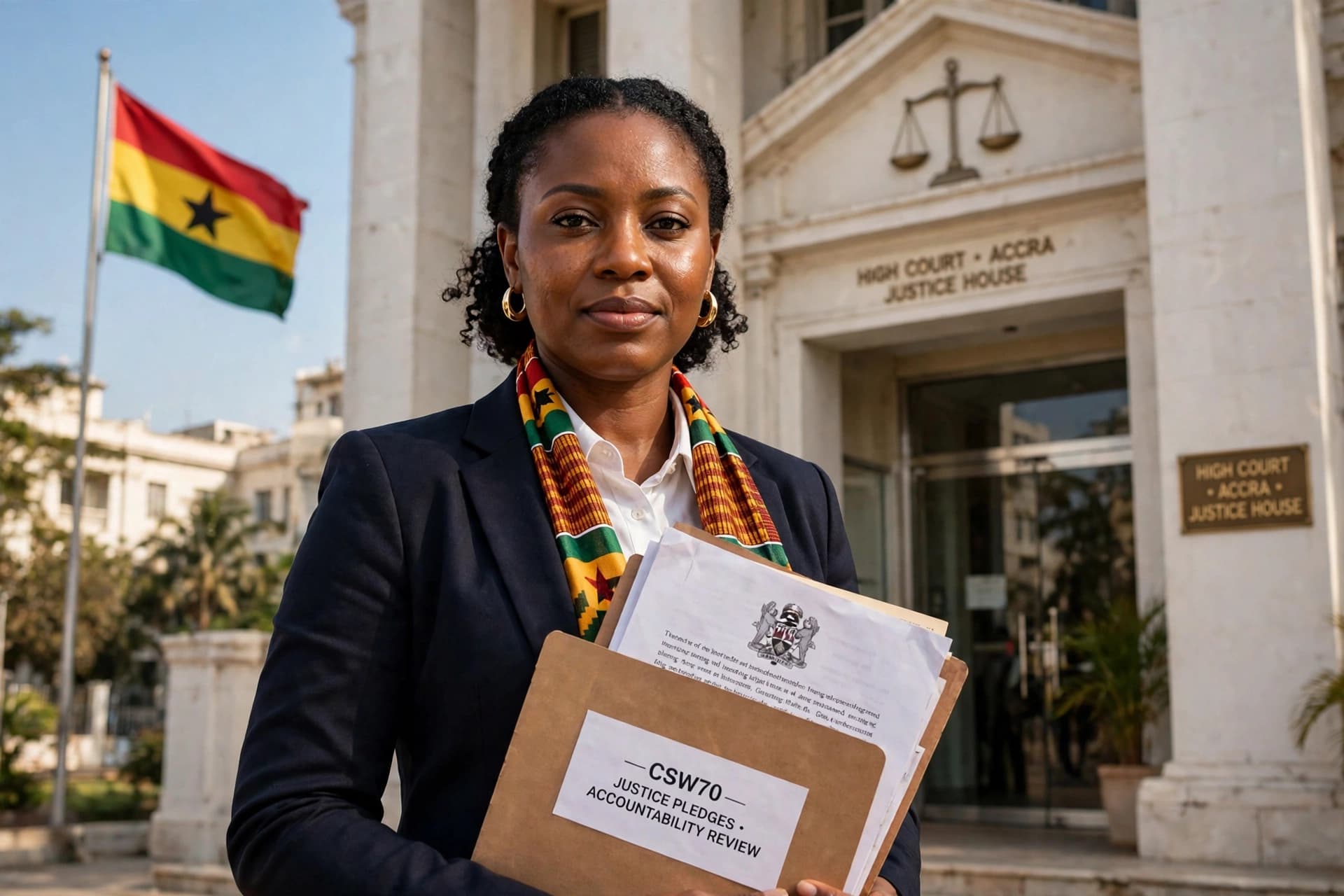
This is an update to our CSW70 scorecard, which tested the Minister's access-to-justice pledges against delivery. Here we follow one pledge: the money meant to stand behind survivors.
What did Ghana promise at CSW70?
In her 12 March statement, the Minister set out four support systems for survivors:
• The DOVVSU One-Stop Centre at Police Headquarters, with child-friendly courts, shelter services, social welfare and legal aid officers, psychologists and a 24-hour helpline.
• The Orange Support Centre, the Ministry's 24-hour toll-free line (0800 111 222) offering counselling, legal and medical support.
• The Boame (Help Me) mobile app, which links survivors to the Orange Support Centre.
• The Domestic Violence Victim Support Fund, for financial assistance, rehabilitation and reintegration.
The Fund is the one that pays for things. When a survivor needs a medical examination, transport, a safe bed or legal help, this is the public money the law set aside for her.
What is the Domestic Violence Fund meant to pay for?
Section 29 of the Domestic Violence Act, 2007 (Act 732) created the Fund. According to FIDA-Ghana, the law intends it to cover basic material support, training, rescue, rehabilitation and reintegration of survivors, and the construction of reception shelters in regions and districts.
In practice, it has done far less. FIDA-Ghana's analysis, released ahead of the 2027 Budget, found the Fund has recorded zero capital expenditure, meaning no money for building shelters. In some years it has supported fewer than 30 survivors nationally with free medical examinations and legal care.
Meanwhile, survivors pay GH¢500 to GH¢2,000 for mandatory medical examinations, and more for psychological assessments or protection orders, the same analysis found.
How much has the Fund received before?
The Fund's history is one of sharp swings. In 2024 it was allocated about GH¢2.7 million, but only 29 per cent of that, about GH¢800,000, was disbursed.
In 2025 the allocation fell by 87.66 per cent compared with 2024. FIDA-Ghana said only about GH¢337,000 was released to serve the entire country that year.
The 2026 Budget allocated GH¢1 million, a figure SEND Ghana welcomed while calling for predictable, multi-year funding. The MP for Savelugu, Hajia Fatahiya Abdul Aziz, called it a drastic cut from 2024 levels.
Explainer: allocated, released, spent
Allocated is what the budget says a fund will get. Parliament approves it, but no money has moved yet.
Released is what the Ministry of Finance actually transfers. This is often less than the allocation, and it can arrive late in the year.
Spent is what reaches services and survivors. A fund can be allocated GH¢10 million and still help very few people if only a small share is released, or released too late to use.
For survivors, only the last number matters. Ghana publishes the first one every November. It rarely publishes the other two.
What has changed for survivors in 2026?
There has been real movement on shelters. On 29 May, the Minister opened a new shelter for domestic violence survivors, alongside the Domestic Violence Board and UNICEF. At the opening, she acknowledged that access to safe shelters for survivors "remains limited."
In September, she told the Government Accountability Series that the government had commissioned the Accra shelter and supported two more in the Upper West and Eastern Regions. The Ministry plans two to three more in 2027, working towards a shelter in each of Ghana's 16 regions.
At the same event, the Ministry reported that 152 domestic violence survivors received counselling and support, and 1,432 victims of human trafficking received rehabilitation. These are government-reported figures. They have not been independently verified, and the Ministry has not published a breakdown by region, type of support or cost.
Will GH¢10 million be enough?
It is a meaningful increase. It is also a small share of the Ministry's budget. The 2027 Budget allocates GH¢3.4 billion to the Ministry of Gender, Children and Social Protection, most of it for the Livelihood Empowerment Against Poverty (LEAP) programme and school feeding. GH¢10 million is about 0.3 per cent of that total.
FIDA-Ghana and its partners have proposed a floor of at least one per cent of the Ministry's goods and services budget, rising by 30 per cent a year. They also want money ring-fenced for emergency medical care, forensic examinations, transport, shelter and psychosocial support, and released early in the year.
Even at GH¢10 million, the bigger question is structural. A survivor in Wa or Koforidua cannot use a budget line. She can use a shelter bed, a free medical examination or a lawyer. The Fund will be judged by how many of those it buys.
What to watch between now and March 2027
• Approval. Does Parliament pass the GH¢10 million intact in the 2027 Appropriation Act?
• Release. How much is released, and when? The 2024 record shows an allocation can shrink to less than a third in practice.
• Shelters. Will any of the money go to building and running shelters, after years of zero capital spending?
• Free examinations. Will the Fund end the GH¢500 to GH¢2,000 cost survivors pay for medical examinations?
• Public data. Will the Ministry publish quarterly releases, spending and the number of survivors helped?
CSW71 opens in March 2027. When Ghana reports back to the Commission, the question will not be how much it allocated. It will be how many survivors the money reached.
Gender Lens Africa will track the release of the Fund through 2027. For our earlier reporting on what happens after a survivor reports violence, read After survivors report gender-based violence in Ghana, the data stops where justice should begin.
Need help? The Orange Support Centre is free on 0800 111 222 or WhatsApp 055 1755 7575. The DOVVSU hotline is 055 1000 900.