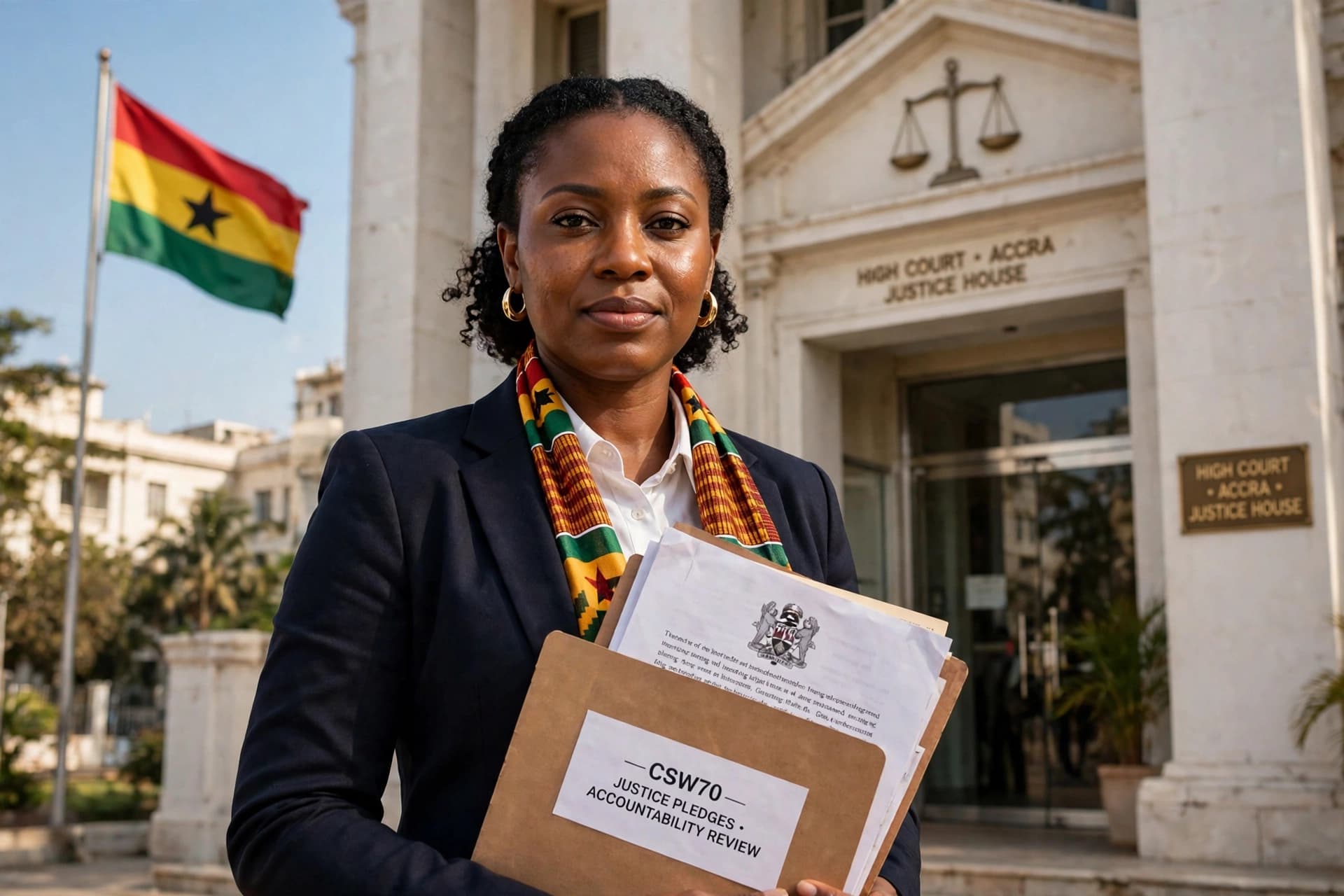
Accra, Ghana, October 23, 2026: A woman who cannot afford a lawyer has the same constitutional right to equality as a minister. Whether she can use that right is the question the United Nations Commission on the Status of Women (CSW) put at the centre of its March 2026 session.
The Commission's 70th session (CSW70) adopted agreed conclusions on access to justice on 9 March 2026. UN Women's account of the outcome says governments recommitted to repeal discriminatory laws, strengthen protections at work and reinforce national systems against violence. Ghana's laws already cover much of that ground. The gaps lie in definitions, data and enforcement.
What CSW70 agreed, and how governments voted
The session ran from 9 to 19 March 2026 in New York. Its priority theme was ensuring and strengthening access to justice for all women and girls, including by removing discriminatory laws, policies and practices and tackling structural barriers.
Delegates adopted the agreed conclusions by a recorded vote of 37 in favour, one against and six abstentions. The United States cast the one vote against. The Commission has traditionally adopted these texts by consensus. The European Women's Lobby reports that this was the first recorded vote on an outcome document in the Commission's history.
The text is not legally binding. It is a political commitment. Its value lies in giving governments, courts and civil society a shared yardstick.
Ghana's own account at CSW70
Ghana's Minister for Gender, Children and Social Protection, Dr Agnes Naa Momo Lartey, addressed the session on 9 March. In her statement, she described legal and policy reforms, expanded legal aid and training for judges, police, social workers and paralegals, including paralegals in market centres. She also named specialised police units and gender desks.
She listed six frameworks: the Affirmative Action (Gender Equity) Act, 2024 (Act 1121); the National Gender Policy (2025 to 2034); the Social Protection Act, 2025 (Act 1148); the Cybersecurity Act, 2020 (Act 1038); the Land Act, 2020 (Act 1036); and the Environmental Protection Act, 2025 (Act 1124). She added that more must be done. The statement gave no figures on legal aid cases, paralegals or prosecutions.
Five commitments set against Ghana's laws
The graphic below places five themes of the agreed conclusions beside what Ghanaian law and the Minister's statement say. It does not claim that Ghana meets every CSW70 commitment. It shows where each protection sits and what readers should ask next.
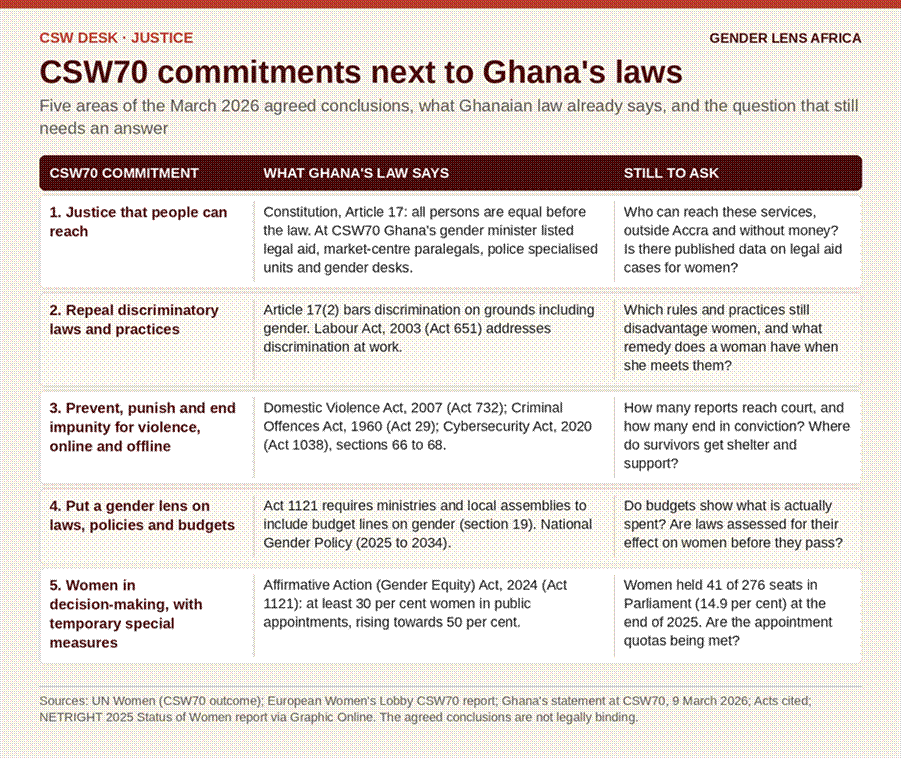
Graphic: CSW70 commitments next to Ghana's laws. Gender Lens Africa.
1. Justice that people can reach
The agreed conclusions call for justice that is accessible, affordable, timely and centred on survivors, according to the European Women's Lobby's analysis. A court that a woman cannot reach or pay for does not deliver that.
Article 17(1) of Ghana's 1992 Constitution says all persons are equal before the law. The Minister's list of legal aid, paralegals and gender desks shows the intended route. Coverage is the open question. How many women used legal aid in 2025? Where do the paralegals work? What does a woman outside Accra pay to bring a case?
2. Discriminatory laws and practices
Article 17(2) of the Constitution says a person shall not be discriminated against on grounds of gender, race, colour, ethnic origin, religion, creed or social or economic status. Ghana News Agency reproduces the text alongside the Labour Act's rules on pregnant workers and maternity leave in sections 55 to 57.
The Labour Act, 2003 (Act 651) also prohibits discrimination in employment on grounds that include gender, and its full text is public. These are real protections for working women.
One gap has stood for twenty years. In its 2006 concluding observations, the United Nations Committee on the Elimination of Discrimination against Women (CEDAW Committee) said Article 17(2) did not match Article 1 of the Convention, which covers direct and indirect discrimination. It asked Ghana to add a definition in line with the Convention. Ghana ratified the Convention on 2 January 1986. Whether the Constitution now carries that definition is a question for the Attorney-General and the Ministry.
3. Violence and impunity
CSW70 commits governments to prevent, investigate, prosecute and punish violence against women and girls, online and offline. It also calls for safe, confidential reporting without re-victimisation, as the European Women's Lobby summarises.
Ghana's main laws are the Domestic Violence Act, 2007 (Act 732), the Criminal Offences Act, 1960 (Act 29) and, for online offences, the Cybersecurity Act, 2020 (Act 1038). Sections 66 to 68 of Act 1038 cover sexual extortion, sharing intimate images without consent and threats to share them. Our explainer on online abuse sets out what each section covers.
Dr Lartey told CSW70 that police units, gender desks and cooperation among courts, social welfare services and civil society are improving reporting, case management and prosecution. That is her assessment. The public needs the numbers behind it: reports received, cases charged, convictions and shelter places.
4. A gender lens on laws and budgets
CSW70 calls for a gender perspective at every stage of law and policy making, including gender impact assessments of new and existing laws. The European Women's Lobby calls this commitment largely aspirational without binding measures and accountability.
Ghana's most concrete route is the budget. Section 19 of Act 1121 requires ministries, departments and local authorities to include budget lines on gender-specific issues. At the year-end review of the Network for Women's Rights in Ghana (NETRIGHT), Hamida Harrison of the Women's Manifesto Coalition presented a Status of Women report that raised concerns about the lack of gender-responsive budgeting. Readers can test this themselves. Find the gender line in a ministry's 2027 estimates, then check whether money reached it.
5. Women in decision-making
The agreed conclusions back laws, time-bound targeted policies and temporary special measures to remove barriers to women's participation and leadership. Act 1121 is that kind of law.
Parliament passed the Act on 30 July 2024, and the President assented to it in September 2024. It sets a minimum of 30 per cent women in public appointments, rising towards 50 per cent. Reports differ on the final year. The Daily Graphic cites 2030, while the NETRIGHT report cites 2034. Check the Act's schedule before quoting a date.
The record so far is mixed. In his 2025 State of the Nation Address, President John Mahama said women made up 23.21 per cent of appointments, below the 30 per cent minimum. The NETRIGHT report found women held 41 of 276 seats in Parliament, or 14.9 per cent, at the end of 2025. It also said government grouped all appointments together. Section 14 of the Act requires the 30 per cent minimum in each category, such as ministers, ambassadors, boards and local government.
What the comparison shows
Ghana has laws on equality, work, violence and representation. CSW70 does not ask Ghana to start from nothing. It asks whether the law works for the woman who needs it.
Three tests apply. The definition of discrimination should match international standards. Public data on cases, shelters and budgets should exist. Enforcement should follow when targets are missed. CSW71 in 2027 will look at accelerating gender equality under the 2030 Agenda for Sustainable Development, so these questions will return.
Five questions for the Ministry
• How many women received legal aid in 2025, and in which regions?
• Has Ghana added a definition of direct and indirect discrimination, as the CEDAW Committee asked in 2006?
• How many reports of violence against women reached court in 2025, and how many ended in conviction?
• Which ministries carry a gender budget line under section 19 of Act 1121, and how much did each spend?
• What share of 2026 public appointments went to women, counted by category?
Sources and further reading
UN Women: governments reach agreement on access to justice, 9 March 2026.
United Nations meetings coverage of the CSW70 vote (37 in favour, 1 against, 6 abstentions).
European Women's Lobby: CSW70 report and its full analysis of the agreed conclusions.
Official document E/CN.6/2026/L.2, the agreed conclusions.
Ghana's statement at CSW70, Dr Agnes Naa Momo Lartey, 9 March 2026.
CEDAW Committee concluding observations on Ghana, 2006.
Ghana News Agency on Article 17 and the Labour Act; Labour Act, 2003 (Act 651) full text.
Graphic Online on the 2025 Status of Women report; on the Act's assent.