Accra, Ghana, November 2, 2026: Dr Agnes Naa Momo Lartey, Ghana’s Minister for Gender, Children and Social Protection, addressed the 70th session of the Commission on the Status of Women (CSW70) on 9 March 2026. The text of her statement is posted on the website of Ghana’s Permanent Mission to the United Nations. She named six laws and policies, described training and institutional reforms, and promised to dismantle discriminatory laws.
This analysis examines each commitment against the public evidence available by 1 November 2026. It tracks 14 commitments from the speech and shows the evidence and limits behind each status.
Did Ghana keep its CSW70 promises on access to justice?
Ghana has delivered much of the architecture, but public evidence of impact is thin. Three commitments have an established framework or structure. Four have reported implementation activity, but no established outcomes. Four have incomplete implementation. Two concern existing laws for which I found no specific public enforcement evidence relating to women’s access to justice. For one, the public record is insufficient to assess implementation. The tracker records implementation status. It is not an overall grade for the government.
The sharpest gap is representation. The Affirmative Action (Gender Equity) Act, 2024 (Act 1121) sets a 30 per cent target for women in leadership that falls due at the end of 2026. The latest figures found show two women in a cabinet of 19 in March 2025 and about 14.5 per cent of MPs.
Most evidence of delivery is government-reported activity. Little of it shows how many women received legal help, protection or a conviction.
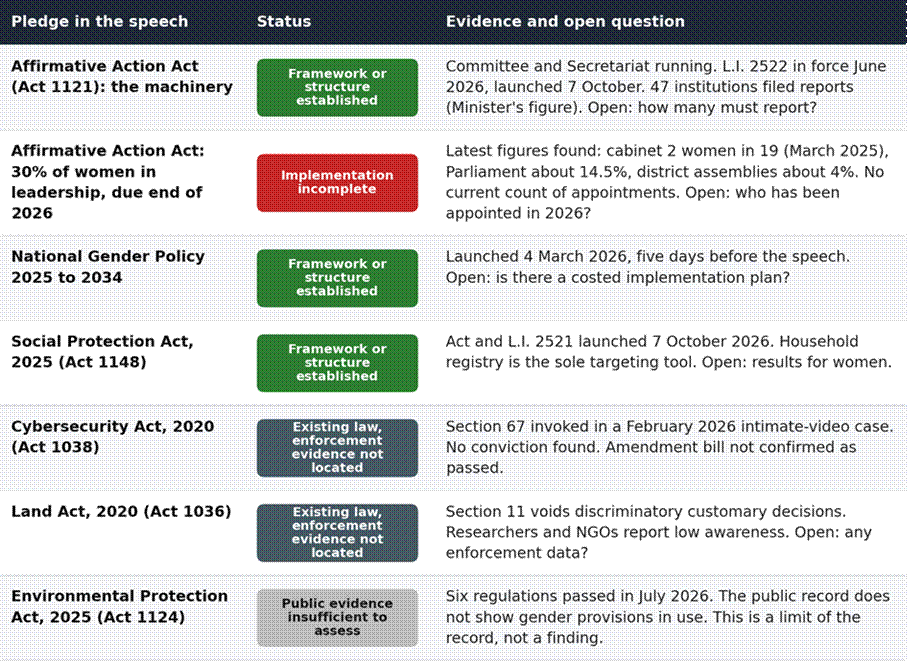
Implementation status tracker, part one: laws and policy frameworks. Gender Lens Africa analysis of public records, as at 1 November 2026.
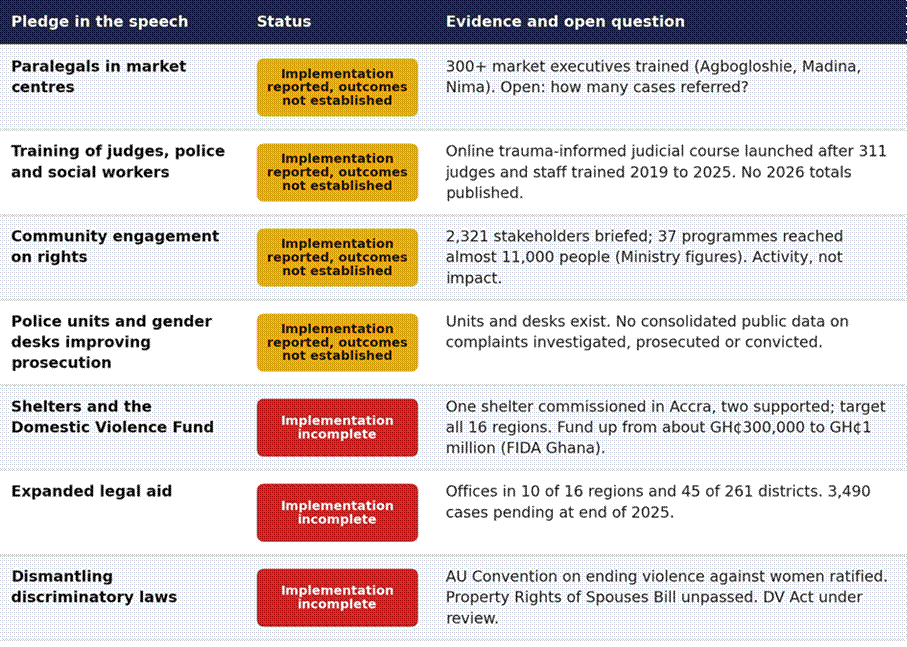
Implementation status tracker, part two: justice system and services. Gender Lens Africa analysis of public records, as at 1 November 2026.
What this analysis can and cannot show
It relies on public records, news reports and government-reported figures. I have not yet interviewed the Ministry, the Legal Aid Commission, DOVVSU, the Judicial Service or parliamentary committees. Their responses will be sought and any update published as a follow-up.
How are the statuses decided?
• Framework or structure established: the law, policy or body exists and is operating on an official or independent record. It does not show impact.
• Implementation reported, outcomes not established: activity is reported, but I found no data on results for women.
• Implementation incomplete: coverage, funding or a measurable target falls short on the latest public figures.
• Existing law, enforcement evidence not located: the law predates March 2026 and I found no public enforcement data.
• Public evidence insufficient to assess: the record does not allow a judgement. This is not a finding of failure.
Implementation has four stages: a law passed, regulations operating, an institution established and a service reaching women. The tracker records the stage the public evidence supports. Most commitments reach the first three. Few reach the fourth with data.
Commitments that existed before March 2026 are assessed on current evidence, not novelty. A government announcement counts as a government claim until independent data confirms it.
What did Ghana promise at CSW70?
The Minister listed six frameworks as the base of Ghana’s approach: the Affirmative Action (Gender Equity) Act, 2024 (Act 1121), the National Gender Policy (2025 to 2034), the Social Protection Act, 2025 (Act 1148), the Cybersecurity Act, 2020 (Act 1038), the Land Act, 2020 (Act 1036) and the Environmental Protection Act, 2025 (Act 1124).
She then made four practical claims. Ghana trains judicial officers, police, social workers and market paralegals. It runs community education on rights. It has built specialised police units and gender desks. Together these, she said, are improving reporting, case management and prosecution.
She closed with a commitment to dismantle discriminatory laws, challenge harmful practices and transform justice systems. She also promised that no woman or girl would be denied justice because of socio-economic or structural barriers.
Is Ghana on track for 30 per cent women in leadership by 2026?
The institutional framework is in place. The Ministry swore in the Gender Equity Committee and Ministerial Advisory Board in July 2025. Earlier this year a Ministry official said the Legislative Instrument was awaiting parliamentary approval. A Legislative Instrument (L.I.) is the regulation that turns an Act’s general rules into operating rules.
On 16 September, Dr Lartey told the Government Accountability Series that the Committee and Secretariat were fully operational. She said L.I. 2522 had come into force in June and that 47 institutions had submitted compliance reports. The regulations were formally launched on 7 October, after the Ministry directed all ministries, departments and agencies to comply in July.
The 47 reports are a start, not a measure. They are the Minister’s figure and have not been independently audited. I could not find a published figure for how many institutions must report.
The outcomes need careful reading. The Act sets targets for women in leadership and public appointments. It covers Parliament’s own staff and structures in Section 18 and places duties on political parties in Section 20, as a summary prepared for Parliament shows. It does not reserve seats or set an electoral quota for MPs, and the Inter-Parliamentary Union records no quota.
So Parliament is evidence of the wider representation gap, not a breach of the Act. The IPU counts 40 women among 275 sitting members, about 14.5 per cent. National reports cite 41 of 276 seats, or 14.9 per cent. Women hold about 4 per cent of district assembly seats.
Appointments are where the target bites. The Speaker said in March 2025 that only two of 19 cabinet ministers were women. That figure predates 2026 and needs refreshing, and I could not find a single current count of women across public appointments.
Representation in the judiciary presents a different picture. A February 2026 report puts women at 220 judges and magistrates, or 49.7 per cent, drawing on 2025 data. That counts women on the bench. It is a different measure from seniority: only four of the 14 Supreme Court judges are women.
Without reserved seats, Parliament’s make-up will not change before the next general election, barring by-elections. The Ministry has started work on the pipeline, with a project to prepare 30 women candidates for the 2027 district elections.
Implementation status: the committee, secretariat and regulations are in place. However, the latest representation figures located do not establish that the 30 per cent target has been met. The deadline is the end of 2026.
Are the National Gender Policy and Social Protection Act being implemented?
Both exist. The government launched the National Gender Policy on 4 March 2026, five days before the speech. It replaces a 2015 policy that expired in 2020. Speakers at the launch said it would need monitoring and adequate financing, and I could not find a published costed implementation plan.
The Social Protection Act and its regulations (L.I. 2521) were launched on 7 October. The Minister said the Act makes the Ghana National Household Registry the sole targeting mechanism and creates a dedicated Social Protection Fund, according to her Government Accountability Series statement. I found no results reported for women separately.
Are the Cybersecurity, Land and Environmental Protection Acts protecting women?
These three laws predate or sit outside the gender framework, and their impact on women is hard to see.
The Cybersecurity Act’s Section 67 makes it an offence to share intimate images without consent. The Cyber Security Authority says the penalty is one to three years in prison. In February, ministers warned that sharing intimate videos of Ghanaian women recorded by a foreign national risked prosecution, and the government said it was preparing to prosecute in absentia. I found no report of a conviction.
An amendment bill would add provisions on cyberbullying, harassment and stalking, as a legal review by the Women Initiative and Children Empowerment Foundation describes. Press freedom groups have warned that the bill needs a more balanced approach. I could not confirm that it has passed.
The Land Act’s Section 11 declares discriminatory customary land decisions void, including those based on gender. Field research in Garu found that rural women may not know how to invoke the law or lack documents. The Widows and Orphans Movement said in May that implementation and awareness remain low.
The Environmental Protection Act has the least documented connection to women’s access to justice among the six frameworks. The government has passed six regulations to operationalise it, but I found no public evidence showing how its implementation addresses gender-related barriers or provides remedies for women. This reflects the limits of the available record, not a finding that the Act has no gender implications.
Have the training and community pledges reached women and girls?
The public record shows training and community outreach, but it does not establish how consistently these activities translate into services for women and girls.
The Minister told Parliament that more than 300 market executives had been trained as community paralegals in hubs such as Agbogloshie, Madina and Nima. A further 20 market leaders in Bolgatanga joined the scheme in December 2025. Nobody has published how many cases these paralegals have referred.
For judges, an online trauma-informed course followed 17 in-person sessions that trained 311 judges and court staff between 2019 and 2025. The Chief Justice said in December that the courts had adopted gender-sensitive procedures and trained judges on digital evidence. I found no 2026 training totals.
The Ministry reports that it has briefed 2,321 stakeholders on the Act and that 37 programmes reached almost 11,000 people on violence, child marriage and harmful practices. These are Ministry figures and measure activity, not change in behaviour. People reached, people trained and people who received assistance are different indicators, and these figures cover only the first two. None of the figures in this section shows how many women obtained legal assistance, how many complaints were investigated, how many cases reached court or how many perpetrators were convicted.
The claim that police units and gender desks are improving prosecution is the hardest to test. I found no consolidated public dataset showing how many gender-based violence complaints are investigated, prosecuted and concluded in conviction. Without that information, the effect of specialised police units and gender desks on prosecution outcomes cannot be established.
The resource picture is clearer. In 2025 the head of the Domestic Violence and Victims Support Unit (DOVVSU) said the unit lacked rescue vehicles and was “always begging” for resources.
Are there enough shelters and legal aid for survivors?
Publicly available figures show that access remains limited, although both services are expanding. The Minister commissioned a new shelter at the end of May and said access to safe shelters remains limited. In September she reported one commissioned shelter in Accra and two supported shelters in the Upper West and Eastern regions. She plans two to three more in 2027 on the way to all 16 regions.
The Domestic Violence Fund pays for survivor support. FIDA Ghana reports the 2026 allocation rose from about GH¢300,000 to GH¢1 million and says that is still too little to reach beyond Accra.
On legal aid, the Legal Aid Commission has offices in only 10 of 16 regions and 45 of 261 districts, although the law requires offices in every region and district. One MP said Tamale and Bolgatanga share a single legal aid lawyer. The Commission handled 6,612 cases in 2025, resolved 3,122 and left 3,490 pending.
There is movement. The Attorney-General has urged the Commission to expand to districts, and the Commission is taking services into markets. The pledge to expand is under way, but the gap between the law and the map remains wide.
Has Ghana acted on its commitment to legal reform?
One major step has been completed, while another remains under review. Parliament ratified the African Union Convention on Ending Violence Against Women and Girls on 30 July. Ghana deposited its instrument on 29 September, becoming the second member state after The Gambia.
The Minister has also told Parliament that the Domestic Violence Act is under review. I found no published timetable for the review.
Why does the Property Rights of Spouses Bill matter to women’s access to justice?
The Property Rights of Spouses Bill is still unpassed, although Article 22(2) of the Constitution requires Parliament to pass it. The bill would set rules for dividing property when a marriage ends. FIDA Ghana petitioned Parliament in May and warned that the gap deepens hardship for women and children after divorce.
For a woman, this is a justice question before it is a legislative one. Without a clear statutory rule, a wife who raised children and kept the home can leave a marriage with little claim on what the couple built. That economic weakness makes it harder to leave violence and harder to pay for a lawyer.
The Speaker defended the delay by citing cultural and religious sensitivities. The Minister listed the Land Act as a protection for women, yet the law that would govern marital property remains missing.
What does the Obuasi SHTS case show about justice delivery?
The case of Obuasi Senior High Technical School (SHTS) tests the pledge in real time. The allegations have not been proven in court, and the headmaster denies wrongdoing.
Police say a 20-year-old Form Two student reported an alleged rape to the Obuasi DOVVSU on 4 August, accompanied by her father. Police say they completed a medical examination, scene reconstruction, photographs and witness statements, and forwarded the docket to the Attorney-General for study and advice in the third week of October. The docket covers that single complaint, and other allegations need separate investigations.
On 20 October the Interior Minister told Parliament’s Public Accounts Committee that the headmaster had been arrested. Police say he was arrested after the complaint and granted bail. The headmaster says he was cautioned and granted self-recognisance bail. No charge has been reported.
The wider record gives context, not proof of guilt in any single case. A JoyNews review tracked at least 44 cases involving at least 53 teachers and school heads from January 2015 to 14 October 2026. Of the 44 cases, 12 reportedly ended in criminal convictions and eight in dismissals. The review does not establish whether the outcomes overlap. More than half of the cases have no reported conviction or final disciplinary outcome.
The case shows the distance between a system that takes a report and one that delivers an outcome. It is also the clearest live test of whether the pledge of survivor-centred justice holds when the accused holds power.
What to watch before the 30 per cent deadline
• A public compliance register: how many institutions must report, how many have, and how many are certified or sanctioned.
• Appointments in the last two months of 2026 across cabinet, deputy ministers, district chief executives and boards.
• The 2027 budget lines for the Domestic Violence Fund, legal aid and shelters.
• Passage of the Property Rights of Spouses Bill and the outcome of the Domestic Violence Act review.
• Conviction data from DOVVSU and the Judicial Service for 2025 and 2026.
• Candidate lists for the 2027 district assembly elections.
The central question is not how many documents Ghana has produced. It is whether a woman experiencing violence, a widow facing property dispossession or a girl reporting sexual abuse can obtain protection and justice without financial, institutional or social barriers. That is the test against which the Minister’s words should ultimately be examined.