Accra, Ghana, October 19, 2026: In October 2026, a court sentenced an 87-year-old man to 20 years' imprisonment with hard labour after convicting him of defiling a nine-year-old girl in Accra, the Accra Regional Police Command announced. The case demonstrates that a complaint can result in prosecution and conviction.
It does not tell us how consistently cases progress through the justice system, or how long that process takes across Ghana. That is the question this report asks.
Gender Lens Africa (GLA) examined what published evidence shows at each stage after a survivor reports, for Through Her Lens, its campaign for the 2026 16 Days of Activism. This desk report draws on official statistics, legislation, court monitoring and research. No new interviews or requests for institutional comment were conducted for this edition.
What the law provides
The Domestic Violence Act, 2007 (Act 732) covers domestic violence. It lets a survivor, or anyone with information, file a complaint with the police, allows arrest without a warrant in specified circumstances and lets courts issue protection orders.
Section 8 sets out what police must do when a complaint arrives. Under Section 8, a victim of domestic violence whom the police assist to obtain medical treatment is entitled to free treatment from the State. Rape and defilement are prosecuted as offences under the Criminal Offences Act, 1960 (Act 29), although the two can overlap. Act 732 protections may apply where a sexual offence occurs within a domestic relationship.
Survivors can call the Gender Ministry's Orange Support Centre toll-free on 0800 111 222, or on WhatsApp at 055 1755 7575, the Minister has said.
Many survivors never seek help
The 2022 Ghana Demographic and Health Survey (GDHS) shows how many women who experience physical or sexual violence do not seek help or tell anyone about it. About one in three women aged 15 to 49 has experienced physical violence since the age of 15, and 14 per cent have experienced sexual violence.
Among women who had experienced physical or sexual violence, 38 per cent sought help to stop the violence. Another 10 per cent did not seek help but told someone. More than half, 51 per cent, neither sought help nor told anyone.
These figures cover help-seeking from any source, not just the police. They cannot establish how many survivors reported to DOVVSU, obtained a protection order or pursued a case in court. They do show that many women who experience violence do not disclose it or seek help, leaving unmet need beyond the reach of police case statistics alone.
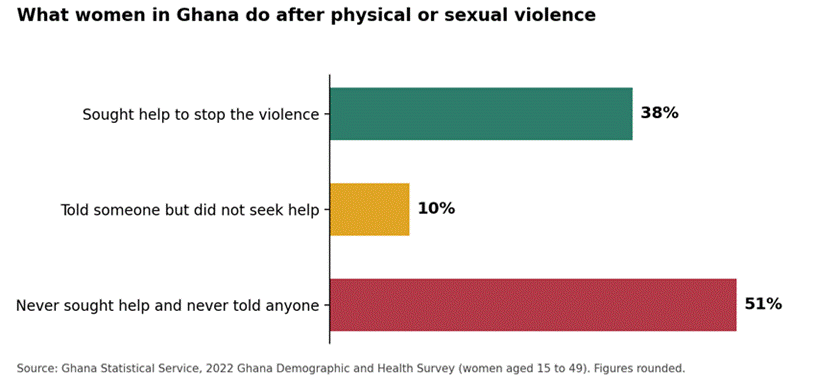
Figure 1. Help-seeking after physical or sexual violence, women aged 15 to 49, 2022.
From complaint to court: the data gap
Published figures do not give a consistent national picture across the stages of the justice process. DOVVSU figures released at different times illustrate the gap. They differ in coverage and classification, and they are not a comparable series.
Nationally in 2010, the unit received 12,706 cases, sent 954 to court and secured 118 convictions, according to its 2011 annual report as cited by Womankind Worldwide. Nationally in 2015, it recorded 15,749 sexual and gender-based violence cases, sent 1,291 to court and obtained 139 convictions, with 10,945 under investigation, a Gender Ministry official told a stakeholder dialogue.
Explainer: why this is not a conviction rate. Each figure counts different cases at different stages, and DOVVSU's caseload includes offences that are not violence against women. In the Bono Region in 2019, the most common category was non-maintenance, a failure to provide for a child, at 362 of 937 cases. The unit settled and closed 373 cases, and 19 ended in conviction, the regional coordinator reported. Dividing 19 by 937 would count maintenance disputes and settled cases as failed prosecutions.
The latest complete annual DOVVSU offence breakdown identified in the sources reviewed covers 2020, with 305 rapes and 1,047 defilements recorded. Those figures describe cases at the reporting stage. They do not show how many reached prosecution or conviction, and prosecution counts, where published, describe a different stage.
We found no published national DOVVSU report for 2024 or 2025, and no public Judicial Service or Attorney-General's Department dataset that tracks gender-based violence cases from charge to outcome. That does not prove such records do not exist. It means they were not publicly available in what we reviewed.
One peer-reviewed study examined 985 defilement cases processed in Greater Accra circuit courts between July 2014 and June 2016. It found that many were disposed of without a full trial, including through withdrawal for lack of evidence, complainant attrition and family settlement. The study is a decade old.
Four barriers
The cost of pursuing a complaint: Survivors have reported paying between GH¢300 and GH¢1,500 to complete the police medical form that investigators need in rape and defilement cases. Plan International Ghana links missing evidence to survivors who cannot afford it. Those reports date from 2022.
DOVVSU said in late 2025 that clinic and laboratory services at its One-Stop Centre in Accra are free to survivors. A November 2025 Daily Graphic editorial said the free medical care guarantee still awaits implementation. Section 8 applies to victims of domestic violence as Act 732 defines it, so fees reported in rape and defilement cases raise a related but separate question of access.
What the evidence establishes: Fees were reported in 2022, and the Accra centre lists clinical and laboratory services for survivors as free. What remains unknown: Whether free services are available beyond the Accra centre, and whether fees persist elsewhere in 2026.
The time it takes: Child Rights International reviewed 899 child protection cases across 10 regions, including 534 cases of defilement. Published reports of the findings differ on the number of cases pending before the courts. Ghanaian Times reported 286 pending cases overall, while Graphic Online reported that 32 per cent of the defilement cases were in court. Some cases had reportedly remained unresolved for two to 10 years. The findings document delays in the cases reviewed, but do not establish a national average.
Court monitoring by Human Rights and Development Services (HURDS) in the Western Region identified at least 11 unresolved cases. Participants attributed delays to prosecutorial inaction and alleged that some prosecutors encouraged private settlement. These are reported observations and allegations, not findings against named officers.
What the evidence establishes: Delays of years are documented in NGO case records and court monitoring. What remains unknown: How typical they are nationally, because no official timeline data is published.
Access to legal support: The Legal Aid Commission has offices in 10 of Ghana's 16 regions and 45 of its 261 districts. Its board chairman, Justice Samuel Kwame Asiedu Adibu, said on 12 October 2026 that it was short of about 180 staff. The law requires the Commission to establish offices in every region and district. The available figures do not establish how many survivors sought legal aid, received representation or could not obtain help.
What the evidence establishes: The Commission itself reports a large reach gap. What remains unknown: How many gender-based violence survivors it has represented or turned away.
Access to protection: Section 29 of Act 732 created the Domestic Violence Fund for shelters, legal aid and rehabilitation. FIDA-Ghana's budget tracking found an allocation of about GH¢2.74 million in 2024, of which only GH¢800,000, or 29 per cent, was disbursed. It reported an 87.66 per cent cut in 2025, to GH¢337,500. A funding expert at a FIDA-Ghana and UNFPA dialogue described the fall as about 88 per cent.
The initial 2026 budget table and SEND Ghana give GH¢1 million for the Fund. FIDA-Ghana's analysis puts it at GH¢1.6 million, and later budget comparisons show about GH¢1.17 million. We use GH¢1 million as the provisional figure. The discrepancy needs reconciling against the budget documents.
An allocation is not money released, and money released is not services delivered. FIDA-Ghana also found that none of the Ministry's GH¢11.6 million capital expenditure for 2026 was earmarked for shelters. No source reviewed gives released or spent amounts for 2025 or 2026.
Accounts of shelters conflict. Gender Minister Dr Agnes Naa Momo Lartey told the UN Commission on the Status of Women in 2026 that the Domestic Violence Victim Support Fund is operational. She says government has commissioned a shelter in Accra, supported two more and plans two or three new facilities in 2027. The Daily Graphic editorial said the only functioning shelter dedicated to abused women and children was run privately by the Ark Foundation.
What the evidence establishes: Allocations to the Fund have been small and have fallen sharply, and in 2024 less than a third was disbursed. What remains unknown: Released and spent amounts for 2025 and 2026, and an independently verified list of operating shelters by region.
What would change the picture
Ghana needs more than awareness campaigns. It needs to count what happens after a survivor reports violence. Child Rights International has called for a national digital case-tracking system that follows a case from report to final judgement.
Four measures would make progress visible: common case definitions and a shared case-tracking framework across the police, prosecutors and courts; annual publication of comparable data on case progression and outcomes; published budgeted, released and spent amounts for the Domestic Violence Fund; and a regional list of shelters and legal aid offices.
Free medical treatment must reach every region. Child Rights International and the HURDS monitors also call for fixed timelines for sexual abuse cases, particularly those involving children.
A survivor's access to justice should not depend on what she can pay or whether she lives in Accra.
If you or someone you know needs help: call the Orange Support Centre toll-free on 0800 111 222, or message 055 1755 7575 on WhatsApp. You can also report to your nearest DOVVSU office or police station.