Accra, Ghana, October 17, 2026: Four in five Africans (79%) say they or a family member went without a cash income at least once in the past year. That money gap sits behind every pad a girl cannot buy.
Period poverty means a girl or woman cannot get what she needs to manage her period safely. It covers pads, clean water, a private toilet, pain relief and honest information. The World Bank estimates that 500 million women and girls lack menstrual products and adequate facilities.
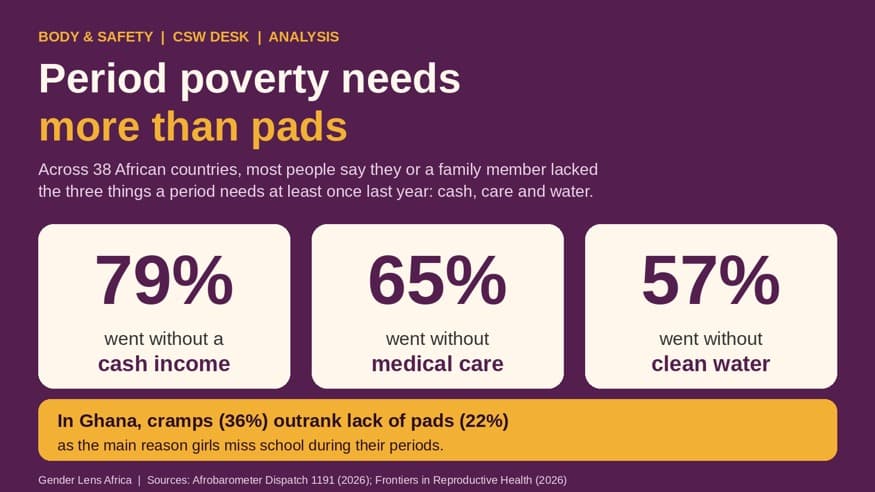
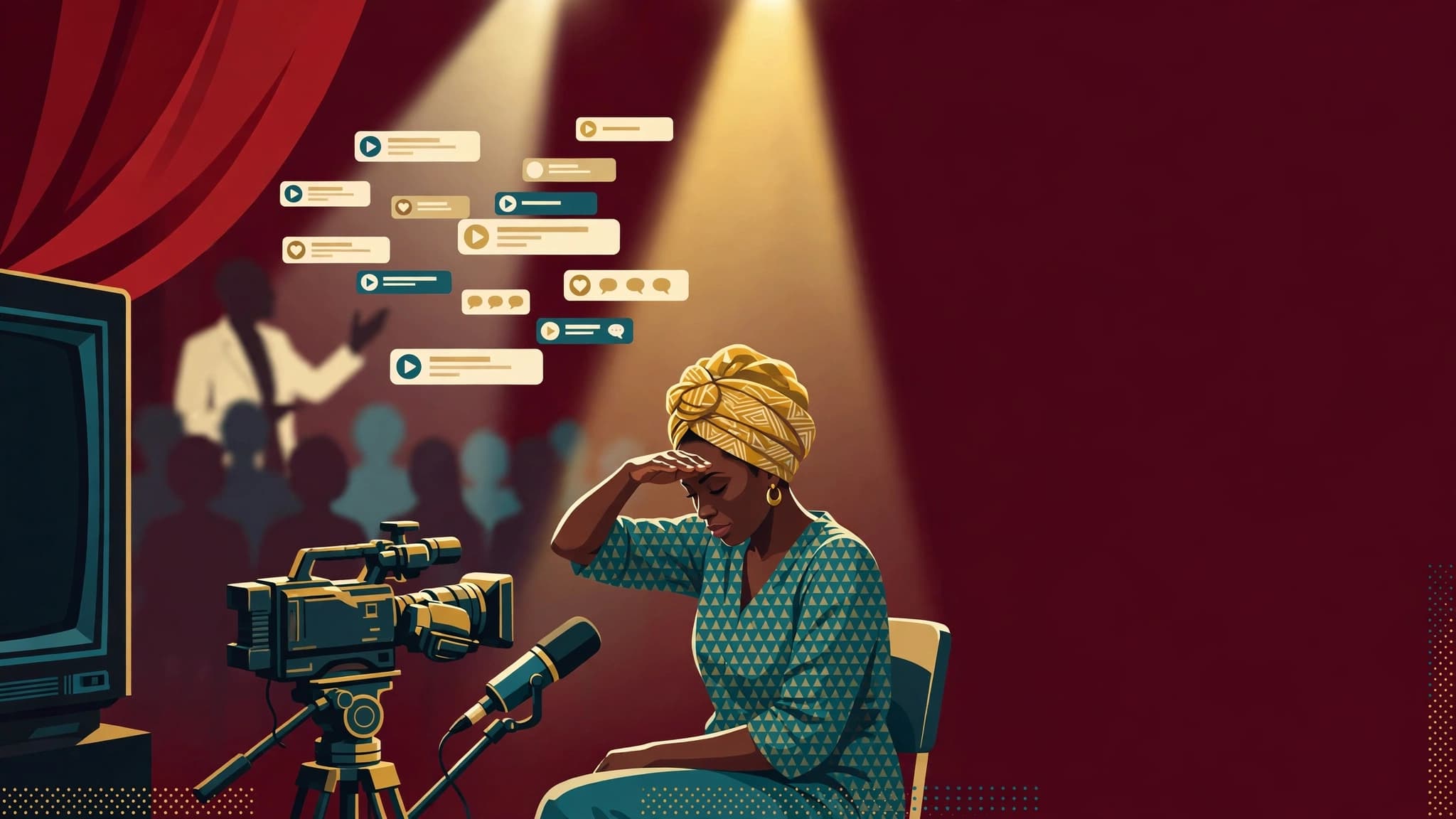
Gender Lens Africa graphic. Sources: Afrobarometer and Frontiers in Reproductive Health
What Afrobarometer found in 38 countries
Afrobarometer is a pan-African research network that interviews adults face to face. Its June 2026 dispatch draws on 50,961 interviews in 38 countries in 2024 and 2025.
Interviewers asked how often the person or anyone in the family lacked five basic needs in the past year. Majorities said it happened at least once for all five: cash income (79%), medical care (65%), food (58%), clean water (57%) and cooking fuel (52%).
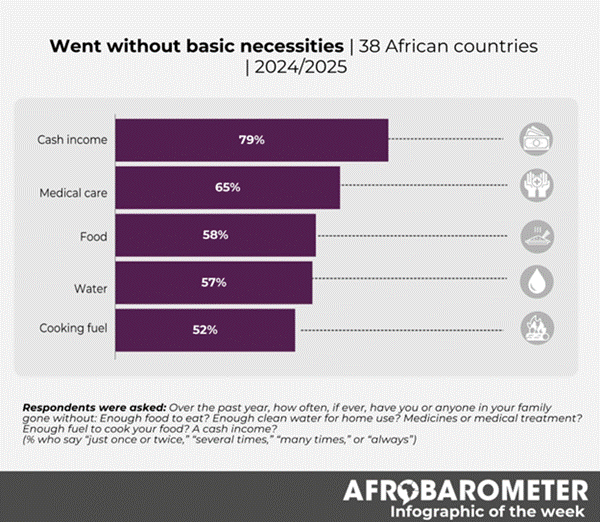
Share of Africans who say they or a family member went without basic necessities, 38 countries, 2024/2025. Source: Afrobarometer.
The survey did not ask about periods, and it reports on households rather than on women’s own experience. Read the numbers as the conditions a girl comes home to, not as a count of period poverty.
Why cash, water and care matter for a girl’s period
Three of the five basic needs have direct implications for menstrual health. Cash buys pads and soap. Clean water and private toilets help girls manage their periods safely, while access to healthcare can help them manage severe menstrual pain.
The gaps differ by country. Madagascar has the highest share lacking cash (96%), Chad medical care (89%) and Gabon clean water (84%). Chad stands out, with more than 80% reporting shortages of all five needs.
Seychelles shows the gap can shrink. Only 27% there went without cash, 13% without medical care and 8% without water.
The gap has also hardened. In 28 countries tracked since 2014, shortages of medical care rose by 14 percentage points, water by 11 and cash by 6. Those rises came by 2021/2023 and have held steady since.
What schools and tax add across Africa
Schools offer little relief. The WHO/UNICEF Joint Monitoring Programme, the United Nations body that tracks water and sanitation, reports that only 11% of schools in sub-Saharan Africa have bins for menstrual waste in girls’ toilets. Just 12% provide menstrual materials, free or for sale. These are preliminary estimates, and the JMP says nationally representative data on menstrual health remain limited.
Tax has kept pads dear. Kenya became the first country to scrap VAT on pads in 2004, and at least 17 others have followed. South Africa and Rwanda both dropped the tax in 2019.
Free supply is a second route. South Africa, Botswana and Zambia give pads to schoolgirls, and Kenya budgets for school distribution, though campaigners say the supply is patchy.
Ghana’s schoolgirls say pain comes before pads
In Ghana, 71% went without cash, 53% without medical care and 45% without clean water. Those figures sit below the 38-country average, yet they still describe millions of homes.
Prices add pressure. Civil society groups said in 2023 that imported pads carried a 20% import duty plus 12.5% VAT. The government removed taxes on pad raw materials in 2024, yet a Daily Graphic report says shop prices have not fallen and pads can still cost nearly GH₵20. In Afrobarometer’s survey, 91% of Ghanaians rate their government badly on keeping prices stable.
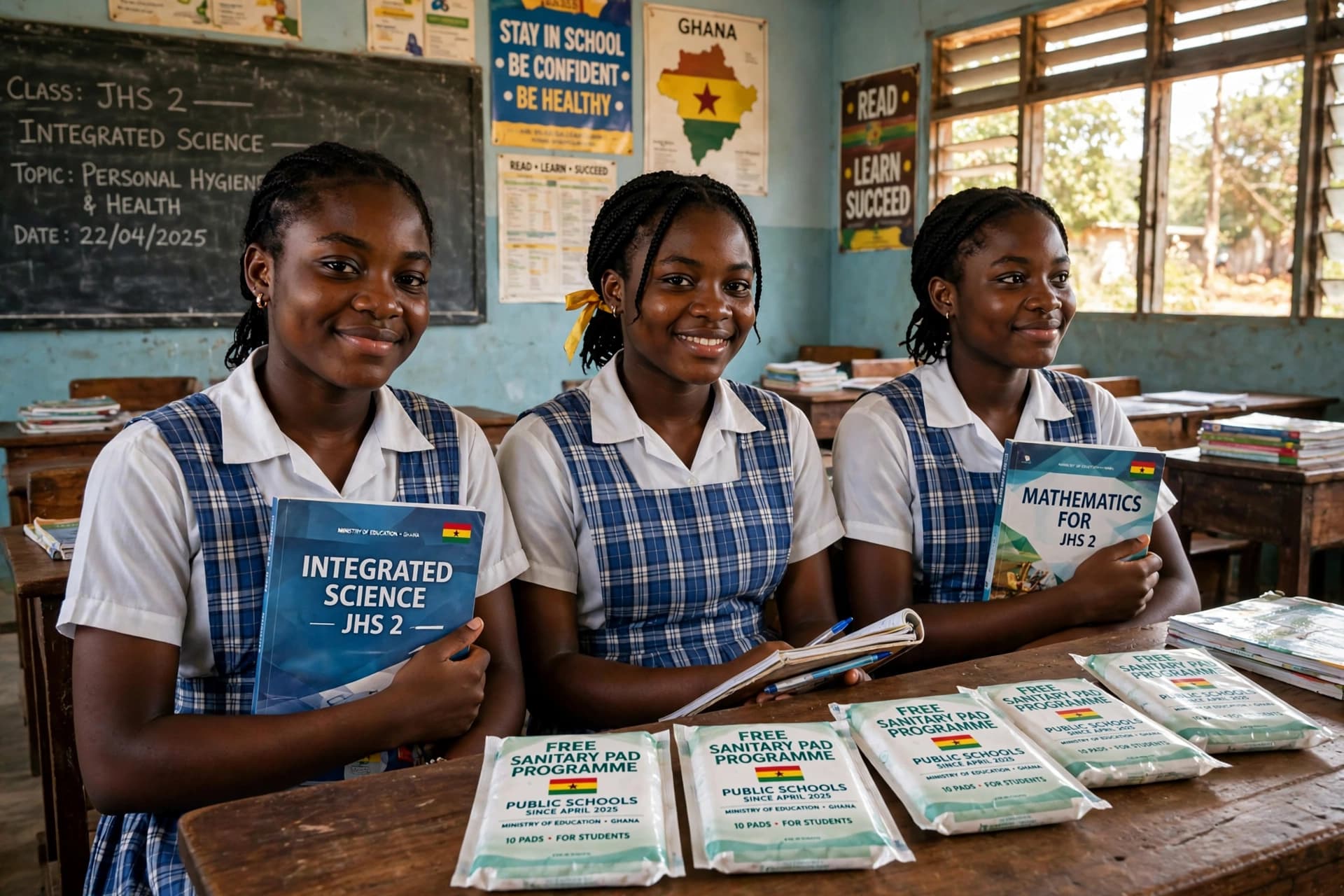
The government has responded. It launched a free sanitary pad programme for public schools in April 2025 and says it distributed more than six million pads to basic and secondary school girls that year.
A study published in July 2026 in Frontiers in Reproductive Health tests whether pads are the main reason girls miss school. Researchers surveyed 1,346 girls who had started their periods in the Northern, Ashanti and Central regions, and held focus groups with teachers and parents.
About one in three girls (32%) said they miss school during their periods. Asked for the main reason, they named cramps first, then poor school toilets and water, then a lack of pads.
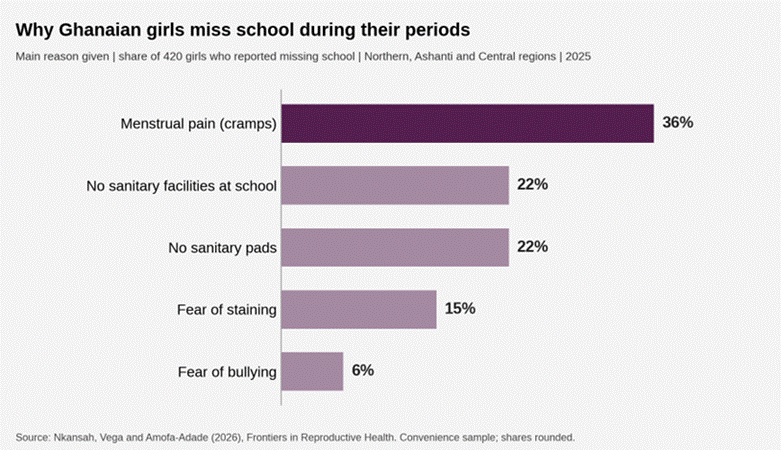
Main reason Ghanaian girls give for missing school during their period, 2025. Source: Nkansah, Vega and Amofa-Adade (2026), Frontiers in Reproductive Health. Chart: Gender Lens Africa.
Pads did not close the gap. Among girls who missed school and said they always had pads, half (90 of 179) still named cramps as the main reason.
Adults read the problem differently. Teachers and parents ranked pad cost first, while girls ranked pain and toilets higher. No school the researchers visited had a sick bay or first aid service.
UNICEF Ghana adds the national picture. An estimated 1.9 million children lack water facilities at school and 1.8 million lack toilets, and over 31% of adolescent girls have never had menstrual health education.
The authors chose schools for access rather than at random, so the findings cannot speak for all of Ghana. Treat them as a strong signal, not a national count.
How African governments can close the gap
African governments have already promised to protect this. The Maputo Protocol, the African Union treaty on women’s rights, covers women’s health and reproductive rights in Article 14. The Convention on the Elimination of All Forms of Discrimination Against Women (CEDAW), the United Nations treaty on women’s rights, covers health care in Article 12. Ghana ratified CEDAW in 1986 and the Maputo Protocol in 2007.
A right to health means little without clinics and water behind it. The data points to four steps. First, place pain relief and a first aid corner in every school beside the free pads. Second, fund school water and toilets as menstrual health spending.
Third, stock pads for heavy flows, because teachers told the researchers the current packs suit only light to medium flows. Fourth, track shop prices after every tax cut, so relief reaches the buyer.
Governments also need to count. UNICEF says Ghana has no national tracking system, which leaves out-of-school girls out of planning. A single question on periods in household surveys, such as Afrobarometer’s, would let countries track period poverty next to cash, water and care.
Pads open the door. Cash, water and care decide whether a girl walks through it.
Sidebar | Gender Lens Africa 2030 map
- Sustainable Development Goals (SDGs): SDG 1 (no poverty), SDG 3 (good health), SDG 4 (quality education), SDG 5 (gender equality) and SDG 6, target 6.2, which calls for sanitation and hygiene for all, with special attention to women and girls.
- Beijing Platform for Action: The 1995 global plan for women’s rights. This piece touches three of its areas: women and poverty, education and training, and women and health.
- CSW71: The UN Commission on the Status of Women meets in New York from 8 to 19 March 2027. Its critical area of concern is poverty and the economic empowerment of women.
- Ghana’s commitments: A free sanitary pad programme for public schools since April 2025, and the 2024 removal of taxes on pad raw materials.
- What to watch: Whether Ghana’s 2027 budget funds school water, toilets and pain relief next to the pads.