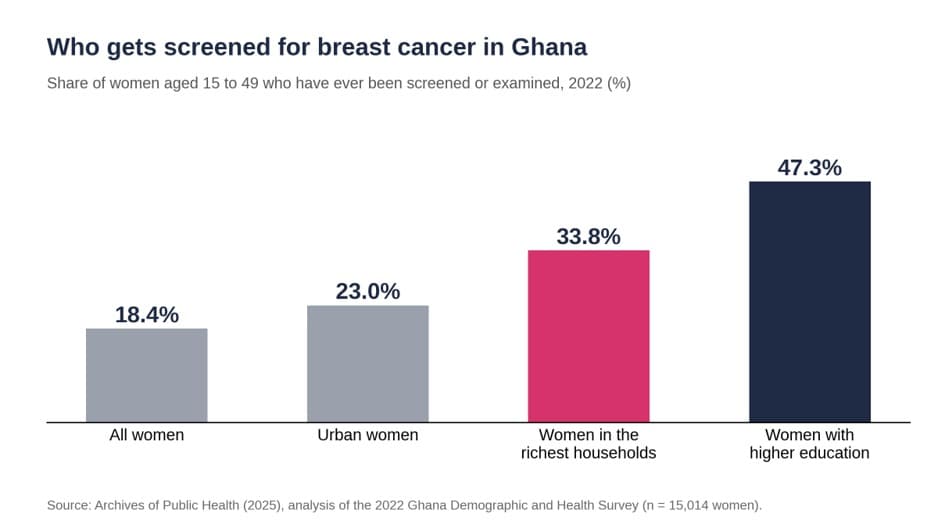
Accra, Ghana, October 8 2026: Fewer than one in five Ghanaian women aged 15 to 49 has ever reported a breast cancer screening or examination by a health professional.
Those figures come from a peer-reviewed analysis of the 2022 Ghana Demographic and Health Survey (GDHS). In that study, “screening” means a woman said she had ever had a breast cancer screening or a breast examination by a health professional. It is not a mammography rate.
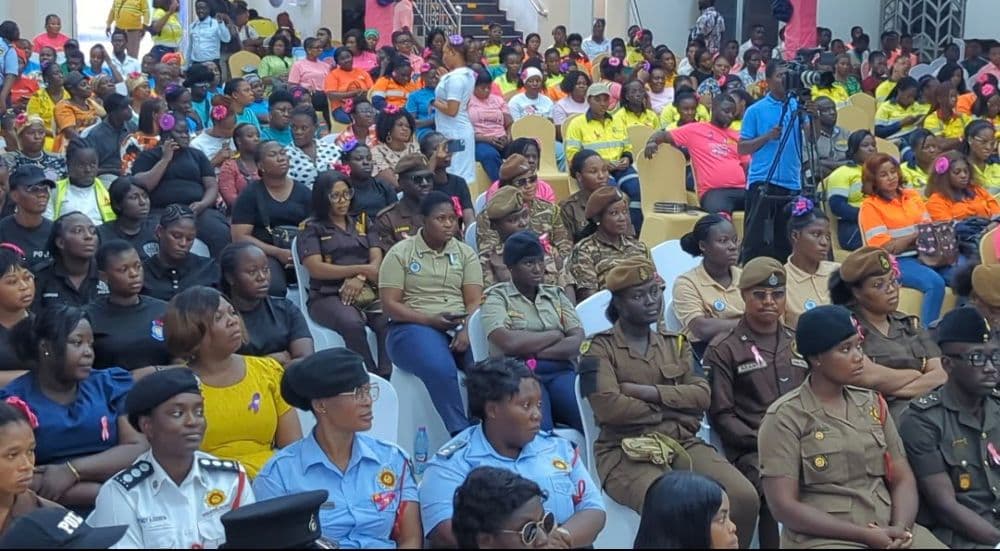
The numbers frame Pink October 2026, when a radiation oncologist at Korle-Bu said about 70 per cent of patients reach health facilities with advanced disease. This story asks who gets screened, and who does not.
How many women, and how late?
At the national launch in Accra on 30 September, Deputy Minister of Health Prof. Grace Ayensu-Danquah said Ghana records an estimated 4,650 new breast cancer cases and about 2,060 deaths a year.
Dr Mary-Ann Dadzie, a radiation oncologist at Korle-Bu Teaching Hospital, gave higher figures at the same launch: more than 5,000 cases and 2,695 deaths. She said about 70 per cent of patients reach a health facility with advanced disease. Gender Minister Dr Agnes Naa Momo Lartey also used about 5,000 new cases a year when she launched the national campaign in Ho.
None of the speeches named a data source. A hospital chief executive at a separate launch in Tema cited the same 2,695 deaths for 2024, alongside more than 5,400 new cases. This story attributes each figure to the person who gave it and treats about 5,000 cases a year as the national scale. The 70 percent figure is Dadzie's.
Advanced disease means the cancer has grown or spread, which makes treatment harder and survival less likely. Dadzie said some women wait months or years before seeking care, by which time the cancer may have reached the lungs, liver, bones or brain.
Volta Region: five years of recorded cases
The Volta Regional Health Directorate released its own figures at the national launch in Ho. It recorded 1,182 breast cancer cases between 2021 and 2025: 284 in 2021, 258 in 2022, 199 in 2023, 217 in 2024 and 224 in 2025. A further 146 cases had been reported in 2026 by the time of the launch.
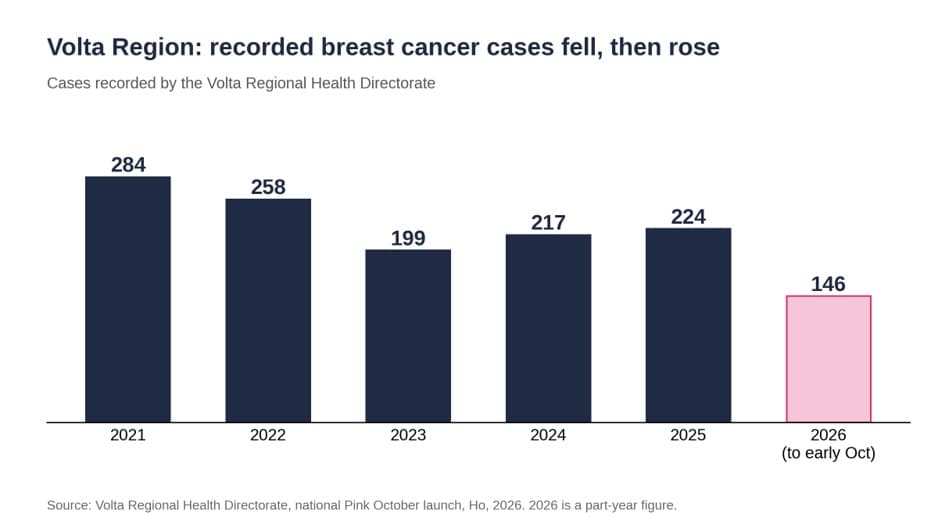
The trend has two halves. Recorded cases fell by 85 between 2021 and 2023, then rose in both following years. The 2025 figure is about 13 per cent above 2023.
A fall in recorded cases does not prove fewer cancers. It can also mean fewer women reached a facility to be counted.
The directorate recorded nine deaths in 2025 and ten so far in 2026. These are facility records, so they do not capture women who never reached a health facility.
Dr Hectoria Awekeya, the directorate's acting deputy director of public health, said treating advanced breast cancer can be prolonged and expensive, with poorer survival. The authors of a study of mammography reports at Ho Teaching Hospital describe the Volta as a largely rural region where many women have low incomes and may find mammography unaffordable.
Screening follows household wealth
The survey sorts households into five wealth bands. Among women in the richest households, 33.8 percent had been screened, against 18.4 per cent nationally. Among women with higher education the figure was 47.3 per cent, and rural women had about a third lower odds of being screened than urban women.
A separate analysis found that women in the richest households had almost twice the odds of a provider breast examination compared with the poorest (adjusted odds ratio 1.95). An adjusted odds ratio compares the likelihood of an outcome in two groups after accounting for other factors.
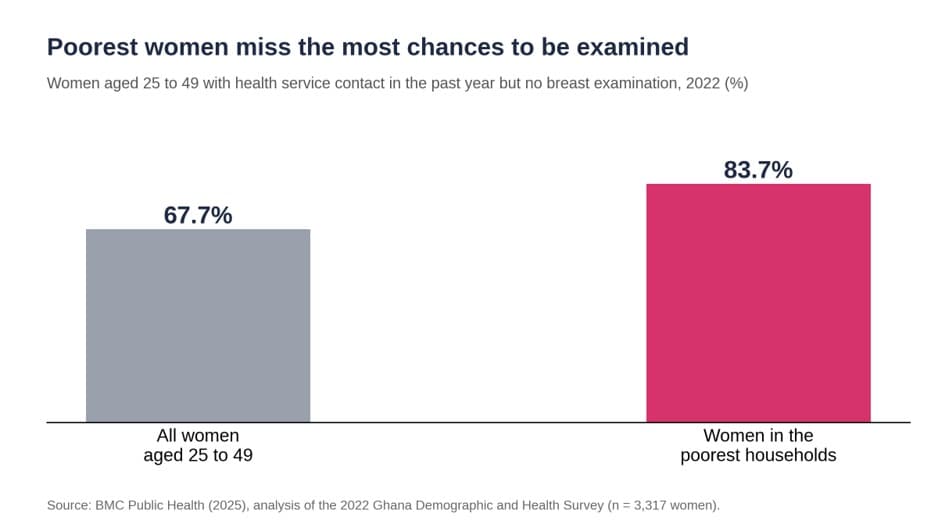
Missed opportunities tell the same story. A study of women aged 25 to 49 who had contacted a health service in the past year found that 67.7 per cent had never had a breast examination. Among the poorest women the figure was 83.7 per cent, the highest of any wealth group. The authors call this unmet need. These are national findings, not Volta-specific ones.
Cost does not end at the screening door
Dadzie said about 45 per cent of breast cancer patients seen at Korle-Bu fail to return after starting treatment. She attributed this to fear, stigma, cost and distance from health facilities.
Lartey said a diagnosis reaches into income, childcare and household responsibilities, especially for women already in vulnerable situations.
What insurance covers, and what patients get
The National Health Insurance Scheme's benefits include radiotherapy and some chemotherapy drugs for breast cancer, and mammography is also listed. But a peer-reviewed study of stakeholder views found that coverage and implementation gaps persist.
The gaps show up in clinics. An earlier Graphic report quoted the clinical director of Eastern Regional Hospital saying chemotherapy and radiotherapy were not covered for patients there. Coverage in the benefits list and care in the hospital are two different things.
The National Health Insurance Authority has now added breast cancer screening to its benefits under Free Primary Healthcare, which launched in April 2026. The Deputy Health Minister said government is also operationalising the Ghana Medical Trust Fund, known as MahamaCare, to help people whose cancer treatment costs could become catastrophic. The Gender Ministry announced a 10-day free breast screening exercise in Accra.
The benchmarks Ghana is measured against
The World Health Organization's Global Breast Cancer Initiative aims to cut breast cancer mortality by 2.5 percent a year. It sets three targets; diagnose at least 60 per cent of invasive cancers at stage I or II, complete diagnosis within 60 days, and see at least 80 per cent of patients through a full course of treatment.
Stage I and II mean the cancer is still small and has not spread far. The Deputy Health Minister said Ghana's response is guided by the initiative. The public record does not yet show how Ghana compares on any of the three targets.
Three numbers Ghana should publish next
The first is the number of breast examinations done under Free Primary Healthcare since April, broken down by region and household wealth. The second is the share of cases diagnosed at stage I or II in each region, including the Volta, set against the 60 percent target. The third is screening among women over 49, which the 2022 survey does not capture.
“Breast cancer is not a death sentence when it is found early,” Dadzie told the launch.
Pink October has spent years telling women to be aware. The data now raises a harder question, can women reach the care they are being told to seek?