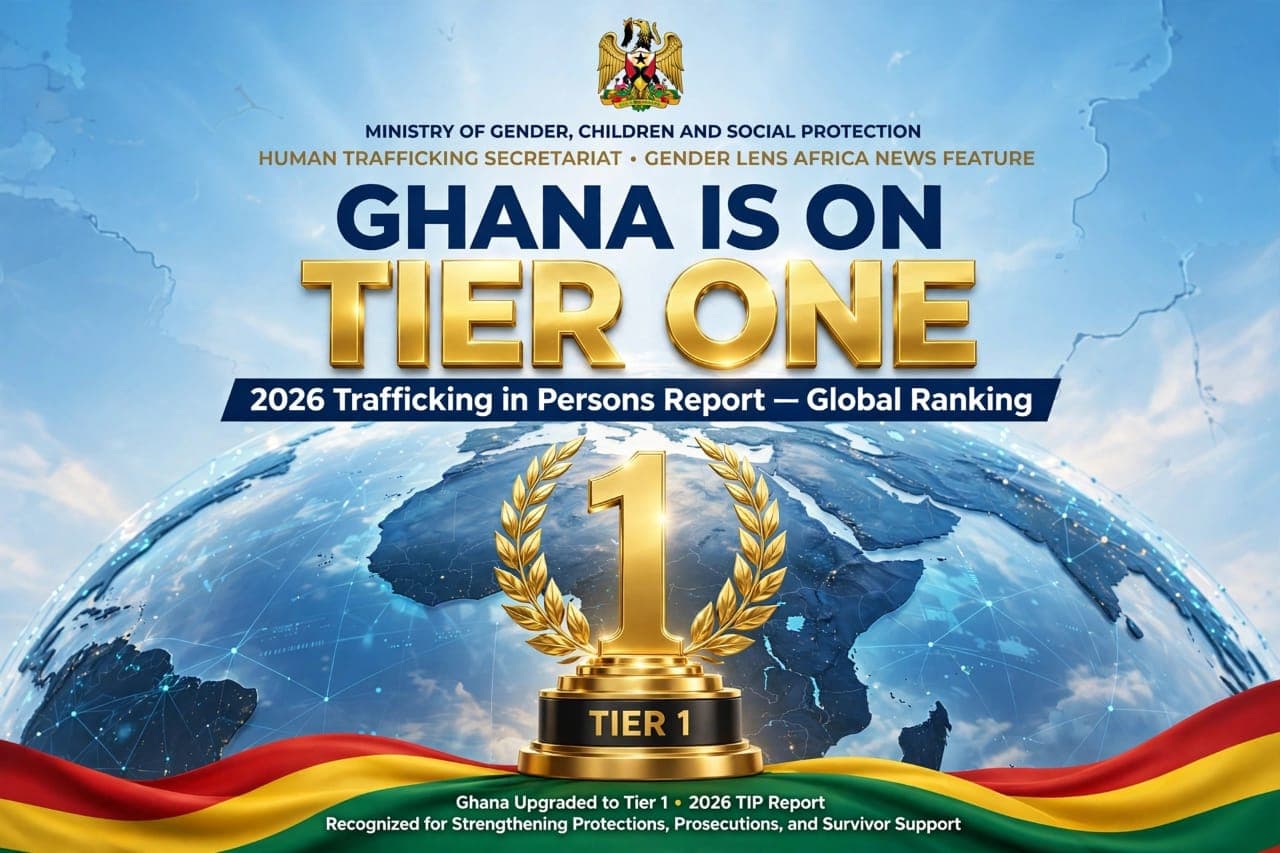
Accra, Ghana, October 16, 2026: Ghana has been placed on Tier 1 in the 2026 United States Trafficking in Persons (TIP) Report, the highest category in the US government's assessment of countries' efforts to combat human trafficking.
The ranking recognises the government's efforts to meet the minimum standards for eliminating trafficking, including increased prosecutions and convictions of traffickers, the identification and referral of more victims to support services, stronger action against online scam operations, increased funding for anti-trafficking interventions and training for frontline officials.
Ghana's placement is significant. But a country's position in an international assessment is not the same as proof that trafficking has been eliminated or that every survivor can obtain the help they need.
For women and girls, the more immediate questions concern identification, safe accommodation, access to justice, psychosocial support and the resources available to help them rebuild their lives.
What Ghana's Tier 1 ranking means
The US Department of State classifies countries into four categories: Tier 1, Tier 2, the Tier 2 Watch List and Tier 3.
Tier 1 means a government fully meets the minimum standards set out in the US Trafficking Victims Protection Act. Tier 2 applies where a government does not fully meet those standards but is making significant efforts to do so. The Watch List applies to countries meeting specified additional criteria, while Tier 3 covers governments that do not fully meet the standards and are not making significant efforts to do so.
The ranking assesses government action against a defined set of standards. It does not mean that trafficking no longer occurs within a country.
For Ghana, the 2026 report points to progress in law enforcement, victim identification, funding and training. These are important elements of an effective response. However, their significance must also be assessed against the support available to people who have experienced trafficking and exploitation.
The gap between identifying victims and supporting survivors
Identifying a trafficking victim is only one stage of the response. Survivors may need safe accommodation, medical care, counselling, legal assistance and help returning to education, employment or family life where it is safe to do so.
The government's reported increase in victim identification and referrals is therefore an important indicator to examine. The next questions are how many people received appropriate services, whether those services were available when needed and whether survivors could access them for as long as necessary.
Ghana's response has previously faced challenges involving the availability of specialised shelter services. Information retained in our earlier reporting notes also flagged concerns about the operation of an adult female shelter. The current status of that facility, its capacity and the alternatives available to adult women require verification before publication.
Without reliable information on accommodation and aftercare, an increase in the number of victims identified cannot by itself establish whether survivors are receiving sustained support.
Funding must translate into services
The US report identifies increased government funding for anti-trafficking interventions as part of the progress behind Ghana's Tier 1 placement.
Funding matters because frontline institutions need the resources to identify victims, investigate cases, prosecute offenders and provide protection. Shelters also need adequate staffing, secure facilities and access to specialised services.
The question is how that funding translates into support on the ground. Relevant indicators include the resources allocated to victim protection, the number and capacity of functioning shelters, the availability of counselling and legal assistance, and the systems used to monitor outcomes after a survivor leaves care.
A stronger response should be visible not only in government expenditure or the number of people identified, but also in the quality and continuity of the services available to them.
Prosecutions matter, but so does survivor protection
The Ministry's announcement highlights more prosecutions and convictions of traffickers. These are important measures of law enforcement activity, but they do not provide a complete picture of the justice system's response.
A fuller assessment would examine how many investigations lead to prosecution and conviction, how long cases take, whether survivors can access legal support and whether they are protected from intimidation or further exploitation during proceedings.
Women and girls who have experienced trafficking may face economic insecurity, stigma and other barriers to seeking help. Services must respond to these realities without placing the burden of enforcement on survivors.
The number of convictions is one measure of progress. The safety, dignity and recovery of the people affected must also remain central to the response.
What should happen next?
Ghana's Tier 1 placement provides an opportunity to sustain and strengthen its anti-trafficking work. The government and its partners can build on the reported progress by making information about implementation and outcomes accessible to the public.
This includes publishing clear data on victims identified and referred to services, the support provided, shelter availability, prosecutions and convictions, and the resources committed to victim protection. Where possible, reporting should distinguish adults from children and women from men, while protecting survivors' identities.
The government should also demonstrate how it is addressing gaps identified by service providers and survivors, including access to safe accommodation and longer-term assistance.
The 2026 ranking recognises government efforts to combat trafficking. It should not end scrutiny of the conditions in which survivors seek safety, recover and rebuild their lives.
Ghana's progress will ultimately be measured not only by its position in an international report, but by whether people subjected to trafficking can reach safety, obtain justice and access the support they need to move forward.