Accra, Ghana, October 10, 2026: In 2019, the total economic cost of breast cancer treatment averaged GH¢34,631 per patient at three of Ghana's leading hospitals, according to a 2024 study of 217 patients. The figure counts hospital costs, travel and food costs, and lost income. It is not the amount patients paid the hospital.
For scale, the national daily minimum wage in 2019 was GH¢10.65. In value, the total equals more than 3,200 days at that wage. A large part of it was income patients lost, not money paid to a hospital.
The researchers counted direct costs such as surgery, chemotherapy, radiotherapy, drugs and tests, plus transport and special diets. They then added indirect costs, including lost income.
How the total cost breaks down
The median total cost was GH¢31,021 per patient. Estimates ranged from GH¢12,252 to GH¢89,383.
The patients were treated at Korle-Bu Teaching Hospital, Komfo Anokye Teaching Hospital and the private Sweden Ghana Medical Centre.
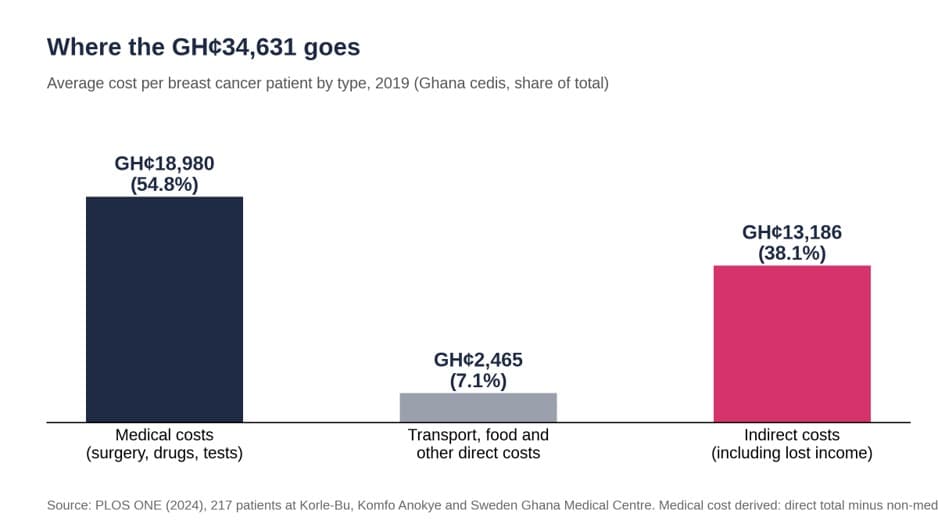
Medical costs made up 54.8 per cent of the total, about GH¢18,980 a patient. Transport, food and other direct non-medical costs added 7.1 per cent. Indirect costs, which include lost income, made up 38.1 per cent, or GH¢13,186.
At the public hospitals studied, the study reports a median total cost of GH¢29,606, and indirect costs were 44.3 per cent of the total. Lost income is part of the bill even though no hospital receives it.
Why this is a women's economic issue
Gender Minister Dr Agnes Naa Momo Lartey said a diagnosis reaches into income, childcare and household responsibilities, especially for women already in vulnerable situations. The study's authors reached a similar conclusion in money terms. They found the cost overwhelming for patients and families given low average incomes in Ghana, and called for more public funding of treatment.
Cost also shapes who finishes treatment. Dr Mary-Ann Dadzie of Korle-Bu said about 45 per cent of patients seen there fail to return after starting, and she listed fear, stigma, cost and distance among the reasons. These are the reasons she gave at the launch. The report does not cite a study or define abandonment, and the reasons are not ranked.
Insurance helps, but not fully
The National Health Insurance Scheme's benefits include radiotherapy and some chemotherapy drugs for breast cancer. But a peer-reviewed study of stakeholder views found that coverage and implementation gaps persist.
One patient's experience shows how this plays out. A Ghanaian Times report described a woman who had eight rounds of chemotherapy, a mastectomy and 25 radiotherapy sessions, and found the scheme did not cover all of it.
Free Primary Healthcare now covers breast cancer screening, which began in April 2026. That addresses screening. It does not cover diagnosis, medicines, surgery or a full course of treatment, which are a separate question.
What today's bill looks like
The 2019 figure is not today's price, and this story found no peer-reviewed update. A News Ghana report gives a median of about GH¢29,600 at public hospitals and up to GH¢55,000 at private ones. The public figure repeats the 2019 study's median. The report does not make clear where the private figure comes from. This story did not obtain current price lists from hospitals.
Three numbers Ghana should publish next
The first is the current price of a chemotherapy cycle, a radiotherapy course and breast surgery at Korle-Bu and Komfo Anokye. The second is how many breast cancer patients had a full course of treatment paid for by health insurance in 2025. The third is how many patients abandon treatment because they cannot pay.
Treatment is not only a medical decision. For a woman who supports children, pays rent or earns the household's income, it is an economic one too. The 2019 study shows the scale of the economic burden. Ghana still needs clearer public information on what patients pay, what insurance covers and how much families must find themselves.