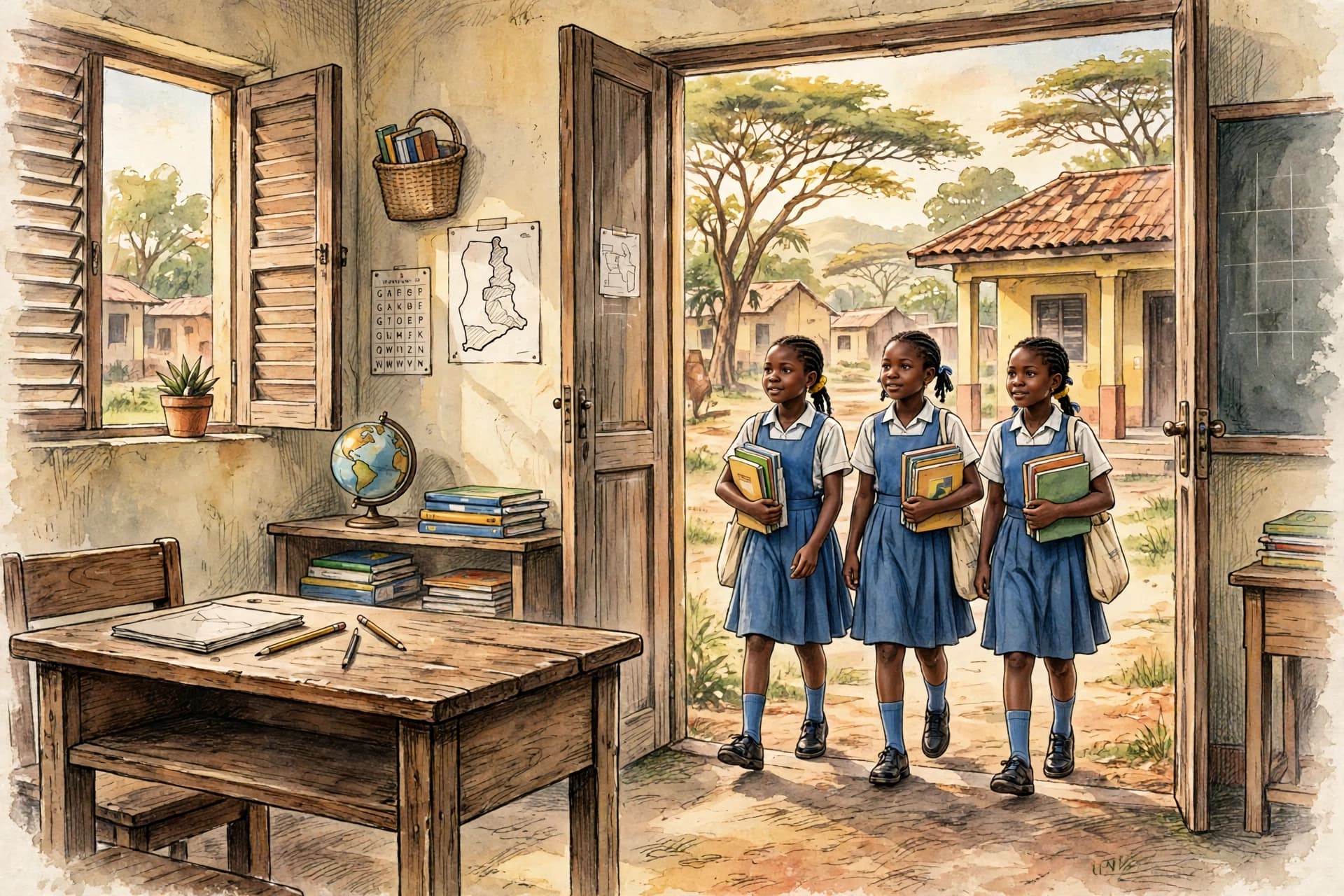
Accra, Ghana, November 13, 2026: girl can start primary school full of promise and, years later, find herself outside the education system. Nobody may notice her leaving. She misses classes gradually, falls behind, becomes pregnant, marries, takes on work at home or starts earning for her family.
Some girls never enrol. Others attend for years before circumstances force them out. Some finish primary school but never reach junior high school (JHS) or senior high school (SHS), and many never return.
Their stories differ, but they share one problem: access to education does not guarantee the chance to complete it. Ghana has reached near gender parity in primary school completion. The gap between primary school and upper-secondary completion shows that opening classroom doors is only half the task.
How many children are out of school in Ghana?
The Ghana Statistical Service's 2021 Population and Housing Census brief on childhood vulnerabilities counted 1,215,546 children aged 4 to 17 who were not attending school. The figure covers girls and boys, including children who never enrolled and those who left.
More boys than girls were out of school in most age groups. Among 15 to 17-year-olds, however, girls outnumbered boys, at the stage when young people should be moving through secondary school.
The census found that 9.5 per cent of children aged 4 to 17 had never attended school. The rate was 15.8 per cent in rural areas and 3.9 per cent in urban areas. A further 2.8 per cent had attended before but stopped.
These figures cover both sexes and form a 2021 baseline, not a 2026 count. They still show the scale of the problem and the rural-urban divide.
The brief also found pupils at least two years behind the expected grade for their age. A girl can stay on the register while repetition and missed lessons derail her education. Attendance alone does not tell the whole story.
Why do girls fall behind in secondary school?
A December 2025 data brief from UNESCO's International Institute for Capacity-Building in Africa estimates that 90.2 per cent of girls completed primary education in 2024, against 90 per cent of boys. At lower-secondary level, the rates were 76.8 per cent for girls and 80.4 per cent for boys. At upper-secondary level, 48.9 per cent of girls completed, against 55.8 per cent of boys.
Girls match boys in primary school and fall behind as they climb.
These are estimates, not a headcount. UNESCO calculates them from household surveys and census data, including older children who finish a level late, so they can differ from Ministry of Education figures. The question for policymakers stands: what changes between primary school and the end of senior high school that makes completion harder for girls?
The National Development Planning Commission's (NDPC) 2024 National Annual Progress Report recorded a rise in the JHS-to-SHS transition rate from 72 per cent in 2023 to 82.3 per cent in 2024. The transition from primary six to JHS reached 99.1 per cent. These figures are not broken down by sex, so they are not girls' transition rates. They show that the move into second-cycle education needs close monitoring.
How does teenage pregnancy affect girls' education in Ghana?
Pregnancy is one barrier among several, not the only explanation for exclusion. The Ghana Demographic and Health Survey (GDHS) 2022 found that 15.2 per cent of women aged 15 to 19 had ever been pregnant, including those who had given birth, were pregnant at the time or had lost a pregnancy.
Prevalence was 25.9 per cent in the Savannah Region and 6 per cent in Greater Accra. It was 19.7 per cent in rural areas and 11.4 per cent in urban areas.
Pregnancy interrupts schooling through stigma, rejection by classmates, unsympathetic teachers, money problems and family pressure. After birth, childcare makes returning harder still.
In 2018, the Ghana Education Service (GES) introduced guidelines on preventing pregnancy among schoolgirls and facilitating re-entry after childbirth. A pregnant student may keep studying while her health permits, take maternity leave and return afterwards. No girl should face permanent exclusion for becoming pregnant.
A right on paper is not a return in practice. Human Rights Watch told the UN Committee on the Rights of the Child in 2024 that implementation falls short, citing stigma and a lack of practical support. A 2019 study in the Ghana Social Science Journal of student mothers in Accra's Ashiedu Keteke Sub-Metro found that childcare duties, poverty, unsympathetic teachers and classmates, and weak policy implementation blocked their return.
A young mother must find someone to mind her baby, pay for transport and learning materials, and face attitudes that make her feel unwelcome. Schools need to know how to apply the guidelines. Teachers need training to support pregnant learners and young mothers without discrimination, and families and communities must accept that motherhood does not cancel a girl's right to learn.
Does child marriage end girls' schooling?
Child marriage can close the classroom door, especially where marriage ends schooling or shifts a girl's duties to her husband's household. Ghana has reduced child marriage, but the practice persists.
The UNFPA-UNICEF Global Programme to End Child Marriage's Ghana country profile reports that 16 per cent of women aged 20 to 24 married before 18, down from 19 per cent in 2017/18. Three per cent married before 15. These figures describe women who married as children. They do not show the share of all girls currently married.
Poverty, gender inequality and social expectations drive early marriage. In some households, marriage, housework or immediate money worries outrank a girl's schooling. Marriage then brings pregnancy, childcare, domestic work and limits on her movement, which make staying in or returning to school harder.
The link runs both ways. Leaving school raises a girl's risk of early marriage, and early marriage makes returning harder. Keeping girls in school therefore protects their rights, choices and futures.
How does poverty keep girls out of school?
Even where tuition is covered, school costs money for transport, uniforms, books, food and materials. Households under financial strain may withdraw a girl first. The Ghana Statistical Service's census analysis showed large rural-urban gaps in attendance and how poverty, household circumstances and access to services shape children's opportunities.
Girls also carry unpaid work. They may care for younger siblings, do chores, work on the family farm, sell at the market or help a family business. Some combine this with school. Others lose the time and energy to attend regularly, finish assignments and prepare for exams.
Girls do not lack ambition. Their education becomes negotiable when families face hard economic choices. Policy must recognise these indirect costs and the unpaid duties that fall on girls.
Why do girls miss school during their periods?
Menstrual health is often treated as a side issue. Without suitable facilities and support, it shapes whether girls can attend comfortably and take part fully. Pads matter, but so do clean, working toilets, water, privacy, disposal facilities, freedom from shame and help with severe pain.
A July 2026 study in Frontiers in Reproductive Health, titled Positive but Insufficient, surveyed 1,346 schoolgirls and held discussions with teachers and parents. Of the girls surveyed, 32 per cent reported missing school during their periods, regularly or occasionally. Of those, 40 per cent lost three or more days.
Menstrual discomfort was the most common reason, followed by inadequate sanitation facilities and limited access to pads. Girls with regular access to pads still missed school because of pain and poor facilities. The study challenges the assumption that distributing pads alone will end period-related absenteeism.
The sample was schoolgirls, not a nationally representative survey, so the 32 per cent figure cannot stand for all Ghanaian schoolgirls. Its value lies in showing the range of causes and the limits of pad-only interventions.
That matters as Ghana rolls out free sanitary pads in public schools. The policy meets a real material need, but it cannot supply pain management, working toilets, clean water, private changing space or supportive teachers. A school with unusable toilets and no water cannot claim to offer an enabling environment.
What has Ghana promised on girls' education?
Ghana's duty to keep girls in school rests on its Constitution, the treaties it has ratified and its regional commitments.
The 1992 Constitution gives every person the right to equal educational opportunities in Article 25. Basic education must be free, compulsory and available to all, and secondary education generally available and accessible. Article 17 guarantees equality before the law and prohibits discrimination, including on grounds of gender.
CEDAW: ending discrimination and school dropout
The Convention on the Elimination of All Forms of Discrimination Against Women (CEDAW) was adopted in 1979. Ghana ratified it in 1986.
Article 10 requires governments to end discrimination in education. It covers equal access, equal opportunity to benefit, measures to reduce female dropout and programmes for girls and women who left school early. Enrolment cannot be the only measure of progress. Ghana must examine why girls leave and how they can resume.
The Maputo Protocol: keeping girls in education
The Maputo Protocol is the African Union's treaty on the rights of women. Ghana ratified it in 2007.
Article 12 requires states to remove discrimination in education, protect women and girls from sexual harassment and abuse in schools, and promote the enrolment and retention of girls. It also calls for programmes for women who leave school early. Getting girls in is not enough. Governments must help them stay.
The African Children's Charter: pregnant girls must be able to return
The African Charter on the Rights and Welfare of the Child is a legally binding regional treaty. Article 11 requires states to encourage regular attendance, reduce dropout and take special measures for equal access for girls and disadvantaged children.
Article 11(6) requires states to ensure that children who become pregnant before finishing school can continue their education, based on individual ability. That gives Ghana's re-entry guidelines a regional rights foundation. They should be assessed as a child rights obligation, not only as an education programme.
The Convention on the Rights of the Child: education without discrimination
The UN Convention on the Rights of the Child (CRC), which Ghana has ratified, recognises every child's right to education. Article 28 requires compulsory, free primary education, access to secondary education and measures to reduce dropout. Article 2 prohibits discrimination, and Article 3 makes the child's best interests a primary consideration.
These provisions apply when a girl is excluded because she is pregnant, has a disability, comes from a poor household or is expected to put domestic duties before school.
The Sustainable Development Goals: the 2030 deadline
The Sustainable Development Goals (SDGs), adopted in 2015, are global commitments, not a binding treaty. Target 4.1 requires all girls and boys to complete free, equitable and quality primary and secondary education. Target 4.5 calls for an end to gender disparities in education, and Target 4.a addresses safe and inclusive learning environments.
Target 5.3 under SDG 5 calls for an end to harmful practices, including child, early and forced marriage. With 2030 approaching, Ghana's progress must be measured by whether girls complete their education, not by enrolment.
The Beijing Platform for Action: a promise made three decades ago
The Beijing Declaration and Platform for Action, adopted in 1995, is not a treaty, but it remains a reference point for the Commission on the Status of Women. It calls for equal access to education, an end to gender disparities and action against the barriers that keep girls and women out.
Three decades on, the continued interruption of girls' education raises a hard question. How much of that progress has reached the girls most at risk of being left behind?
Girls with disabilities and inclusive education
The Convention on the Rights of Persons with Disabilities makes the same point for girls with disabilities. Article 24 requires an inclusive education system at every level, without discrimination, with reasonable accommodation and support.
Girls with disabilities face inaccessible classrooms, materials and toilets, and discriminatory attitudes. Any serious test of whether Ghana keeps girls in school must include them.
Together, these frameworks make one point: getting girls into classrooms is only the beginning. The question is no longer whether Ghana has made commitments to girls' education. It is whether its policies, resources and institutions deliver them to the girls who need them most.
Do Ghana's education policies reach the girls who need them?
Ghana has introduced the Free Compulsory Universal Basic Education (FCUBE) framework, the Free Senior High School programme, GES girls' education interventions and the pregnancy prevention and re-entry guidelines. The evidence shows the problem is not whether policies exist. It is whether they are funded, applied consistently and matched to the reasons girls miss school or leave.
The NDPC report gives a basis for monitoring transition. UNESCO's completion estimates show why those figures must be read alongside the share of girls who complete each stage.
The response must also reach beyond the education sector. Health services, social protection, child protection agencies, local authorities and communities all have a role.
What would keep more girls in school?
A stronger response should include:
• Better tracking of attendance and completion. Schools and education authorities should spot absence, delayed progression and withdrawal early, before a girl disappears from the system.
• Practical support for adolescent mothers. Back re-entry guidelines with counselling, childcare, financial help where needed and protection from stigma.
• Safe, working school facilities. Treat water, clean toilets, private changing spaces and menstrual health support as essential education infrastructure.
• Support for poorer households. Use social protection and targeted education support to cover the indirect costs that make regular attendance hard.
• Stronger action against child marriage. Education authorities, social welfare officers, traditional leaders and communities must work together to protect girls' right to finish school.
• Inclusive education. Give girls with disabilities accessible classrooms, learning materials, sanitation facilities and support.
• Data that shows who is being left behind. Disaggregate education statistics by sex, age, disability, location and household circumstances, so national averages stop hiding inequality.
The right to education includes the right to finish
Ghana's achievements deserve recognition. More girls are entering school, and primary completion shows them performing almost level with boys. But those gains cannot hide the girls still missing from classrooms, or those whose education ends before secondary school.
The figures also warn against treating girls as one group. A rural girl who has never attended faces different barriers from a pregnant student trying to return to senior high school, or a girl who misses lessons because her school has no adequate sanitation. Each needs a different intervention. What they share is the need for an education system that does not abandon them when their lives become complicated.
The responsibility cannot rest on girls alone. Families must support their education, schools must offer safe and inclusive learning environments, and government must back its policies with the resources and accountability to make them work.
The question is not how many girls Ghana can enrol. It is whether a girl who starts school has a fair chance of finishing it, wherever she lives, whatever her family earns, whether or not she has a disability and even if she becomes a mother before adulthood.
Every girl who disappears from the classroom leaves more than an empty seat. She loses the chance to learn, make choices, earn a living and take a full part in society. Ghana's commitment to girls' education should be measured not by the doors it opens, but by how many girls walk through them to the end.