Accra, Ghana, November 3, 2026: When Communications Minister Samuel Nartey George told Ghana's media organisations that government did not want to become the editor of the country's newsrooms, he was making a case for professional responsibility.
Speaking at a public forum organised by the Media Foundation for West Africa (MFWA) in Accra on 2 November 2026, he urged journalists and media organisations to enforce their codes of ethics, sanction professional misconduct, establish complaints mechanisms and correct errors openly.
His position was that effective peer regulation would help prevent excessive government intervention and protect press freedom.
There is an important principle in that argument. Journalists and media owners should take responsibility for the standards of their profession. A publication that gets a story wrong should correct it. A person who believes they have been unfairly treated should have access to a credible complaints process. Professional misconduct should have consequences.
But the Minister also made another point: a journalist's professional misconduct does not justify violence against them. A bad story, he said, should be answered with a correction, a right of reply, a complaint or, where necessary, legal action. It should never be answered with a fist, a gun or a threat.
That distinction matters in a country where journalists continue to report attacks, intimidation and unresolved cases.
The debate about self-regulation must therefore go further than whether media organisations can discipline their members. It must address the conditions that allow journalists to work freely, the institutions responsible for protecting them and the consequences when those institutions fail.
Ghana cannot discuss the independence of its media without discussing the safety of the people who work in it.
Self-regulation is not the same as freedom from accountability
The call for stronger self-regulation raises a question about what kind of regulation Ghana actually has.
The country's constitutional framework does not leave media accountability entirely to voluntary professional associations. Chapter 12 of the 1992 Constitution guarantees media freedom and establishes the National Media Commission (NMC) as an independent constitutional institution with responsibilities for media standards and complaints.
Article 162 guarantees freedom and independence of the media. It prohibits censorship, protects the establishment of private media and states that editors and publishers must not be subjected to government control or interference because of their editorial views or the content they publish.
Article 167 gives the NMC responsibility for promoting media freedom and independence and taking appropriate measures to maintain high journalistic standards. This includes investigating, mediating and settling complaints made against or by the press and other mass media.
Article 172 provides that the Commission is not subject to the direction or control of any person or authority in the performance of its functions. Article 173 also makes clear that the Commission must not exercise control or direction over the professional functions of people engaged in producing newspapers or other media.
These provisions are important because they distinguish the NMC's constitutional role from direct government control of editorial decisions.
The Commission is not simply a ministry department or an instrument for deciding what journalists may publish. Its composition is designed to draw representation from different sections of society, including the Ghana Journalists Association, private press owners, the legal profession, journalism training institutions, religious organisations, Parliament and the Presidency.
The constitutional design also gives it responsibility for insulating state-owned media from government control.
The Constitution's Chapter 12 provisions therefore establish a framework in which media freedom and professional accountability are intended to operate together.
This is why the distinction between state control, independent constitutional regulation and voluntary peer self-regulation must be made carefully. They are not the same thing.
The NMC's existence does not automatically amount to state control. Equally, calling for self-regulation should not be used to suggest that an independent complaints and standards institution has no legitimate role.
The more useful question is how these different mechanisms can work without undermining editorial independence or denying the public a means of seeking redress.
Ghana already has a complaints mechanism. Is it working as it should?
The NMC's constitutional responsibilities include investigating, mediating and settling complaints against or by the media. The National Media Commission Act, 1993 (Act 449) provides further detail on the Commission's complaints process.
The law provides for a Complaints Settlement Committee and allows an aggrieved person to lodge a complaint concerning a publication or the conduct of a journalist, proprietor, publisher or other person in relation to a media publication.
The Act provides for remedies including corrections, apologies, rejoinders and disciplinary recommendations where appropriate.
These are important alternatives to censorship and intimidation. They allow disputes about media content to be addressed through an established process rather than through threats, physical attacks or political pressure.
But the existence of a complaints mechanism is not proof that it is accessible, trusted or effective.
How many complaints does the Commission receive each year? How many are resolved through mediation? How long does the process take? How often are its decisions implemented? Are members of the public aware that they can complain? Can journalists themselves use the institution when they face threats or unfair treatment?
These questions deserve public answers.
The NMC should regularly publish accessible information about complaints received, the nature of disputes, outcomes, implementation of decisions and challenges affecting its work. Such reporting would help the public understand what the Commission does and allow media organisations to assess whether the complaints system is delivering meaningful accountability.
Media organisations also have responsibilities of their own. The Ghana Journalists Association and other professional bodies should make their disciplinary procedures clear, ensure that complaints are handled fairly and communicate the outcomes of cases in which members breach professional standards.
Self-regulation cannot mean that media organisations decide privately whether they have done anything wrong. It must include transparent procedures, fair hearings and consequences.
Attacks on journalists are not a media ethics problem
The most urgent test of Ghana's commitment to press freedom is not whether a journalist who publishes an inaccurate story receives a correction order. It is whether a journalist who is assaulted, threatened or intimidated can obtain justice.
At the same November 2026 observance, the Ghana Journalists Association (GJA) reported that it had recorded more than 50 incidents of attacks, assaults, arrests, threats and harassment of journalists since 2022.
GJA President Albert Dwumfuor said five attacks were recorded in January 2026 alone, three of which allegedly involved state security personnel. He cited incidents involving journalists covering elections, illegal mining, security situations in Bawku and Walewale, and demolitions at Labadi and Laboma beaches in Accra.
He also called for transparent investigations, appropriate sanctions or prosecution where the evidence supported them, and a dedicated police focal point to receive complaints and provide updates.
These figures are the GJA's own recorded incidents, not a verified national census of every attack on journalists. But they provide a measure of the concerns being raised by the professional association.
A separate investigation by the Committee to Protect Journalists (CPJ), published on 8 June 2026, documented eight incidents in which at least 17 journalists had been attacked since President John Dramani Mahama took office in January 2025.
CPJ reported that eight of the journalists were attacked by police, firefighters or soldiers, while nine were attacked by illegal miners or unidentified individuals. It found that, among the incidents it examined, the only case with clear evidence of justice was the prosecution of illegal miners who attacked three journalists reporting on suspected illegal mining. One of the journalists received compensation for damaged equipment.
In other cases, journalists told CPJ they had received little or no information about investigations. Some said they had lost confidence in the willingness or ability of authorities to hold perpetrators accountable.
The CPJ investigation is not a complete record of all attacks in Ghana. It documents specific cases and interviews with affected journalists. Its findings should not be treated as a national conviction rate. But the cases expose a serious accountability question: what happens after a journalist reports an attack?
An announcement that an investigation has begun is not the same as an investigation that has been completed. An arrest is not the same as a prosecution. A prosecution is not the same as a conviction. And a journalist who receives no information about their case has little reason to believe that the system will protect them if they are attacked again.
The GJA's demand for a dedicated police focal point is therefore worth serious consideration. A journalist reporting an assault should not have to repeatedly chase several institutions to find out whether anyone is investigating the case.
A functioning mechanism should provide a clear point of contact, a reference for the complaint, updates on investigative progress and a process for escalating cases where there is no action.
Where security personnel are accused, the process must be capable of establishing the facts independently and transparently. Their uniforms or institutional positions must not place them beyond accountability.
The state has a duty to protect journalists, not merely promise investigations
There is a difficult but important distinction between protecting journalists and controlling the media.
The state should not decide what journalists publish. But it has a responsibility to ensure that people can exercise their rights without violence, intimidation or unlawful interference.
That responsibility extends to attacks by state and non-state actors.
The African Commission on Human and Peoples' Rights makes this distinction in its 2019 Declaration of Principles on Freedom of Expression and Access to Information in Africa .
Principle 16 calls on states to encourage impartial, timely and cost-effective media self-regulation. It also says codes of ethics should be developed through transparent and participatory processes and effectively implemented. Importantly, it recognises co-regulation as a possible complement to self-regulation, involving public regulatory authorities, media organisations and civil society.
Principle 20 addresses the safety of journalists and other media practitioners. It calls on states to guarantee their safety and take measures to prevent attacks, including murder, torture, arbitrary arrest, kidnapping, intimidation, threats and unlawful surveillance by state and non-state actors.
The regional framework therefore does not present self-regulation and state responsibility as competing obligations. It recognises that media organisations have professional responsibilities while governments have duties to protect the rights of journalists.
That is the distinction Ghana's policy discussion must preserve.
A government that respects press freedom does not need to control newsrooms to demonstrate that it takes professional standards seriously. It can support independent institutions, protect journalists, investigate attacks and ensure that public officials do not use their authority to intimidate the press.
The test is what happens when a journalist reports on a politically sensitive issue, challenges a public official or investigates misconduct involving a powerful institution.
A safety policy cannot remain on paper
At the November forum, the Communications Minister welcomed MFWA's Model Safety of Journalists Policy and urged media owners to adopt it.
He identified practical measures that newsrooms should provide, including risk assessments, emergency contacts, secure devices, and legal and psychological support for journalists.
This is important because safety cannot be treated as the journalist's personal responsibility alone.
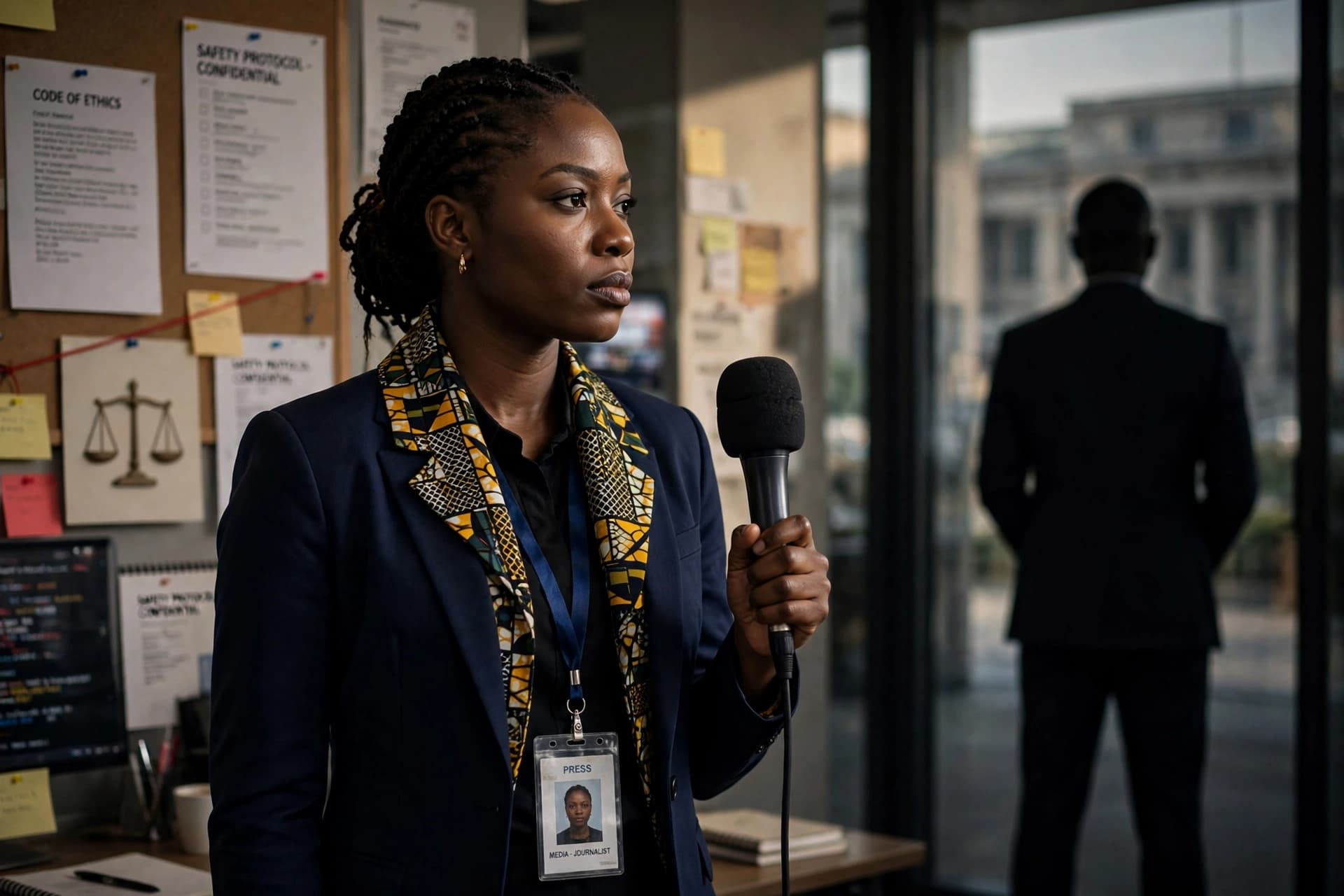
A reporter sent to cover an election, protest, demolition, mining site or violent incident should not have to make every safety decision without institutional support. Editors and media managers must assess risks before assignments, provide appropriate equipment and establish procedures for emergencies.
The MFWA's earlier call for the development of a model policy outlined the need for physical safety protocols for field reporting and high-risk assignments, digital security measures, emergency response procedures and provisions for marginalised groups, including female journalists and minority reporters. It also identified training and compliance monitoring as part of newsroom adoption.
The MFWA policy development brief MFWA policy development brief makes clear that the intended policy was not simply a document about physical attacks. It was designed to address digital threats, online harassment and the particular safety needs of groups who may face additional risks.
The next question is implementation.
How many media organisations have adopted the policy? Which newsrooms have conducted risk assessments? Are journalists given emergency contacts before assignments? Do editors know what to do when a reporter is detained or assaulted? Is there a budget for legal assistance, medical care or psychological support?
A policy that is launched but not funded, communicated or monitored cannot protect journalists.
Media owners should make their safety policies accessible to staff and explain how they work. Newsroom managers should receive training on risk assessment and emergency response. Journalists should know who to contact when a threat occurs and should not face retaliation for reporting safety concerns.
The NMC, GJA and MFWA can help monitor adoption and identify gaps, but responsibility for protecting employees and contributors must remain with the organisations that assign and publish their work.
Women journalists face risks that newsroom policies often overlook
The safety discussion must also account for the different ways women journalists experience threats and intimidation.
Physical attacks are only part of the problem. Women journalists can face sexual harassment, gendered insults, threats of sexual violence, online abuse, non-consensual sharing of intimate images and attacks designed to undermine their credibility because of their gender.
These experiences can affect whether women accept assignments, pursue particular investigations, speak publicly or seek leadership positions.
MFWA's March 2026 article, Rights. Justice. Action: Time to act on the safety of female journalists in Ghana Time to act on the safety of female journalists in Ghana, documented concerns about physical and online attacks, intimidation, sexual harassment and limited opportunities for advancement.
It referred to the July 2025 Ablekuma North parliamentary rerun, during which JoyNews digital journalist Sally Martey was slapped and shoved by a masked man while reporting. The article also cited attacks involving Citi FM/Channel One TV journalist Akosua Otchere and Adom FM journalist Ohemaa Sakyiwaa.
These cases show why a general commitment to journalist safety is not enough. Newsrooms need procedures that recognise the specific risks women face and provide confidential, credible ways to report abuse.
The MFWA's model policy development brief explicitly identified female journalists as a group requiring particular consideration. That provision should not be reduced to a paragraph in a document. It needs to translate into practical protections.
A newsroom should have a clear sexual harassment policy, an independent reporting channel, protection against retaliation and a fair process for investigating complaints. Women journalists should be able to report online threats and receive support with preserving evidence, assessing risks and seeking appropriate legal assistance.
Editors must also understand that online abuse can become a workplace safety issue. A journalist targeted because of a story she has published may face threats that affect her ability to work, her family and her physical safety. Leaving her to manage those threats alone is not an adequate response.
There is a further question about representation. Women journalists should participate in developing, implementing and reviewing safety policies. A policy designed without the people most affected by particular forms of abuse may fail to address the realities they face.
Journalists cannot defend press freedom while their own livelihoods remain insecure
At the Accra forum, Ghana Broadcasting Corporation Director-General Professor Amin Alhassan raised another issue: the economic conditions under which journalists work.
He called on the National Communications Authority to consider making payment of Social Security contributions for media workers a requirement for renewing broadcasting licences. He said some media organisations did not maintain proper payroll systems, leaving journalists at risk of retiring without pensions.
His proposal raises questions about how labour obligations should be enforced in the broadcasting sector, and whether licensing conditions are the appropriate mechanism. Any such measure would require legal examination, consultation with employers and workers, and clarity about the responsibilities of the relevant institutions.
But the underlying problem deserves attention.
A journalist without a written contract, regular salary or social protection may be more vulnerable to economic pressure. A reporter who fears losing their job may think twice before challenging an advertiser, questioning an owner or pursuing a story that could anger a powerful source.
The MFWA's State of the Ghanaian Media Report 2023 Ghanaian Media Report 2023 examined financial viability, working conditions, media freedom, professional practices and journalist safety. Its inclusion of these subjects in one study reflects an important reality: the health of the media depends on more than constitutional guarantees and professional ethics.
Journalists need decent working conditions to do their jobs. Media organisations need sustainable business models that allow them to pay staff, invest in reporting and protect their independence. Freelancers and contributors also need fair agreements and timely payment.
Press freedom cannot be measured only by whether a journalist is legally allowed to publish. It must also consider whether they have the practical freedom and security to do the work.
What should happen next?
The Minister's call for self-regulation should be treated as an opportunity to address the responsibilities of media organisations and the state together. But it needs to be followed by measurable action.
Media organisations must make self-regulation visible. They should publish or make accessible their editorial codes, complaints procedures and correction policies. Complaints should be acknowledged and resolved within reasonable timeframes. Where serious breaches occur, disciplinary processes should be fair and transparent.
The National Media Commission should publish its performance. The public needs regular information about complaints received, outcomes, mediation, delays and implementation of decisions. The Commission should also explain how people can access its complaints process and what remedies are available.
The police and security institutions must account for investigations into attacks. A dedicated journalist safety focal point, as proposed by the GJA, could provide a clear route for reporting incidents and receiving updates. Cases involving security personnel should be investigated transparently, with appropriate disciplinary or criminal action where evidence supports it.
Media owners must adopt and fund safety policies. Physical safety, digital security, emergency response, legal assistance and psychological support should be part of newsroom operations. Policies should include protections for women journalists and other groups facing specific risks, with training and monitoring to ensure implementation.
Government must protect the independence of the media while fulfilling its duty to protect journalists. This includes respecting Article 162, supporting independent institutions and ensuring that public officials and security agencies do not use their positions to intimidate journalists.
Journalists' associations must strengthen professional accountability and worker protection. Codes of ethics should be enforced consistently, while advocacy for fair pay, written contracts, social protection and safe working conditions should remain central to their work.
These are not competing priorities. They are parts of the same responsibility.
Press freedom is measured by what happens after the attack
Ghana's constitutional framework provides strong protections for media freedom. The country also has a National Media Commission with a defined role in maintaining professional standards and resolving complaints. Media organisations have professional codes, and civil society organisations continue to advocate for journalist safety.
Yet the reports from the GJA and CPJ show that attacks remain a concern, while journalists and their associations continue to demand investigations and accountability.
The question raised by the Minister's call for self-regulation should therefore not end with whether journalists can discipline their own members.
It should also ask whether public institutions can investigate attacks without favour, whether media owners protect their staff, whether the NMC can demonstrate the effectiveness of its complaints system and whether women journalists can work without harassment and intimidation.
A journalist who publishes a falsehood should be held accountable through fair and lawful processes. A journalist who is assaulted for reporting should receive protection and access to justice. Neither responsibility cancels the other.
Self-regulation must not become a substitute for state accountability. And state responsibility must never become an excuse for controlling editorial decisions.
Ghana's media does not only need the freedom to publish. It needs the freedom to investigate, question and report without fear, and the institutions that make those freedoms real.