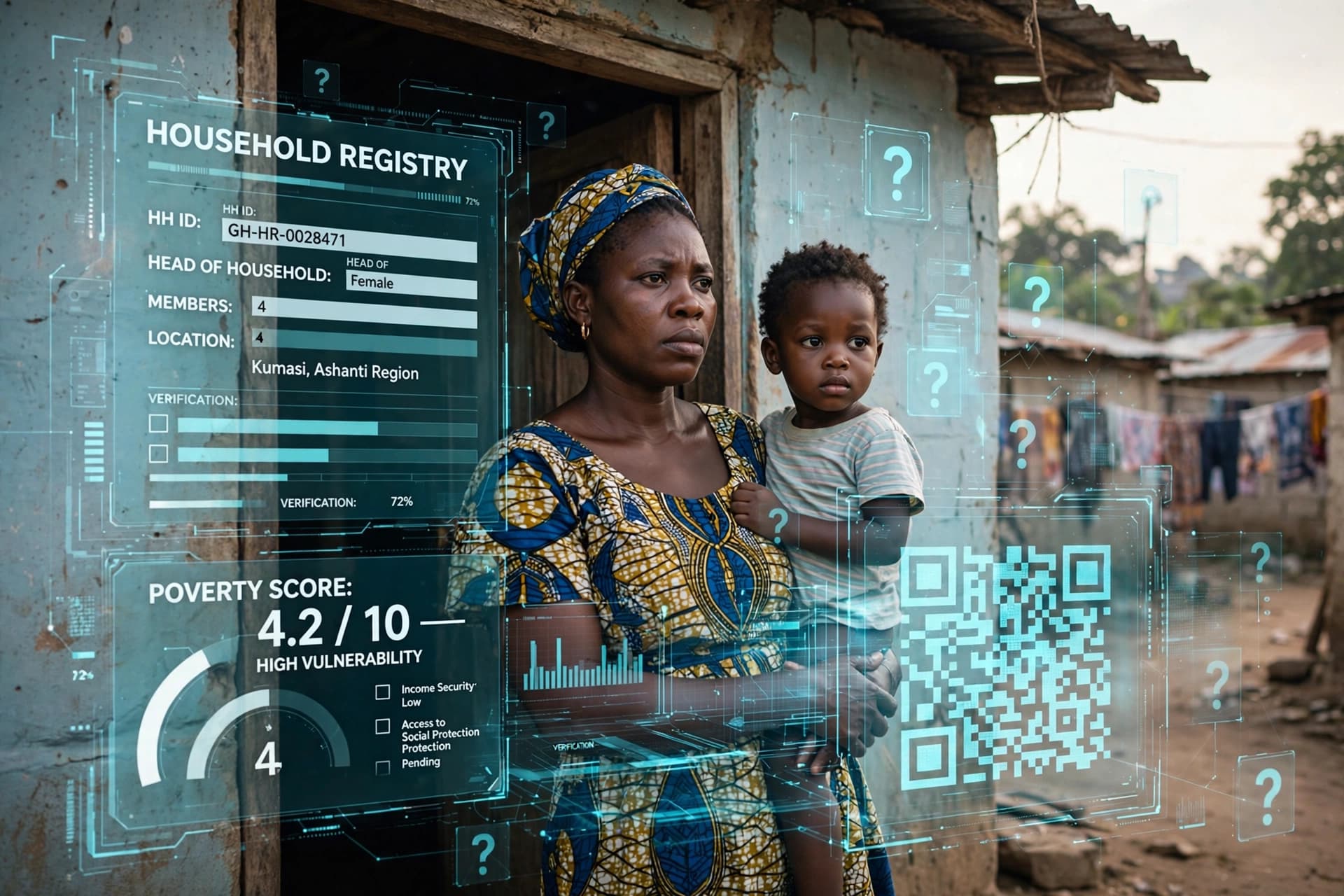
Accra, Ghana, November 3, 2026: A household can own a television and still struggle to afford food. A woman can live in a house with a regular income and have no control over the money coming into it. A family that was financially stable when its information was collected can lose its main source of income months later.
These circumstances are not always easy to capture in a questionnaire or translate into a poverty score. Yet they matter when governments use household information to determine who should receive social protection.
Ghana's approach to identifying poor and vulnerable households increasingly depends on the Ghana National Household Registry (GNHR), a national database established to provide a common reference point for social protection programmes.
The Registry now holds information on nearly three million households across the country's 16 regions. Its growing importance makes a recent decision by the Ministry of Gender, Children and Social Protection particularly significant.
The Ministry has constituted and sworn in a Data Review Committee to examine, validate and endorse analytical reports and findings generated from the Registry before they are shared with government institutions, development partners and the public.
The committee is expected to check the accuracy, consistency, completeness and reliability of the data, identify methodological gaps and recommend corrective action.
The establishment of this committee is a welcome development. A national database that informs public policy requires rigorous quality assurance. But the question Ghana must confront goes beyond whether its statistical outputs are technically sound.
It is whether the information accurately represents the circumstances of the people whose access to public assistance may depend on it.
A database is becoming central to social protection
The GNHR was launched in 2015 as part of efforts to improve the identification and targeting of poor and vulnerable households. Its purpose was to reduce fragmented beneficiary identification systems and provide social protection programmes with a common source of household information.
According to the Ministry of Gender's description of the Registry , it uses a common Proxy Means Test (PMT) methodology to support the identification of potential beneficiaries.
The GNHR's official website explains that its methodology was developed using data from the Ghana Living Standards Survey 7 (GLSS 7), conducted in 2016/17.
The Registry collects information about household members, living conditions and socioeconomic characteristics. These indicators are used to estimate household welfare and classify households into different categories.
This approach offers an administrative advantage. Instead of requiring every social protection programme to build an entirely separate database, government institutions can draw on a shared information system.
The potential benefits include reduced duplication, improved coordination, more consistent beneficiary identification and better planning.
However, the Registry's importance has changed with the introduction of the Social Protection Act, 2025 (Act 1148).
Sections 10 to 13 of the Act establish the National Household Registry and set out its functions. Section 12 requires social protection interventions and programmes to identify beneficiaries from the Registry, while retaining the eligibility criteria of individual programmes.
This is an important distinction. Being registered does not automatically make a household eligible for every intervention. Programme-specific criteria still apply. However, the Registry is now the statutory starting point for beneficiary identification.
The Act therefore gives the quality of the information held by the GNHR much greater significance.
A database that once primarily supported coordination and targeting has become central to the legal architecture of social protection delivery.
The problem with measuring poverty through proxies
The Proxy Means Test is designed to estimate a household's economic position using characteristics that can be observed and recorded.
It is particularly useful where informal employment, irregular earnings and the absence of reliable income records make conventional means testing difficult.
But a proxy is not the same as a household's actual financial circumstances.
A household's assets, housing materials, access to services and other characteristics may provide useful indications of its economic position. They cannot necessarily establish whether the household can meet its daily needs or respond to an unexpected crisis.
This is not an argument against the PMT. It is an argument for recognising its limitations.
Research conducted in Ghana has previously demonstrated why the choice of poverty assessment method matters.
A 2010 study by Genevieve Aryeetey and colleagues, published in Tropical Medicine & International Health, examined different approaches to identifying poor households for National Health Insurance Scheme premium exemptions.
The researchers compared means testing, proxy means testing and participatory wealth ranking in urban, rural and semi-urban settings.
Their findings showed considerable differences in errors of inclusion and exclusion across the methods and locations studied. The PMT's exclusion errors ranged from 46 to 63 per cent in the study settings, while inclusion errors ranged from 21 to 36 per cent.
These findings came from a relatively small study conducted for a particular health insurance targeting exercise in 2010. They should not be presented as evidence of the current GNHR's error rate. The Registry's present methodology and coverage require their own independent assessment.
However, the research remains relevant to a wider policy question: no targeting method should be treated as infallible simply because it uses standardised indicators.
A more recent study examining machine learning-based proxy means testing for water subsidies in Ghana also illustrates the importance of examining different targeting approaches. It found differences in performance, implementation costs and stakeholder perceptions when comparing proxy means testing with community-based approaches.
The lesson is that the effectiveness of a targeting system must be assessed against the realities of the people it is intended to reach.
The cost of getting household information wrong
Errors in a national household registry can have consequences beyond inaccurate statistics.
Consider a household whose circumstances change after data collection. A breadwinner loses employment, a family member develops a disability or a household takes on additional care responsibilities.
If the information held by the Registry does not reflect these changes, the household's recorded welfare position may no longer correspond to its current circumstances.
There are two broad risks in poverty targeting.
An exclusion error occurs when someone who meets a programme's eligibility requirements is left out. An inclusion error occurs when someone who does not meet those requirements is included.
Both matter, but their consequences are different.
An inclusion error can affect the efficient use of limited public resources. An exclusion error can leave an eligible household without assistance it needs.
For a family experiencing severe deprivation, being incorrectly classified or overlooked can mean losing access to support that might help meet basic needs.
This is why the quality of a social protection database cannot be judged solely by the number of records it contains.
The World Bank's research on social protection targeting recognises the wider challenges governments face in designing systems that identify and reach vulnerable populations.
Ghana needs to assess not only whether its Registry captures household information but also whether its targeting approach identifies eligible households fairly across different geographical, economic and social circumstances.
Five years is a long time for a household's circumstances to change
There is another issue that deserves attention: how frequently household information is updated.
Section 11 of the Social Protection Act, 2025 provides for the National Household Registry to update its data every five years, in line with the Ghana Living Standards Survey and other relevant indicators.
The provision creates a statutory update cycle, but household circumstances do not change according to a five-year timetable.
A family may experience unemployment, illness, bereavement, displacement, a change in household composition or an unexpected financial shock between formal updates.
The question is not necessarily whether the entire national database should be collected again every year. That would have substantial financial and administrative implications.
Rather, Ghana needs to make clear how changes in individual household circumstances can be reported, verified and reflected in the Registry between the scheduled updates.
The GNHR describes its data collection approach as involving community engagement, household verification and quality assurance. Its published information on the Registry also refers to community-driven data collection and public verification.
These are useful safeguards, but the public also needs accessible information about what happens after the initial collection.
Can a household request a correction? Can a family report a change in its circumstances? How quickly are those changes assessed? Can an individual challenge a decision influenced by information they believe is inaccurate?
These are not minor administrative questions. They are central to making a national social protection system responsive to the people it serves.
Why gender must be part of the data conversation
For Gender Lens Africa, one of the most important questions is whether the Registry's approach adequately captures inequalities within households.
Poverty is frequently assessed at household level, but resources and decision-making power are not necessarily shared equally among household members.
A woman may live in a household with property, assets and a regular income but have little control over any of them.
She may also undertake unpaid care work, support children and older relatives, or depend financially on a partner who controls household resources.
A household-level poverty classification may not fully reveal these differences.
The issue becomes particularly important when considering women experiencing domestic abuse, economic dependence, disability or other forms of exclusion.
A woman may technically belong to a household that is not classified as extremely poor while having very limited access to the resources available within it.
This is not evidence that the GNHR's current model necessarily fails to account for these experiences. The publicly available information does not establish the extent to which its PMT indicators capture intra-household inequalities.
That is precisely why greater methodological transparency matters.
The Ministry should make clear whether the Registry's indicators account for household composition, disability, care responsibilities, women's access to resources and other factors that can shape vulnerability.
It should also explain how the model handles households in which the economic circumstances of individual members differ significantly.
A gender-responsive social protection system cannot assume that the economic position of a household automatically reflects the welfare of every woman, child or person with a disability living in it.
Data protection is not separate from social protection
The Registry contains information about millions of people. This makes privacy, security and responsible data-sharing essential to its credibility.
The Data Protection Act, 2012 (Act 843) provides an important legal framework.
Section 26 requires data controllers to ensure that personal information is complete, accurate, up to date and not misleading, having regard to the purpose for which it is processed.
Sections 32 and 33 provide for individuals to access and request the correction of personal information held about them.
Section 35 also addresses the information that data controllers must provide to data subjects and the logic behind decisions based solely on automated processing where those decisions significantly affect an individual.
These provisions are particularly relevant to a registry that supports decisions about access to public assistance.
People should understand what information is collected about them, why it is needed, who may receive it and how it is used.
They should also have meaningful ways to exercise their rights when information is inaccurate or has been used improperly.
The Ministry's responsibility is not limited to securing a database against unauthorised access. It must also ensure that the information is handled lawfully, that data-sharing arrangements are properly governed and that people are not left without recourse when something goes wrong.
The Data Review Committee must be more than a technical formality
The Ministry's decision to constitute a Data Review Committee is an important development.
Its stated responsibilities include reviewing analytical reports, identifying methodological gaps, recommending corrective measures and providing guidance on data-sharing protocols and analytical tools.
These functions can strengthen confidence in the Registry's findings.
However, a distinction must be made between reviewing analytical outputs and auditing individual household records.
The committee's announced mandate focuses on the former. It should not automatically be assumed that it will handle individual complaints, determine beneficiary eligibility or independently investigate every household record.
Those functions require clearly defined procedures and institutional responsibilities.
The public also needs to know who serves on the committee, what expertise its members bring, how conflicts of interest are managed and whether its recommendations will be published.
If the committee is to improve public confidence, its work should be visible beyond the meetings at which members are sworn in.
There should be a clear record of the standards it applies, the methodological concerns it identifies and the corrective action taken by the Registry.
An independent evaluation of the PMT methodology would also help establish how accurately it identifies poor and vulnerable households across Ghana's different regions and population groups.
The results should be disaggregated where appropriate, including by sex, disability, household composition and geographical location.
This would allow government and researchers to identify patterns that aggregate national figures might conceal.
What Ghana should do next
The establishment of the committee provides an opportunity to strengthen the Registry beyond the quality of its statistical outputs.
Four priorities deserve attention.
Publish the methodology and its limitations. The GNHR should make accessible information about its PMT indicators, model, validation procedures and performance. Researchers and civil society organisations need sufficient information to understand how household welfare is assessed.
Establish accessible correction and review mechanisms. Households should be able to report changes, challenge inaccurate information and seek clarification about decisions that affect their access to assistance. These procedures should be available to people who may face literacy, language, disability or geographical barriers.
Strengthen gender-sensitive measurement. The Ministry should examine whether its methodology adequately reflects women's economic insecurity, unpaid care responsibilities and inequalities within households. Where household-level indicators cannot capture individual vulnerability, complementary assessments may be necessary.
Make quality assurance accountable to the public. The Data Review Committee should publish periodic findings and recommendations, while the Ministry should explain how identified problems are addressed. An independent assessment of targeting accuracy would further strengthen public confidence.
These measures would help move the Registry from being a database that government uses to one whose quality and fairness can also be scrutinised by the people it represents.
The real test is who gets reached
Ghana has made an important investment in building a national household registry. A common information system can improve coordination, reduce duplication and help government plan social protection interventions more effectively.
But a national database is not an end in itself.
Its success should not be measured only by the number of households registered, the number of reports generated or the speed at which information can be shared between institutions.
It should also be measured by whether eligible households are identified, whether changing circumstances are recognised, whether personal information is protected and whether people can challenge errors that affect them.
The Data Review Committee has an opportunity to strengthen the credibility of the GNHR. Its work should be accompanied by transparency, independent scrutiny and a commitment to making the system responsive to the realities of the people it is intended to serve.
When a household registry becomes central to access to public assistance, data quality becomes a matter of social justice.
The numbers must be right. But the people behind the numbers must not become invisible.