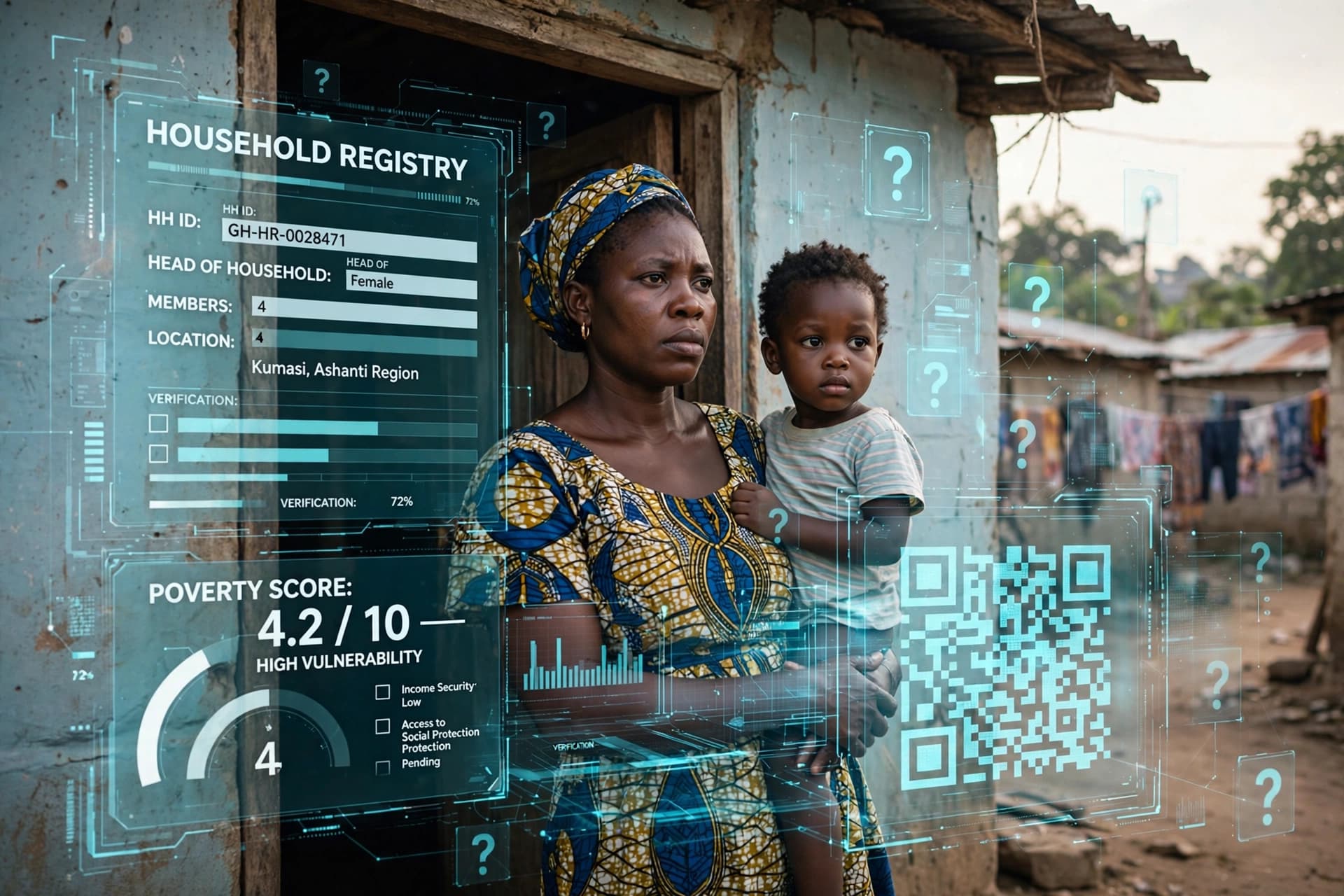

Accra, Ghana 23 October,2026: A message arrives from an unknown account. The sender says he holds your private photographs and wants money. Or you find that images you sent a partner are in a group chat. Or strangers repeat threats under every post you make.
Ghana's Cybersecurity Act, 2020 (Act 1038), assented to on 29 December 2020, creates specific offences for some of this abuse. It does not cover every insult or dispute online. This explainer sets out five forms of abuse, the section that may apply to each and the first steps to take.
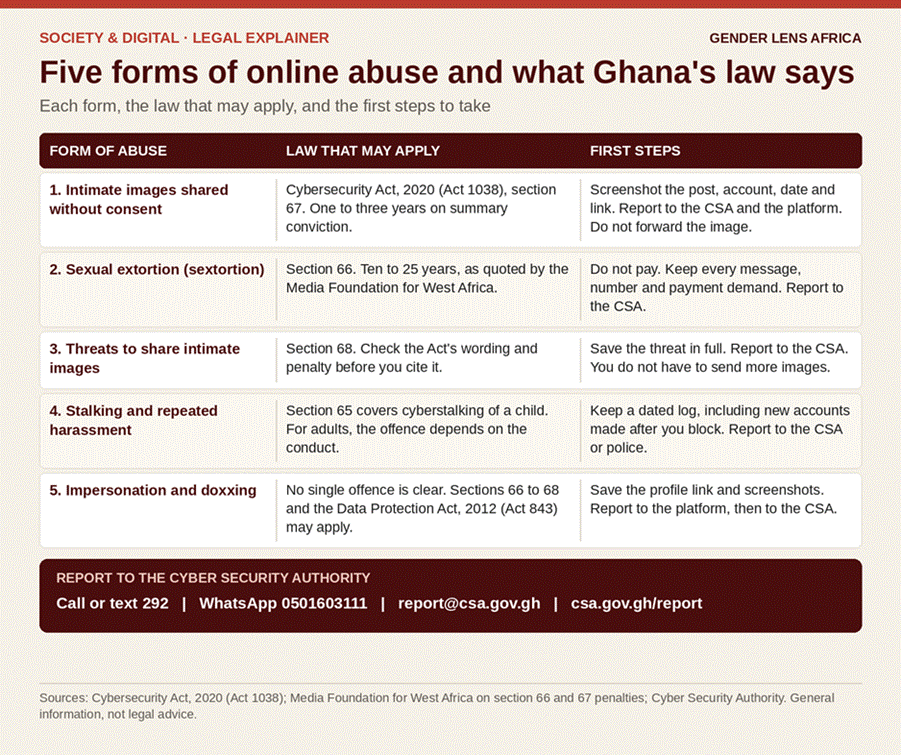
Graphic: five forms of online abuse, the law that may apply and first steps. Gender Lens Africa.
Intimate images shared without consent
Section 67 makes it an offence to share, or cause another person to share, an intimate image or recording of an identifiable person without consent. The penalty on summary conviction is one to three years in prison, according to the Media Foundation for West Africa (MFWA). The offence has conditions, including a reasonable expectation of privacy, so whether a case fits depends on the facts.
That the first sharing was private does not give the recipient the right to pass the image on. Government has said the same about circulation. A minister's statement on a widely reported case warned that anyone who shares, downloads or circulates such content may face prosecution under the Act.
Sexual extortion
Section 66 covers sexual extortion, where someone uses threats of exposure to coerce money, images or sex. The MFWA quotes the penalty as 10 to 25 years on summary conviction. It reported that an Accra court jailed a phone repairer for 14 years: 12 for sexual extortion and two for non-consensual sharing.
Do not pay. Payment tends to bring more demands. Keep every message, number and payment request, then report to the CSA. You do not have to send further images to prove anything.
Threats to share intimate images
Section 68 makes it an offence to threaten to distribute an intimate image or recording. A threat can be an offence before any image appears. Read the section's wording and penalty in the Act before you cite it. We have not confirmed the penalty.
Save the threat word for word, with the date, time and account. Report it. Take any threat tied to a place, a time or a planned meeting seriously and prioritise your physical safety.
Stalking and repeated harassment
Section 65 covers cyberstalking of a child, in cases where identifying information is used to arrange a meeting for sexual activity. It is not a general offence for adult victims. Repeated unwanted contact, new accounts after blocking and threats to people around you are serious. Which law applies depends on the conduct. Threats, extortion or sexual images may fall under sections 66 to 68, and threats may also fall under the Criminal Offences Act, 1960 (Act 29).
Keep a dated log. Record each new account made after you blocked the last one. Report the pattern, not only the latest message, to the CSA or the police.
Impersonation and doxxing
A fake account in your name, or a post with your phone number and address, can bring harassment to your door. We found no single section that covers all of this. Sections 66 to 68 may apply if the account is used to threaten you or share intimate images. The Data Protection Act, 2012 (Act 843) may apply to organisations that disclose your personal data.
Save the profile link and screenshots. Report the account to the platform and ask for removal. Then report to the CSA. Section 87 of the Act deals with blocking, filtering and takedown of illegal content, which gives the CSA a route to act on content online.
How to keep evidence safely
•Screenshot the post or message with the account name, date and time, and copy the link.
•Keep the original files and chats. Do not delete the conversation, even if it hurts to see it.
•Do not forward an intimate image to prove your case. Describe it in your report instead.
•Change passwords, turn on two-factor authentication and review privacy settings.
•Ask a trusted person to hold copies of the evidence.
Where to report
The CSA takes reports 24 hours a day: call or text 292, send a WhatsApp message to 0501603111, email report@csa.gov.gh or use the online reporting page. Reporting to a platform does not replace a report to the CSA or the police. If you are in danger now, contact emergency services first.
Two limits of the law
Not every cruel message is a crime, and an offence needs its elements proved. Many cases fail because the evidence was deleted or the account cannot be traced. A 2025 amendment bill reportedly proposes new offences, including cyberbullying, so check whether the Act has changed before you cite a section.
The public also has a part. Sharing, forwarding or joking about an intimate image deepens the harm, and the minister's warning shows it can be a crime.
Sources and further reading
Business & Financial Times: key sections of the Cybersecurity Act, 2020 (sections 62 to 66) and part two (sections 67, 68 and 87).
Media Foundation for West Africa: justice for victim of sexual extortion, with section 66 and 67 penalties.
Ghanaian Times: minister vows crackdown on cybercrime against women.
Starr FM: understanding sextortion in Ghana.
Cyber Security Authority: incident reporting.
Parliament of Ghana repository: Cybersecurity Act, 2020 (Act 1038).
Rights for Life and Development: Act 1038 and image-based sexual abuse.