Accra, Ghana, October 29, 2026: When Arno Yafunga Botay was six years old, his family fled the Democratic Republic of Congo after threats to his father's life culminated in an attack on their home. His baby sibling, just seven months old, died in the attack.
The family eventually settled in Nairobi, Kenya, after spending time in Kakuma refugee camp. It was there, in a new country and a life shaped by displacement, that Arno's interest in judo began to grow.
He watched his father, Arnold, practise the sport and asked him to teach him. At seven, he began learning its rules and techniques. Nine years later, the 15-year-old is preparing to compete on an international stage as a member of the Refugee Olympic Team at the Dakar 2026 Youth Olympic Games.
His journey has not been straightforward. Arno told BBC Sport Africa that he struggled to afford a judo uniform and transport to local competitions. School fees were also a challenge for his family.
Then came the news that he had been selected for the team.
“I didn't expect to be selected,” he told the BBC. “I was so excited. I was crying tears of joy.”
For Arno, Dakar is more than a sporting competition. It is an opportunity to represent a community too often defined by the circumstances that forced its members to leave home.
“As a refugee, we have a right to compete,” he said. “A refugee is a human being like other people.”
Six young athletes, one historic team
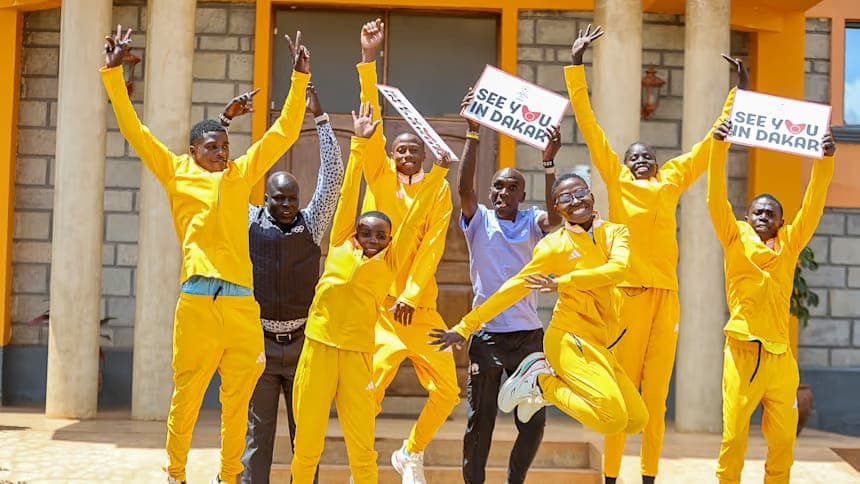
Arno is one of six athletes who will represent the Refugee Olympic Team at Dakar 2026, which opens on 31 October and runs until 13 November in Senegal.
For the first time, a Refugee Olympic Team will compete at the Youth Olympic Games. It is also the first time an Olympic sporting event will be held on African soil.
The six athletes, all based in Kenya and Uganda, will compete in athletics, judo and taekwondo. The team has three young women and three young men, with equal representation across genders.
They are:
Arno, 15, competing in men's judo in the under-55kg category, hosted by Kenya.
Clement, 16, competing in the men's 800 metres, hosted by Kenya.
Florence, 16, competing in the women's 200 metres, hosted by Uganda.
Lourance, 16, competing in women's taekwondo in the under-49kg category, hosted by Kenya.
Nyataba, 17, competing in the women's 800 metres, hosted by Kenya.
Rachid, 16, competing in the men's 200 metres, hosted by Uganda.
Their selection followed trials in Kenya and Uganda. According to the International Olympic Committee (IOC), two athletes were identified through Game Connect, a community sports programme funded by the Olympic Refuge Foundation in Uganda.
The team has since gathered at a training camp in Kaptagat, Kenya, where the athletes prepared together for the competition. It was the first time all six had met in one place, as they usually live and train in different locations.
They also received mentoring from Kenyan Olympic champion Eliud Kipchoge. For young athletes who have had to navigate displacement alongside the demands of training and competition, access to coaching, preparation and a team environment can make a meaningful difference.
The cost of pursuing a dream
Arno's story offers a glimpse into the challenges that can sit behind an athlete's performance. Talent alone does not guarantee the chance to compete. Athletes need equipment, transport, training facilities, coaching, education and the means to meet everyday expenses.
For a young person who has been displaced, these demands can become even harder to manage.
Arno told the BBC that his family struggled with school fees and that he lacked the money for a judo uniform and transport to competitions. These are not simply sporting inconveniences. They affect a young person's ability to continue training, attend school and develop a future beyond immediate uncertainty.
The opportunity to compete in Dakar has come through a support system that connects refugee athletes with sporting pathways. The Olympic Refuge Foundation, national Olympic committees and sports organisations have helped create opportunities for the six athletes to train and prepare for the Games.
But a place on a team is one stage in a much longer journey. Young athletes need sustained support if they are to keep progressing after the competition ends. The same applies to other displaced children who may have the ability and interest to participate in sport but lack access to the resources needed to develop their skills.
A historic appearance at the Youth Olympic Games matters. So does what happens when the athletes return home.
More than a medal
The athletes are not approaching Dakar without ambition.
Clement, the team's 16-year-old 800-metre runner and captain, told the IOC that he wants to win gold. He also spoke about a longer-term ambition: building a home for orphans where children could be safe and athletes could access proper nutrition.
His plans place sporting success within a wider understanding of responsibility and community. The medal matters, but so does what an athlete might be able to do with the opportunities that follow.
Arno has also spoken about wanting to help other young refugees discover judo. He hopes that if he succeeds in Dakar, he can return to Kakuma and teach children there about the sport.
These ambitions challenge the assumption that refugee young people should be understood only through the loss and disruption they have experienced. They are also students, athletes, teammates and young people making plans for their futures.
Their circumstances matter, but those circumstances do not tell the whole story.
What does inclusion look like after Dakar?
The Refugee Olympic Team has a history at the senior Olympic Games. It was first introduced at Rio 2016, and the team won its first Olympic medal at Paris 2024, when boxer Cindy Ngamba took bronze in the women's 75kg category.
Dakar 2026 extends that opportunity to younger athletes. It offers them an international platform and brings visibility to the experiences of displaced young people, particularly those living in African host countries.
The need is substantial. The United Nations refugee agency, UNHCR, has warned that forced displacement affects millions of children and young people worldwide. Kenya and Uganda are among the African countries hosting refugee populations, including children who must find ways to continue their education and pursue their interests after displacement.
Sport cannot resolve the causes of forced displacement or replace the protection, education, housing and other services that young people need. Nor should a small number of exceptional athletes be taken as proof that every displaced child has equal access to opportunity.
But sport can create a route to connection, routine, confidence and achievement. For that route to remain open, programmes need to reach beyond a few selected competitors and provide safe, accessible opportunities for more young people to participate.
That means asking what happens to the six athletes after Dakar, whether they can continue to access coaching and competition, and how community programmes can help other displaced girls and boys take part in sport. It also means recognising that girls may face additional barriers to participation, including safety concerns, limited resources and unequal access to facilities and training.
The team’s equal representation of young women and men is an important part of its story. Its longer-term significance will depend not only on who gets to compete, but also on whether the pathways that brought these athletes to Dakar remain available to others.
A place on the starting line
When the Games begin, the six athletes will compete alongside young sportspeople from across the world. They will bring their training, their ambitions and the support of the communities they represent.
They will also be competing under a team identity that recognises their refugee status without allowing it to erase their athletic achievements.
Arno has said that he wants to win gold. Clement has spoken about building a safe home for orphans. Arno hopes to use his experience to help other young refugees learn judo.
These are individual ambitions, not a single story of resilience that can stand in for every displaced young person. But they show why the opportunity to compete matters: it allows young people to be seen for what they can do and what they hope to become.
As Dakar prepares to make Olympic history, the Refugee Olympic Team offers a reminder that displacement should not be treated as the end of a young person's ambitions. The challenge is to ensure that the opportunity represented by these six athletes does not end with the closing ceremony.
Displaced, but not defeated, they are going to Dakar as athletes with a right to compete, a place on the starting line and futures that are still being written.