Accra, Ghana, November 21, 2026: Every household knows the moment. The money is not stretching, so something has to go. It might be the extra fish in the soup, the trotro fare or the school excursion.
The question is never only how much is cut. It is what gets cut, and who goes without.
Governments face the same choice on a far bigger scale. When they decide to spend less, economists reach for a word that sounds harsh for a reason. That word is our Monster Word this week: austerity.
In the first two editions, we explained why inflation is the speed, not the price and what happens to the money government collects. This edition asks what happens when government decides to spend less of it.
What exactly is austerity?
Austerity refers to policies that significantly reduce government spending, increase taxes, or combine both, to reduce budget deficits and public borrowing.
These measures can affect public services, social protection, jobs and household incomes. The effects are sharpest when the adjustment falls on people with little financial room to absorb it.
Austerity describes a policy approach. Who ends up carrying its cost is a separate question, and it is the one this explainer keeps returning to.
Four words people treat as one
Politicians, economists and commentators use four terms as if they were interchangeable. They are not.
• Fiscal consolidation is the umbrella term. The World Bank describes it as measures that realign public revenue and spending to stop or reverse the build-up of debt. It can come from cutting spending, collecting more revenue, or both.
• Expenditure rationalisation involves reviewing public spending to reduce waste, duplication and inefficiency, with the aim of delivering the same or better services at lower cost.
• Fiscal discipline means keeping to the spending limits and fiscal rules government has set for itself.
• Austerity is consolidation pursued mainly through significant spending cuts, tax rises or both. It is a policy choice; its effects on households must be measured separately.
Put simply: paying board allowances only for meetings actually held is rationalisation. Reducing the money that feeds a schoolchild is a different kind of decision, with different consequences.
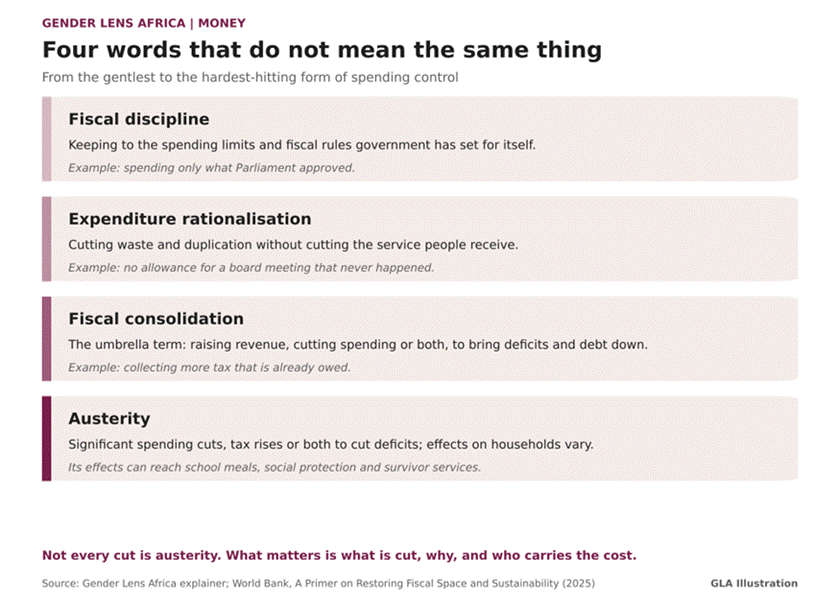
Four terms, four different meanings. GLA Illustration.
Why is the word back in Ghana's conversation?
Two stories have pushed it there this month.
The first is about boards. On 19 November, Okaikwei Central MP Patrick Yaw Boamah asked Parliament to investigate a Finance Ministry directive stopping monthly sitting allowances for board members of state institutions. According to Mr Boamah, the letter, dated 12 October 2026 and signed by a Deputy Finance Minister on behalf of Finance Minister Dr Cassiel Ato Forson, went to more than 164 state-owned enterprises and statutory bodies. GLA has not seen the letter.
Mr Boamah argued that these institutions need regular board meetings to function. He called the directive “a very serious matter that must be looked into by the House.”
The principle is not new. In November 2018, the then Finance Minister Ken Ofori-Atta issued a directive stating that monthly allowances to boards and councils were no longer applicable. Boards were moved to allowances per sitting. The rate reported in that 2018 directive for a Category 1 board chair was GH¢2,500 per meeting; current rates have not been published.
So there are three separate things here: the October 2026 directive Mr Boamah described, the 2018 policy that had already replaced monthly allowances with per-sitting payments, and the open question of how the two relate.
Does the new directive enforce the 2018 rule, reinstate it after boards drifted back to monthly payments, or change it? Does it remove only a monthly retainer while still paying for meetings actually held, or does it also change the rates and conditions for those meetings? And how much does government expect to save? Published reports of the debate carry no response from the Finance Ministry.
The second story is about social protection. The Ranking Member on Parliament's Finance Committee, Dr Mohammed Amin Adam, said allocations for LEAP, the School Feeding Programme and the Capitation Grant fell from GH¢3.46 billion in 2026 to GH¢2.26 billion in 2027, a cut of about 35 per cent under that heading. The 2026 figure matches the “Transfers for Social Protection” line in the 2026 Appropriation Act.
The Finance Ministry disagrees with how that number is being read. Its Coordinating Director (Technical), Samuel Danquah Arkhurst, said the GH¢2.26 billion covers only the programmes listed under that one heading. Other interventions are funded through statutory transfers and ministries, and LEAP benefits are protected by law through inflation indexing, he said.
Both positions deserve scrutiny. We return to them below.
Is the 2027 Budget an austerity budget?
The 2027 Budget does not present an across-the-board spending contraction. On a commitment basis, which counts spending when it is committed rather than when cash is paid out, the full Budget Statement puts 2027 spending at GH¢375 billion. The 2026 Budget set the same measure at GH¢302.5 billion. The Minister's speech used a different measure, GH¢389.2 billion on a cash basis.
Compared with the original 2026 Budget allocation of GH¢302.5 billion, the increase is GH¢72.5 billion. The 2027 Budget Statement, however, uses a revised 2026 projection of GH¢305.5 billion for its year-on-year comparison, putting the increase at GH¢69.5 billion, or 22.8 per cent.
Higher total spending, more capital investment and a smaller surplus target all point to a slower pace of fiscal tightening. But they do not rule out austerity-like effects in particular programmes or services. Section 5 shows where those can appear.
Government has also loosened its main fiscal target. It cut the primary surplus target from 1.5 per cent of GDP in 2026 to 0.5 per cent in 2027. A primary surplus is what is left when revenue exceeds spending before interest payments, a term we unpacked in our budget explainer. A smaller target means less squeeze, not more. The International Monetary Fund has said this looser path is consistent with Ghana's debt goals.
If there was a hard squeeze, it came earlier. Dr Forson has described the adjustment that stabilised the economy as “shock therapy”, noting that government delivered a 2.5 per cent primary surplus in 2025 against a 1.5 per cent target.
Capital spending, money for roads, buildings and equipment, takes centre stage in 2027. This explainer uses the full Budget Statement figure of GH¢98.4 billion, as our budget explainer did. The Minister's speech gave a slightly different headline figure, GH¢100.4 billion. Either way, it is well above the GH¢61 billion set aside for interest.
The 2027 Budget grows overall, but some lines shrink or stand still. GLA Illustration.
Where can austerity hide inside a bigger budget?
A budget can grow and still squeeze particular people. Here are four places to look.
In a single budget line. The 35 per cent fall applies to one social protection heading, not necessarily to all government spending on social protection. The same programmes are also presented under other budget classifications. The speech listed GH¢1.1 billion for LEAP and GH¢2.1 billion for school feeding within the Gender Ministry's GH¢3.4 billion allocation. These figures are classified differently from the GH¢2.26 billion heading, so they are not an alternative total and cannot simply be compared or added up. Government has not yet published one consolidated figure for 2027 social protection spending.
In a number that does not move. SEND Ghana notes that the allocation for free sanitary pads, GH¢292 million, has not changed since 2025. As our inflation explainer showed, the same cedis buy less each year. A frozen allocation loses purchasing power, which is a real-terms reduction. That is not necessarily a deliberate austerity measure, but the effect on the girls who depend on it can be similar.
In money approved but not released. Between January and October 2026, total spending was 7.6 per cent below target. The Integrated Social Development Centre (ISODEC) says primary spending ran 3.4 per cent below target, while the Institute for Fiscal Studies found capital spending fell short by GH¢14.38 billion at mid-year. Underspending can reflect delayed releases, procurement and implementation problems, or deliberate restraint, so it should not automatically be called austerity. But for a shelter waiting on funds, the effect is the same whatever the cause.
In what is left over. SEND Ghana starts from the Gender Ministry's GH¢3.43 billion allocation and deducts LEAP (GH¢1.096 billion), school feeding (GH¢2.095 billion) and staff pay (GH¢134.58 million). By SEND Ghana's calculation, about GH¢100 million, or 2.9 per cent, remains. SEND Ghana says that amount is expected to support the Ministry's other programmes and operations, and warns it could weaken monitoring, coordination, child protection and responses to gender-based violence. A detailed breakdown showing how that balance will be distributed has not been made available in its analysis.
There are increases too. The Domestic Violence Fund rises from GH¢1 million to GH¢10 million, and a new GH¢40 million Social Protection Fund is planned. UNICEF Ghana, however, warns that the LEAP allocation may leave a financing gap of at least GH¢500 million as the programme plans to expand to 470,000 households.
6. What is government's case?
Government's argument starts in 2022. By the end of that year, inflation had reached 54.1 per cent, the primary balance was in deficit and the IMF judged Ghana's debt to be above 100 per cent of GDP.
Provisional public debt stood at GH¢759.3 billion at the end of October 2026, equivalent to 47.5 per cent of GDP. Government wants it at 45 per cent. The GH¢61 billion allocated to interest payments in 2027 shows the scale of government's debt obligations and the competing demands on public resources. It is money that must be budgeted for before government can see how much room remains for other priorities. Controlling waste, including board allowances paid regardless of work done, is part of keeping that bill down.
The Ministry also says LEAP is protected in law through inflation indexing, so its benefits do not depend on a single budget line.
Independent economists accept the stability gains but warn about the limits. Professor Godfred Alufar Bokpin argues that a country with Ghana's infrastructure gaps “could not rely solely on austerity measures” and that deep cuts can slow growth and delay better living conditions.
When government spends less, who picks up the bill?
This is where the gender lens matters most.
Public services provide support that households would otherwise have to provide themselves. When those services become less accessible or less adequately funded, the responsibility does not disappear. It often shifts back into the home.
Globally, women spend 2.5 times as many hours as men on unpaid care work. UN Women also reports that around 45 per cent of working-age women are outside the labour market because of unpaid care responsibilities, compared with five per cent of men. These are global estimates, not Ghana figures.
That pattern is well established. What it means for Ghana in 2027 depends on how these budget decisions play out, so the effects below are potential ones that need tracking with evidence from households and service providers:
• When school feeding is reduced or does not reach children consistently, households may have to absorb extra food costs. In homes where women carry most of the responsibility for feeding children, that adds to their unpaid work.
• If LEAP cannot reach the households waiting to join it, the women who manage those homes may have to absorb the difference.
• If public health services become harder to access, the extra care at home is likely to fall mostly on women, sometimes at the cost of paid work.
• If survivor services are underfunded, women and girls facing violence have fewer places to go.
• If sanitary pad supplies shrink in real terms, girls and their families may have to carry the cost.
UN Women's research on past economic crises found that cuts to health care, school meals and subsidised essentials hit women hardest, because they carry most of the paid and unpaid care work.
Capital spending can help, but not automatically. Roads and factories create jobs. Whether women get those jobs depends on who is hired, trained and paid, and on whether anyone is counting.
So, is Ghana in an era of austerity?
The evidence does not support describing the entire 2027 Budget as an austerity budget. Overall commitment-basis expenditure is increasing, and the primary surplus target is lower than in 2026. Ghana has, however, experienced a period of significant fiscal consolidation, and some expenditure decisions may still produce austerity-like effects.
If the board directive replaces fixed monthly payments with allowances tied to meetings actually held, that would be better understood as expenditure rationalisation or remuneration reform than austerity.
Those effects can be felt inside a growing budget: in lines that shrink, allocations that freeze and releases that never arrive.
Ghanaians will know whether this is discipline or a transfer of hardship by watching a few numbers:
• The actual savings from the board allowance directive, and where that money goes;
• Total 2027 social protection spending, including statutory funds and ministries;
• Quarterly releases to LEAP, school feeding, the Capitation Grant and the Domestic Violence Fund;
• How many beneficiaries are reached, and whether payments keep pace with prices;
• Jobs created under the New Economy programme, counted by sex.
Fiscal discipline is not the enemy. Debt that swallows the budget hurts the poorest first. The test is whether the savings are real, fairly shared and delivering results.
When government decides to spend less, the question that matters most is simple: whose lives become more expensive?
A cut is a choice. So is who carries it.