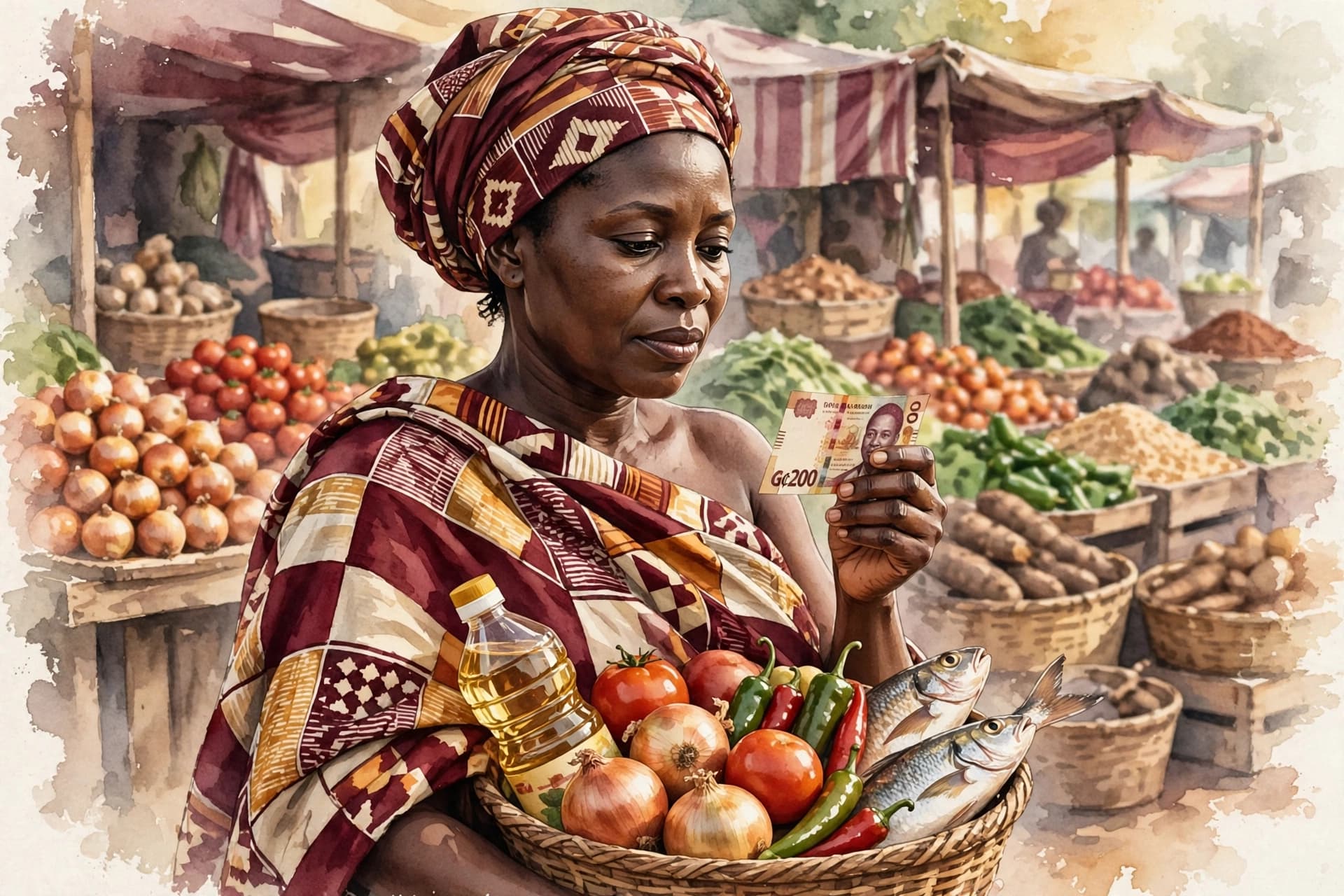
Accra, Ghana, November 7, 2026: Imagine walking into a market with GH¢200 to buy groceries for your household. You have tomatoes, onions, pepper, cooking oil, fish and a few other essentials on your list.
You return home with fewer items than you intended to buy. Some prices have increased, and you have had to adjust your shopping.
Later, you hear an announcement that Ghana’s inflation rate has fallen to 5.5 per cent.
You might reasonably ask: If inflation is falling, why does my GH¢200 still buy so little?
This question has become increasingly common in Ghana’s public conversation about the economy. Political arguments have emerged around comparisons between the inflation rates recorded under the previous New Patriotic Party (NPP) administration and the figures being announced under the current National Democratic Congress (NDC) government.
Supporters of the NDC point to the significant reduction in inflation from the levels recorded in 2022. Critics argue that electricity, food, transport and other essentials remain expensive despite the improvement in the headline figure.
Both sides are raising issues that deserve attention. But to understand the debate, we must first understand what inflation measures.
The simplest way to explain it is this: Inflation is the speed at which prices increase, not the price itself.
What exactly is inflation?
Inflation is the rate at which the general prices of goods and services increase over a period of time. It is not simply the increase in the price of one product.
Economists measure it by tracking changes in the prices of a range of goods and services that households typically buy. The International Monetary Fund (IMF), in its explainer Inflation: Prices on the Rise, describes consumer price inflation as the percentage change in the Consumer Price Index (CPI) over a given period.
Think of a bag of rice that costs GH¢100.
If its price increases to GH¢120, it has gone up by 20 per cent. If the following year it increases by another 10 per cent, it now costs GH¢132. If it increases by a further 5 per cent the year after, it costs GH¢138.60.
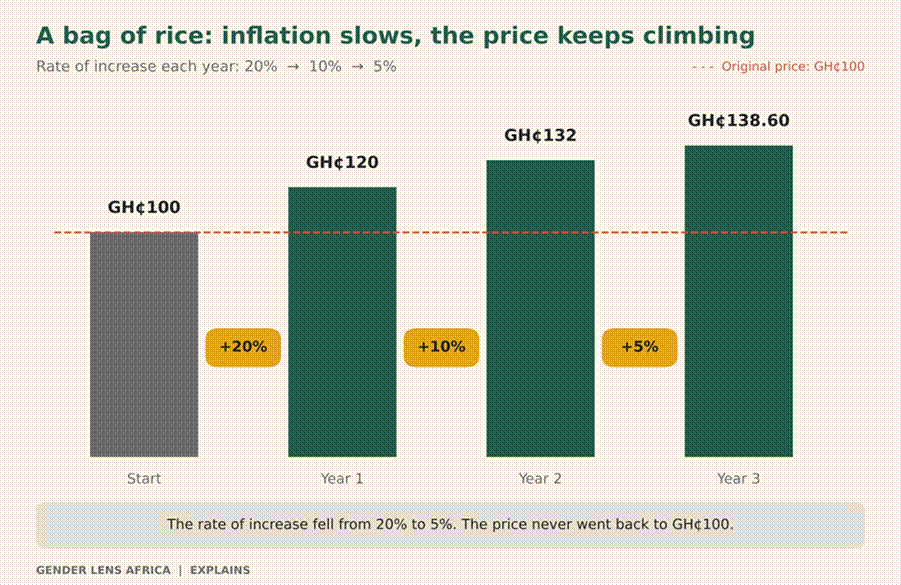
Notice what has happened. The rate of increase has slowed from 20 per cent to 10 per cent and then 5 per cent. But the price has not returned to GH¢100. It has continued to rise, only at a slower rate.
That is the difference between inflation and the price level.
When Ghana reports inflation of 5.5 per cent, it means the average price level measured by the CPI is 5.5 per cent higher than it was in the same month a year earlier. It does not mean that prices have fallen by 5.5 per cent, or that goods are now 5.5 per cent cheaper.
The distinction matters because people often hear that inflation has fallen and understandably expect to see lower prices in the market. But a fall in inflation usually means prices are increasing more slowly, not that previous price increases have been reversed.
How does Ghana calculate inflation?
The Ghana Statistical Service (GSS) measures consumer price changes using the Consumer Price Index.
To do this, it tracks the prices of a representative selection of goods and services consumed by households. These include food, housing, transport, clothing, utilities, health, education and other everyday expenses.
The items are not all given equal importance. Their weights reflect how much households spend on different categories. A change in the price of a category that accounts for a large share of household expenditure can therefore have a different effect on headline inflation from a change in a less heavily weighted category.
The October 2026 CPI report covered 307 items, collected from 8,337 outlets across 57 markets and 13 divisions of spending, according to the GSS.
This is important because the headline inflation rate is an average. It does not mean that every product has increased in price by the same percentage. It also does not mean every household experiences inflation in exactly the same way.
A household that spends a large share of its income on food may feel food price increases more sharply than a household whose spending is weighted towards other goods and services. A person who relies on public transport may experience changes in transport costs differently from someone who owns a car.
The national figure gives us an important picture of the overall direction of prices. It cannot tell the complete story of every household’s budget.
You can explore the figures and reports through the Ghana Statistical Service inflation portal.
Why compare 2022 with 2026?
The political debate around inflation has often focused on the contrast between October 2022 and October 2026.
The comparison is legitimate because both figures represent year-on-year inflation for October. But looking at only two points in time can leave out important parts of the story.
Ghana’s headline inflation rate moved through the following October figures:
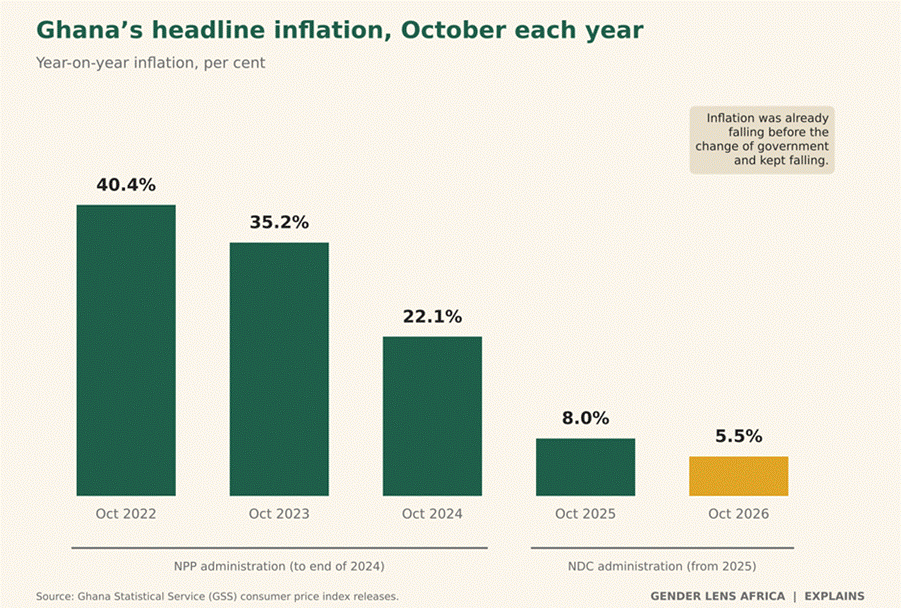
The figures come from Ghana Statistical Service releases, including those for October 2023, October 2025 and October 2026.
The figures show a substantial decline over the period. They also show that inflation had begun falling before the NPP left office at the end of 2024. The reduction continued under the NDC administration.
The wider timeline matters. It would be misleading to suggest that inflation remained at its 2022 peak throughout the NPP administration. It would also be misleading to ignore the continued reduction recorded after the change of government.
There is another important detail. Ghana’s inflation rate reached 54.1 per cent at the end of 2022, according to the IMF. That was a severe period of economic pressure, but it is not the same figure as the 40.4 per cent recorded in October 2022. One refers to December and the other to October.
For women who could no longer afford tomatoes, cooking oil or other essentials during the 2022 cost-of-living crisis, the situation was not an abstract statistic. It meant changing meals, buying less and sometimes going without.
The NPP should be assessed for the economic crisis that unfolded during its tenure, as well as the measures taken and the progress made before it left office. The NDC should be assessed for the policies it has pursued since taking office and whether the gains in economic stability are translating into better living conditions.
Neither assessment should be reduced to a single inflation figure.
If inflation is falling, why are prices still high?
This is perhaps the most important question for households.
The answer lies in the cumulative effect of inflation.
When prices increase year after year, each new increase is applied to a price that may already have risen. The result is that the cost of goods can remain substantially higher even after inflation has slowed.
Return to the rice example. The rate of increase has slowed, but the rice still costs GH¢38.60 more than it did at the beginning of the example.
For the price to return to GH¢100, there would have to be a sustained fall in the price level. Economists call a general and sustained decline in prices deflation.
That is different from disinflation, which is what happens when inflation slows down.
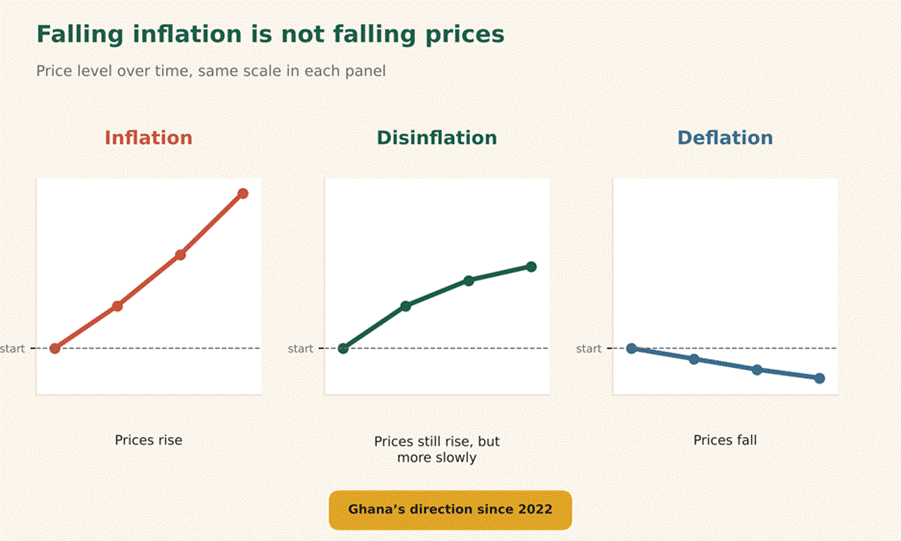
Ghana has experienced a substantial reduction in inflation. That is an improvement in the rate at which prices are rising. It does not automatically undo the increases that households have already absorbed.
This is why a person can acknowledge that inflation has improved and still say that life remains expensive. Those two statements are not contradictory.
Three inflation figures people should not confuse
Part of the public confusion comes from the fact that inflation can be reported over different periods.
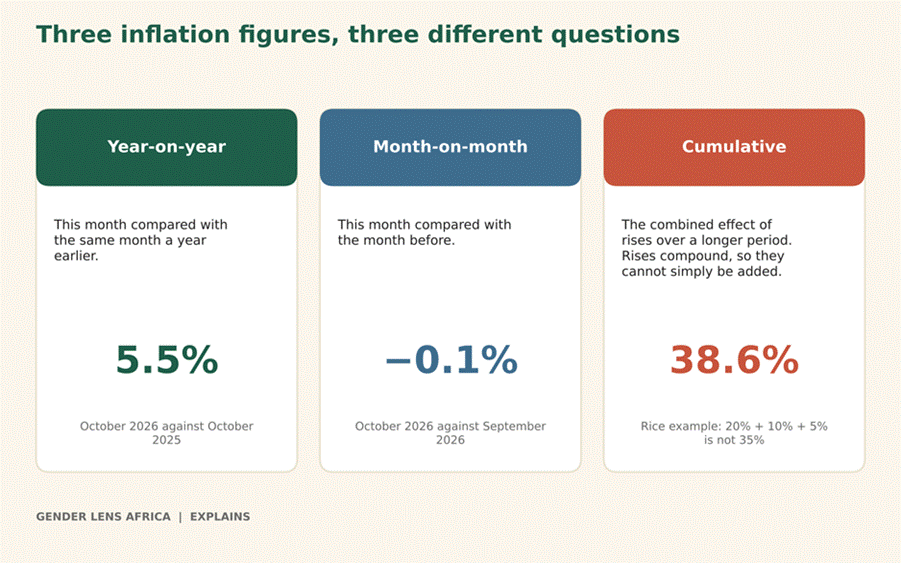
Year-on-year inflation compares the general price level in a particular month with the same month in the previous year. Ghana’s October 2026 headline inflation rate of 5.5 per cent is a year-on-year figure.
Month-on-month inflation compares the price level in one month with the preceding month. The GSS reported that the overall price level declined by 0.1 per cent between September and October 2026.
This does not mean prices were lower than they were in October 2025. It means the measured overall price level was slightly lower in October than in September.
Cumulative inflation describes the combined effect of price increases over a longer period. These increases compound. They cannot simply be added together when calculating the total change.
Understanding these distinctions helps explain how Ghana can record a negative month-on-month change while still reporting positive year-on-year inflation.
It also helps explain why a headline inflation rate can fall over a year even when some individual products become more expensive.
Why can some prices rise while headline inflation falls?
Because the headline figure is an average, prices do not all move in the same direction.
Food prices may rise while prices in another category fall. Transport costs may increase while some household goods become cheaper. The overall inflation rate reflects the combined movement of the different categories, taking their weights into account.
This is particularly important in Ghana, where food prices can be affected by seasonal supply, rainfall, transportation costs, storage, production expenses and disruptions in the movement of goods from farms to markets.
A poor harvest or a shortage of a particular crop can push up its price even when the overall inflation rate is relatively low.
The reverse can also happen. A better harvest or improved supply may reduce the price of some food items.
The price of electricity is another example of why individual costs should not be explained by headline inflation alone. Electricity tariffs are influenced by regulatory reviews and factors such as generation costs, fuel prices and exchange-rate movements. A change in the general inflation rate does not automatically translate into an equivalent change in electricity bills.
For households, the distinction is practical. A lower headline inflation rate does not guarantee that every item on the shopping list will become cheaper.
What causes inflation in the first place?
There is no single explanation for inflation. It can result from several pressures operating at the same time.
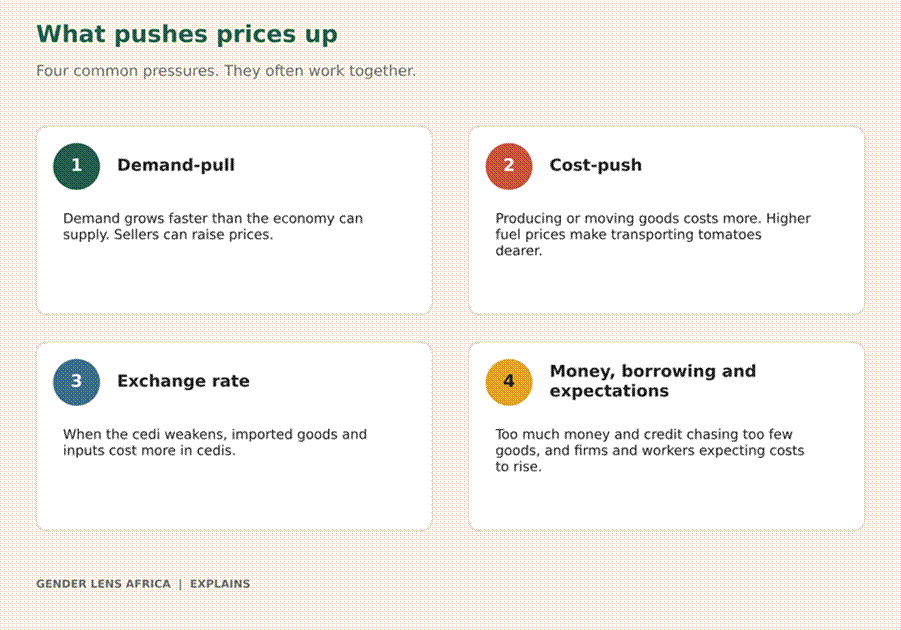
One is demand-pull inflation. This happens when demand for goods and services grows faster than the economy’s ability to supply them. If more people are trying to buy a limited quantity of a product, sellers may increase prices.
Another is cost-push inflation. This occurs when the cost of producing or distributing goods increases. For example, higher fuel prices can raise the cost of transporting tomatoes from a farming community to an urban market. Businesses may pass some of those higher costs on to consumers.
Exchange-rate movements can also matter. When the cedi loses value against major foreign currencies, imported goods and inputs can become more expensive in local currency. This can affect food, medicines, fuel-related costs, machinery and materials used by local businesses.
Monetary and fiscal conditions also influence inflation. If money and credit expand too quickly relative to the goods and services available, demand can put pressure on prices. Government borrowing, spending and the financing of deficits can also affect economic conditions, particularly where central bank financing contributes to excess liquidity.
Expectations matter too. If businesses expect their costs to rise, they may increase prices in anticipation. Workers may seek higher wages to keep up with living costs, while businesses may adjust prices in response to higher wage bills.
These factors can interact. A currency depreciation can raise import costs; higher fuel prices can increase transport costs; and poor food supply can push up market prices. Understanding inflation therefore requires looking beyond one policy decision or one political administration.
What does the IMF say about Ghana’s recovery?
The IMF’s August 2026 assessment of Ghana provides a useful institutional account of the country’s recent economic stabilisation.
In its 2026 Article IV Consultation and Sixth Review under the Extended Credit Facility, the Fund reported that inflation had declined from a peak of 54.1 per cent at the end of 2022 to 5.4 per cent at the end of 2025.
The IMF attributed the broader stabilisation to a combination of fiscal consolidation, monetary policy credibility, the rebuilding of international reserves, progress on debt restructuring and renewed confidence in the cedi. It also noted that historically high gold prices supported reserve accumulation and exchange-rate stability.
This is an important part of the story because the economic recovery did not begin with one administration or one policy announcement.
Ghana’s Extended Credit Facility programme with the IMF was approved in May 2023, during the NPP administration. The programme was designed to help restore macroeconomic stability and debt sustainability through fiscal adjustment, debt restructuring, monetary and exchange-rate policies, and structural reforms. It continued through subsequent reviews after the change of government.
The IMF also identifies weaknesses that Ghana must address. Its 2026 assessment points to risks in the financial sector, fiscal pressures linked to state-owned enterprises and concerns about the sustainability of an adjustment that relies heavily on spending restraint.
The assessment is therefore not a declaration that Ghana’s economic problems have disappeared. It recognises significant progress while identifying vulnerabilities that remain.
That distinction is worth keeping in mind. Economic stabilisation is necessary, but it is not the same as ensuring that every household can afford its basic needs.
What role does the Bank of Ghana play?
The Bank of Ghana uses monetary policy to influence inflation and broader economic conditions.
One of its main tools is the Monetary Policy Rate. This is a key rate that influences the cost of borrowing and lending across the financial system.
When the Bank raises its policy rate, borrowing can become more expensive. This can discourage some spending and investment, reduce pressure on demand and help bring inflation down over time.
When inflation is falling and economic conditions allow, the Bank may reduce the rate to ease borrowing conditions and support economic activity.
But monetary policy involves trade-offs. Higher interest rates can help contain inflation, but they can also make loans more expensive for businesses and households. Lower rates may support borrowing and investment, but if reduced too quickly they can create renewed pressure on prices and the currency.
The IMF’s 2026 assessment noted that the Bank of Ghana had begun easing its monetary policy stance as inflation declined. It also stressed the importance of keeping future decisions prudent and responsive to economic conditions.
Monetary policy is one part of the response to inflation. It cannot, on its own, resolve every supply problem, reduce every transport cost or guarantee lower prices for food.
What does all this mean for women and household incomes?
This is where the discussion moves beyond economic indicators.
For many households, the real question is not simply whether inflation has fallen. It is whether income can now cover the cost of food, transport, rent, utilities, healthcare, education and other essentials.
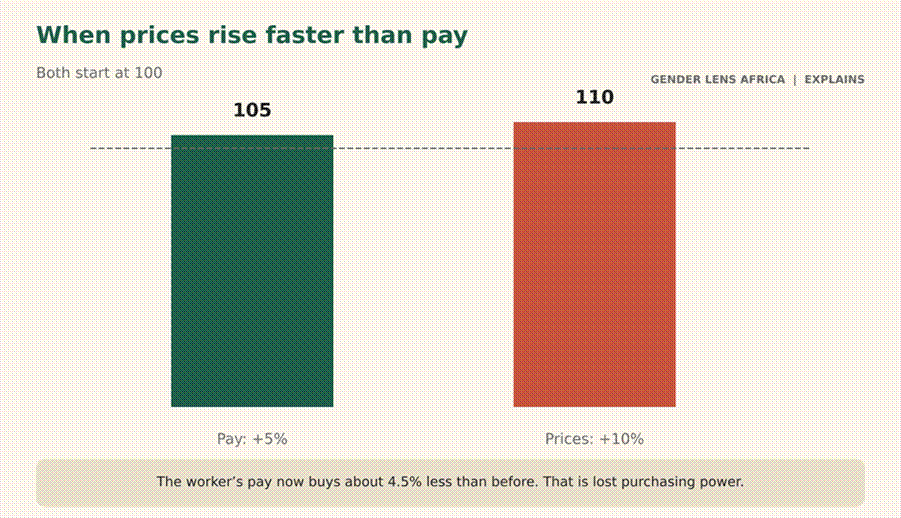
A person’s purchasing power is determined by what their income can actually buy.
If a worker receives a salary increase of 5 per cent while the goods and services they regularly purchase become 10 per cent more expensive, that worker has lost purchasing power in real terms.
The same pressure affects people who do not receive regular salaries. Market traders, domestic workers, small business owners, casual workers and others in informal employment may have incomes that fluctuate from week to week. Their ability to adjust their earnings when costs rise can be limited.
Women often carry a substantial share of household budgeting and care responsibilities. When money is tight, they may be the ones changing meals, reducing their own spending, finding cheaper alternatives, stretching food supplies or making difficult decisions about which household expenses can wait.
Women who trade in markets face another side of the problem. They are not only consumers dealing with higher prices; they may also be business owners navigating the cost of transport, stock, rent, electricity and other operating expenses.
These experiences are not identical for every woman or every household. But they show why economic recovery must be assessed not only through national indicators but also through the conditions under which people earn, spend and provide for their families.
A lower inflation rate is welcome. But if incomes are not keeping pace with the cost of living, the relief may remain difficult to feel.
So, is 5.5 per cent good news?
Yes. A reduction from the exceptionally high inflation recorded in 2022 to 5.5 per cent in October 2026 represents a significant improvement in the pace of price increases.
But the latest figure needs to be read carefully.
The GSS reported that headline inflation rose for a third consecutive month, reaching 5.5 per cent in October, up from 5.2 per cent in September. The rate had been 4.6 per cent in July. October’s figure was still lower than the 8 per cent recorded in October 2025, but the recent monthly movement shows that disinflation is not necessarily a straight line.
The October report also recorded a 0.1 per cent decline in the overall price level between September and October. That monthly movement and the year-on-year increase are different measures, and both matter when interpreting the figures.
The improvement should be recognised. So should the fact that the cost of living remains a serious concern for many households.
The real test of economic recovery is not simply whether inflation is lower than it was. It is whether people’s incomes, jobs and access to essential services are improving enough for them to live with greater financial security.
Political parties will continue to debate who deserves credit and who should be held responsible. Citizens should continue to demand answers from both.
But the public conversation must go beyond the headline number. It must ask whether a market woman can restock her stall and still make a living, whether a parent can buy enough food for the household, whether a worker’s salary covers the month and whether a small business can meet its costs without passing every increase on to customers.
Inflation is the speed, not the price. But for the ordinary Ghanaian, the price is what ultimately determines what goes into the shopping basket.