Ohio, USA, 8 November 2026: Imagine a Ghanaian service company announcing that its new artificial intelligence (AI) assistant has cut the time needed to process customer correspondence by a third. The executive dashboard turns green. Staff receive a congratulatory message.
Then the people who handle the difficult customer cases discover that the assistant has also created more confusing answers, more disputed records and more requests to explain what went wrong.
The dashboard counts the time saved on the first draft. It does not count who cleaned up afterward.
This is a gender equality question as well as a productivity question, especially when women work in administrative, clerical and service roles that organisations often treat as easy to automate.
The International Labour Organization’s (ILO) March 2026 research on gender and generative AI found that 29% of female-dominated occupations in the countries studied were exposed to generative AI, compared with 16% of male-dominated occupations. In its highest-exposure categories, the corresponding figures were 16% and 3%.
These are international occupational exposure measures, not estimates of Ghanaian job losses. They show where technology could change tasks and bargaining power. They cannot tell us how many Ghanaian women will lose their jobs.
They do, however, demand a closer look at whose work is rewarded when AI arrives.
A tool can save time in one place and move work elsewhere
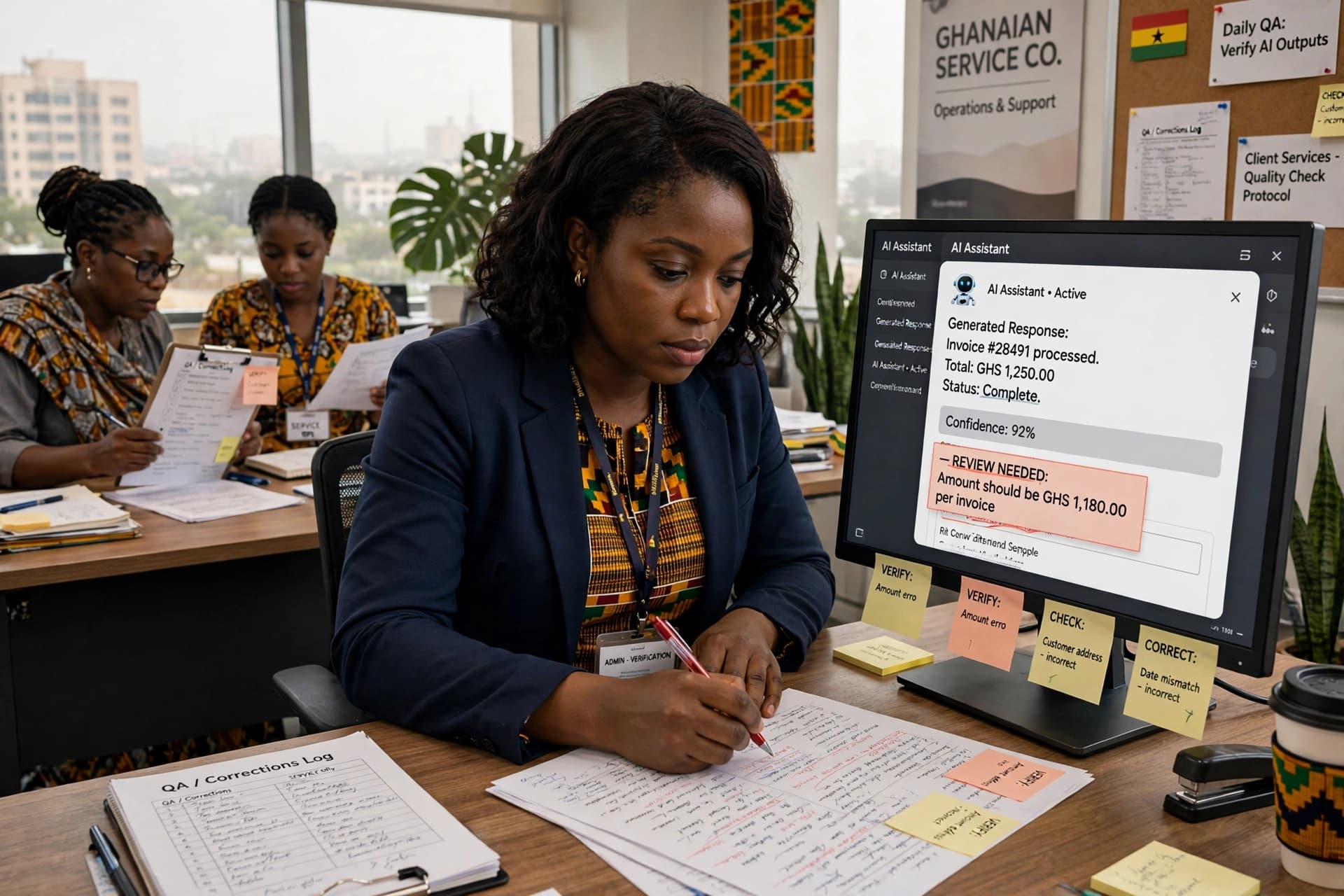
Consider an office where a customer service assistant drafts an insurance response. The person reviewing it must compare the generated wording with the policy, find an omitted exclusion, contact a supervisor and then explain the correction to the customer.
On paper, the assistant has shortened drafting. In reality, it has moved effort from initial writing to verification and repair.
If the organisation’s managers record only the drafting time, they will celebrate a gain that the frontline team cannot feel. If they reward the worker who clicks “send” fastest rather than the worker who catches the serious error, the organisation can end up penalising care and judgement.
Gender enters through the distribution of roles, authority and recognition. The ILO identifies women’s concentration in clerical and business-support occupations as one reason for higher exposure. It also points to women’s underrepresentation in AI-related and technical roles, where future opportunities may emerge.
That combination can leave some employees bearing a disproportionate share of task disruption while gaining too little access to the better-paid work created around AI.
The ILO and World Bank’s March 2026 analysis further warns that relatively high-quality administrative roles in lower-income economies can provide important career pathways for women and young workers. Removing the entry-level tasks without creating replacement routes into skilled work threatens those pathways.
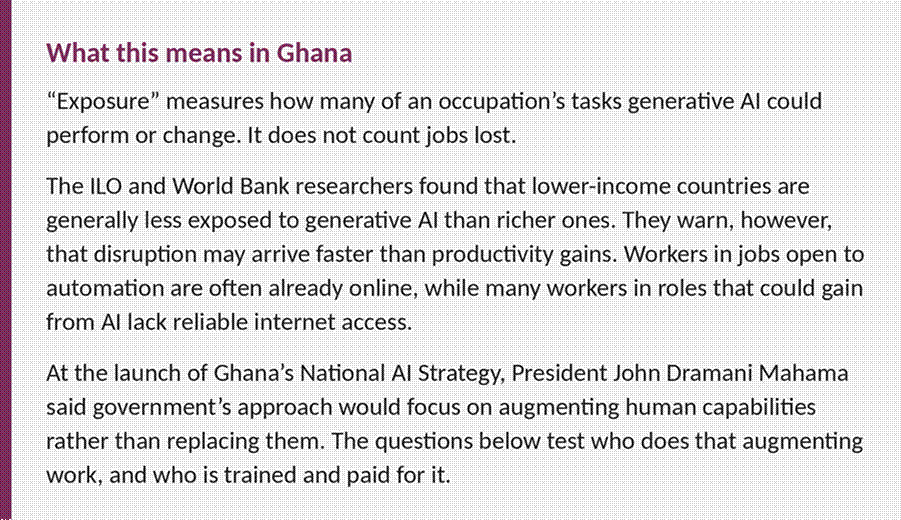
Sources: ILO and World Bank analysis; launch of Ghana’s National AI Strategy.
Ask who gets the new opportunities
Ghana launched a National AI Strategy in April 2026, identifying public services, education, agriculture and healthcare among its priority applications. That ambition creates an opening for employers, public agencies and training providers to put women’s advancement into the design of their projects rather than treating it as a separate promise.
For every significant AI rollout, ask three questions.
1. Who currently performs the tasks that will change?
2. Who is assigned to test, supervise and correct the new system?
3. Who receives the training, pay, promotion opportunities and decision-making authority associated with the redesign?
A company may discover that women do much of the meticulous checking while senior roles elsewhere receive the credit for “AI transformation.” It can prevent that outcome by recognising verification as skilled work and giving reviewers the authority to stop a flawed process.
This matters in finance, healthcare administration, education, and any sector where errors reach a real person.
Measure the work that disappears from the chart
The first reform is a time-use baseline. Before deploying a tool, measure a representative sample of tasks from start to finish: preparing the response, checking its accuracy, dealing with exceptions, fixing errors and satisfying the customer.
Repeat the measurement after deployment. Record the results by role and, where appropriate and privacy-safe, by gender. A smaller drafting figure cannot substitute for the full picture.
Second, protect a meaningful route to escalation. The employee who discovers a mistake should have access to the original source, a supervisor with clear authority and a documented way to correct the outcome.
If management treats an override as resistance to innovation, people will be pressured to accept bad answers. That pressure lands hardest on workers with little institutional power.
Third, build paid learning paths. A woman whose administrative tasks are automated should have a credible opportunity to become an AI quality analyst, customer-resolution specialist, process designer or team lead.
Training should take place during paid working time and include practical exercises. An employee who can identify a subtle AI mistake, explain why it matters and improve the workflow has developed a valuable skill.
Fourth, make career outcomes part of the AI business case. Count not merely the hours the software claims to save but also who moves into higher-responsibility positions, whose pay grows, whose workload changes and whose advancement stalls.
If a pilot speeds up processing while narrowing women’s path to promotion, leadership has learned something important about the design.
Give workers a voice before the system is locked in
A sensible implementation team should include the staff who know where mistakes actually happen. Ask them which exceptions matter, what customers complain about and which review steps can never be skipped.
Those questions may produce a less glamorous product demonstration, but they also produce a more reliable process.
Managers sometimes assume staff participation slows deployment. The alternative can be worse.
Employees notice when a tool creates hidden cleanup work, and they withdraw trust when leaders dismiss their reports. That makes adoption slower and weaker even when the software seems capable.
The correct test for an AI investment is whether it improves the complete service and expands the professional options of the people who do the work. For Ghanaian employers, that means treating gender-disaggregated (split by gender) job quality and advancement as measurable outcomes, not fine print.
A green productivity dashboard should be the start of the conversation. Ask who performed the correction work, who was empowered to challenge the output and who gained a better future because the system was introduced.
Those answers reveal whether AI is helping women advance or quietly asking them to carry its unpaid cost.