Accra, Ghana, October 16, 2026: A sexual offenders register can help keep people with relevant convictions out of jobs that give them access to children. It cannot, on its own, identify someone who has never been caught.
That is the central lesson as Ghana weighs a call by the Association of Women Lawyers, Ghana (AWLA Ghana) for a National Sexual Offenders Register. AWLA Ghana issued the call today. It follows a JoyNews investigation into how complaints against the headmaster of Obuasi Senior High Technical School were handled.
The Minister for Education has directed the suspension of the headmaster pending investigation and asked the Criminal Investigations Department (CID) to investigate. The allegations have not been tested in court, so the presumption of innocence applies. AWLA Ghana says so in its own statement.
What AWLA Ghana is asking for
The statement calls for a register backed by a clear legal framework. It would list people convicted of sexual offences, particularly against children, and inform recruitment decisions in schools and other institutions that serve children. Access would follow clear rules, with data protection and safeguards against wrongful inclusion.
The register is one item on a longer list. AWLA Ghana also wants independent investigations, mandatory background checks, confidential reporting, accountability for institutions that conceal abuse, and support for survivors. That wider package matters, as the evidence below shows.
What a sexual offenders register is
People use the phrase “sex offenders register” to mean three different things. Mixing them up causes much of the confusion in public debate.
A police register requires convicted people to give police their address and details and keep them updated. The aim is monitoring. Only police and justice agencies see it.
A screening register lets employers and licensing bodies check a name before hiring. The aim is to keep known offenders out of jobs with children. Access is restricted.
A public register lets anyone search names, and in some countries addresses. The aim is community awareness and deterrence through exposure.
The AWLA Ghana statement is closest to the second model. It speaks of vetting, recruitment and rules on who may see the list. That is also where international practice is strongest.
How other countries run registers
The table compares four systems. They are not directly comparable, and the differences matter.
Table: How four countries run sexual offender registers, and what Ghana proposes
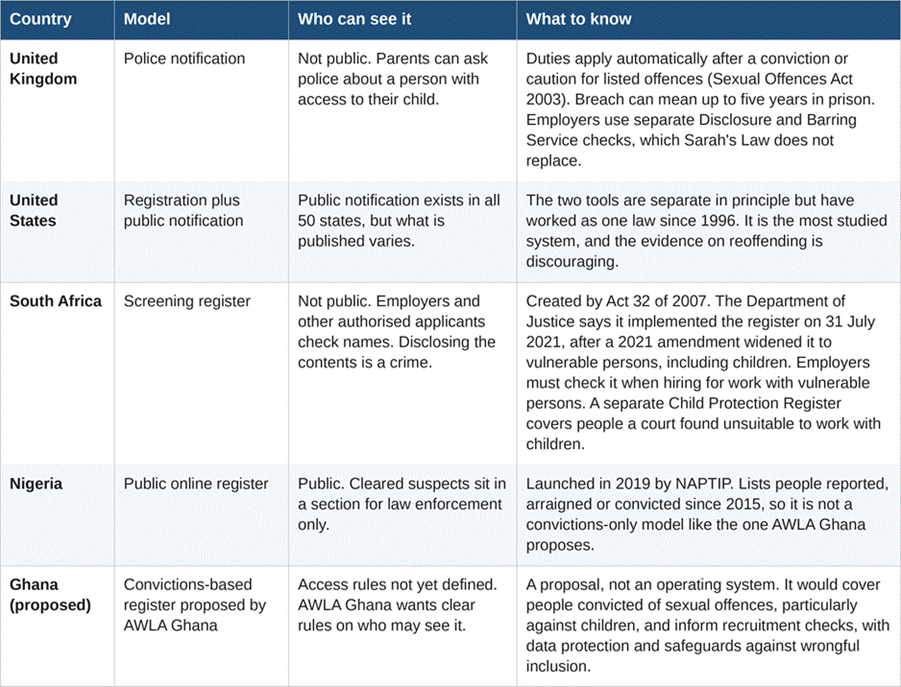
Sources for the table: the House of Commons Library briefing on the UK system, the UK Child Sex Offender Disclosure Scheme guidance, public notification in all 50 US states, the South African Department of Justice page on its register the announcement of Nigeria’s register and AWLA Ghana’s call. South Africa’s employer duty is explained here.
At treaty level, the Council of Europe’s Lanzarote Convention is a widely cited benchmark. It asks states to screen people who will be in regular contact with children at recruitment. The emphasis is on checking, not on publication.
What the research says
The strongest case for a register is also the narrowest. It is a policy rationale, not a proven research finding. A register can help keep a person with a relevant conviction out of work with children, if employers must check and the record is accurate.
The wider claim, that registers reduce sexual offending, is much harder to support. A 2021 meta-analysis by Kristen Zgoba and Meghan Mitchell pooled 18 studies covering 474,640 formerly incarcerated people. It found no statistically significant effect of registration and notification policies on reoffending.
An earlier Washington State Institute for Public Policy review also found no significant effect on reoffending, but warned that only seven credible studies existed. Two other studies hinted that registration might lower offending in the wider public. The review called for more research.
These studies measure reoffending. They do not measure whether screening stops a person with a relevant conviction from being hired, and they test registration and public notification together. The evidence does not establish that registration and notification reduce reoffending. It does not show that every form of register fails either.
A register has a second limit. It only holds people who have already been convicted. A New York study covering 1986 to 2006 found that more than 95 per cent of sexual offence arrests involved people with no earlier sexual offence on record.
In a separate US survey, survivors named 566 offenders in full. Only 4.8 per cent of those offenders were on a registry at the time of the assault. In plain terms, a register can help block a known offender. It cannot identify someone who has never been caught.
Design matters too. A US Department of Justice research brief found that residence restrictions do not reduce reoffending and may raise the risk, while specialised supervision combined with treatment appears to work. A companion brief advises against extending registration to juveniles until more is known.
Supporters can fairly say a register was never meant to prevent every offence. It is a screening tool, and screening is a standard safeguard. Critics can fairly say money and political attention are limited, and a register can create false comfort. Both points are sound.
What it would mean in Ghana
In 2020, the Domestic Violence and Victims Support Unit (DOVVSU) of the Ghana Police Service said a register of convicted rapists was being planned and that convictions are recorded at CID headquarters. I could not verify whether it has since become operational.
The first issue is the conviction gap. A conviction register is only as full as the justice system allows. The BBC reported that in 2019 Ghana recorded 369 rape complaints and convicted three suspects. Cases recorded in a year cannot be compared directly with convictions in the same year. DOVVSU records for 2015 show 15,749 sexual and gender-based violence cases recorded, 1,291 sent to court and 139 convicted.
That 2015 category includes assaults and other offences, and the court outcomes may not relate to the same cases. It is a rough guide, not a conviction rate for child sexual abuse. In the Central Region, police recorded more than 200 defilement cases in 18 months to September 2022. About 101 reached court and 25 ended in conviction, though the source does not say these figures follow the same cases. Reported cases, arrests, prosecutions and convictions are different measures, and Ghana needs current, published figures for each.
A register built on these numbers would start thin. It would fill only as investigations and prosecutions improve. That is a reason to fix the system alongside the register, not to wait.
The second issue is who a conviction register would miss. When teachers face sexual misconduct allegations, the Ghana Education Service (GES) often acts through its own disciplinary process. In 2018 it dismissed six staff for sexual misconduct after internal hearings, and dismissed a seventh after a court convicted him of defilement. A teacher dismissed administratively has no conviction and would not appear on the register AWLA Ghana describes.
Ghana would need to keep three records apart: criminal convictions, professional disciplinary findings by the teaching regulator, and a child-protection record with its own legal threshold. An administrative dismissal is not proof of a crime. Any professional list needs a fair process and a right to challenge errors.
South Africa uses a second list. Its teachers’ council said in 2018 that teachers struck off for sexual misconduct go onto the Child Protection Register, while the sex offenders register holds only court convictions. A Graphic commentary has asked where dismissed teachers go and pointed to private schools as a route back into classrooms. The National Teaching Council is the obvious body to examine, once its statutory powers and the legal basis for sharing information are established.
The third issue is the law. Ghana’s Data Protection Act, 2012 (Act 843) treats information about an alleged or proven offence as special personal data, which it protects more strictly. A register therefore needs a clear legal basis. That basis should set its purpose, who may access it, how accuracy is kept, how errors are corrected, how long data is retained and what stops misuse.
The criminal law is also under scrutiny. A University of Ghana study accepted for publication in 2026 argues that the Criminal Offences Act, 1960 (Act 29) has not kept pace with grooming and online exploitation.
The fourth issue is compliance. South Africa passed its law in 2007. The Department of Justice says it implemented the register on 31 July 2021, and in 2025 the Justice Minister described schools and other child-focused institutions as the first phase of the rollout. In 2018, the teachers’ council conceded it had not used the register when licensing teachers while it sought access.
The gap did not close with the launch. In 2025 and 2026, the Department of Basic Education reported that school principals did not know about the vetting duty and started a national campaign. These are South African findings, not Ghanaian ones, but they show how long a law can take to become a check in practice.
What a workable register would need
If Parliament takes up AWLA Ghana’s call, the evidence points to six design choices.
A clear purpose. Screening people who work with children, set out in law, not public shaming.
Convictions first. List people convicted of defined offences, tiered by seriousness. Be cautious about registering juveniles, where the research is thin.
Restricted access. Schools, churches, licensing bodies and police check names through a formal process, with penalties for misuse. If Ghana wants parents to be able to ask about a person, the UK’s request-based scheme shows one way.
Correction and review. People need a route to challenge wrongful entries and, in lower-risk cases, to apply for removal. South Africa has a removal process, and the UK allows people on indefinite notification to seek a review after 15 years.
A separate safeguarding record for dismissed staff. Consider a professional mechanism run with the teaching regulator, with a fair process and a right to challenge, so a person dismissed after a hearing cannot quietly rejoin the profession elsewhere.
Funding and enforcement. A legal duty to check, training for school heads, and consequences for institutions that skip the check.
One tool, not the whole system
I support a Ghanaian register built on those terms. It answers a real concern. Parents want a legal guarantee that schools check who they hire.
A register can be one part of Ghana’s response to sexual abuse in schools. It cannot replace confidential reporting channels, timely investigations, professional accountability and support for survivors.
Public reporting has not established that the Obuasi headmaster had a previous sexual offence conviction. If he had none, a register limited to convicted offenders would not, by itself, have prevented the alleged conduct. The case makes institutional response urgent. What matters is not only whether a complaint is made, but whether the people responsible for acting on it do so.
A register can keep a known offender out of a school. Only a system that listens to children can find the next one.