Accra, Ghana, October 23, 2026: What can a woman in Ghana expect from her government when she marries, inherits, falls ill or is attacked? Part of the answer sits in a treaty most Ghanaians have never read.
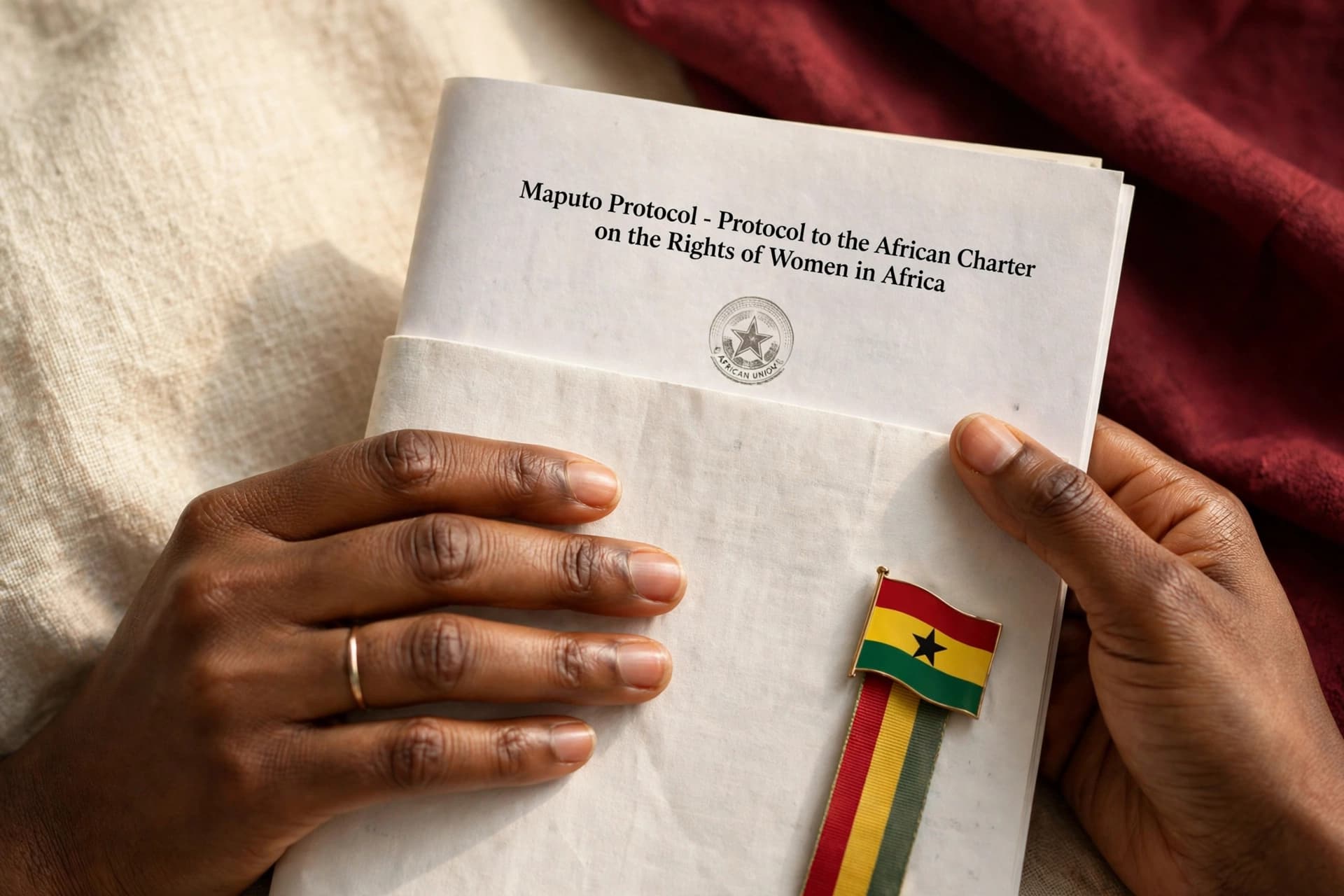
The Protocol to the African Charter on Human and Peoples' Rights on the Rights of Women in Africa, known as the Maputo Protocol, was adopted on 11 July 2003 in Maputo, Mozambique. It entered into force in November 2005. It binds the states that ratify it, and Ghana is one of them.
Three dates that matter for Ghana
Ghana signed the Protocol on 31 October 2003, ratified it on 13 June 2007 and deposited its instrument on 20 July 2007, according to the University of Pretoria's Centre for Human Rights. The Solidarity for African Women's Rights coalition lists the same dates.
Each step has a different meaning. Signing shows intent. Ratification is the state's formal consent to be bound. Deposit with the African Union Commission completes the continental record. Nineteen years have passed since Ghana accepted the treaty, so the useful question is what has changed in the lives of women.
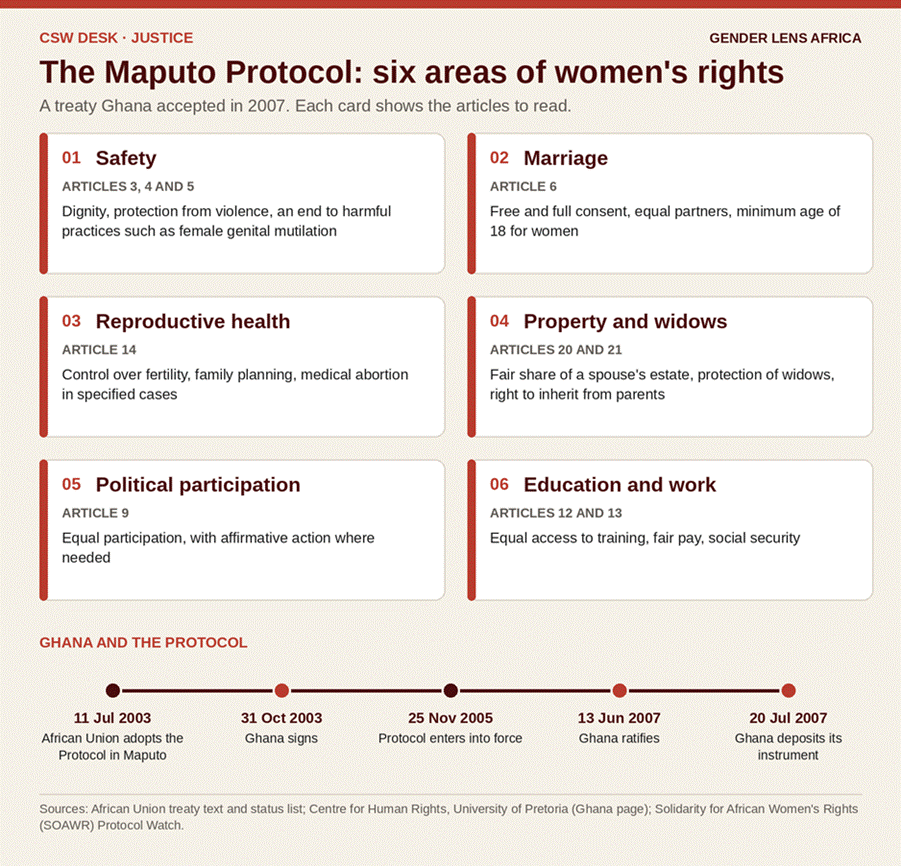
Graphic: six areas of the Maputo Protocol and Ghana's key dates. Gender Lens Africa.
1. Violence and harmful practices
Article 3 protects every woman's dignity. Article 4 protects her life, integrity and security, and requires states to prevent and punish violence in public and private life. Article 5 requires states to prohibit harmful practices, including female genital mutilation, through legislation backed by sanctions.
The Protocol sets the standard. Ghana's own statutes and courts decide how it works in practice. A law on paper protects a girl only if police act on a report, prosecutors bring the case and a court delivers a sentence.
2. Marriage and consent
Article 6 says women and men are equal partners in marriage and that marriage needs the free and full consent of both. It sets 18 as the minimum age for women and requires states to promote registration of marriages.
Ghana's Children's Act, 1998 (Act 560) also sets 18 as the minimum age of marriage. The practical question is enforcement in communities where customary and religious marriages go unregistered.
3. Reproductive health
Article 14 covers sexual and reproductive health. It includes the right to control one's fertility, to choose whether and when to have children, and to access family planning. Article 14(2)(c) asks states to authorise medical abortion in specified cases: sexual assault, rape, incest, and where continuing the pregnancy endangers the woman's mental or physical health or life.
The Protocol does not make every abortion lawful. It names specific cases. Ghana's Criminal Offences Act, 1960 (Act 29) also permits abortion in specified circumstances, and access depends on health services as much as on the text of the law.
4. Property, inheritance and widows
Article 21 gives widows the right to an equitable share of the husband's property and the right to stay in the matrimonial home. It also gives women the right to inherit their parents' property in equitable shares. Article 20 protects widows from degrading treatment.
These articles matter because property decides whether a woman can leave an unsafe home or keep her children housed after a death. Family pressure after a husband dies is a common point of loss.
5. Political participation
Article 9 asks states to take positive action, including affirmative action, so that women take part equally in political life and decision-making. Ghana's Affirmative Action (Gender Equity) Act, 2024 (Act 1121) is the main national tool. It sets a minimum of 30 per cent women in public appointments, and the NETRIGHT status report found women held 14.9 per cent of parliamentary seats at the end of 2025.
The Protocol and Act 1121 are different instruments. One is a regional treaty and the other is a national statute. Together they give advocates two grounds on which to press for results.
6. Education and work
Article 12 requires states to remove discrimination against women in education and training. Article 13 covers equal pay, equal opportunity at work and social security. In Ghana, the Labour Act addresses discrimination and equal pay for equal work, and the Constitution protects fair remuneration.
What reporting tells us
States that ratify the Protocol must report on their progress. Article 26 requires states to describe, in their periodic reports to the African Commission on Human and Peoples' Rights, the legislative and other measures they have taken.
The Centre for Human Rights' Ghana page listed no report by Ghana on the Maputo Protocol when we checked, and its last African Charter report covered 1990 to 2000. A 2019 Legal Resources Centre workshop report gives the same picture. Ghana may have reported since. The Ministry of Gender, Children and Social Protection should say so and publish the report.
What to ask next
• Has Ghana submitted a report on the Maputo Protocol to the African Commission, and where can the public read it?
• Which of the Protocol's six areas has no matching Ghanaian statute, and which has a statute that is not enforced?
• How many widows and daughters won inheritance disputes in court in 2025?
• How many girls under 18 were married in 2025, and what happened to the adults involved?
Sources and further reading
Centre for Human Rights, University of Pretoria: Ghana and the Maputo Protocol.
Solidarity for African Women's Rights: Maputo Protocol ratification status.
Centre for Human Rights: list of countries that signed and ratified, with adoption date.
African Union: Protocol on the Rights of Women in Africa, treaty page.
Legal Resources Centre: state reporting workshop on the African Charter and the Maputo Protocol.