Accra, Ghana, November 1, 2026: An apology can acknowledge a wrong. It can break years of silence, challenge historical denial and establish a basis for reconciliation. But it cannot, on its own, return what was taken, restore what was destroyed or reverse inequalities that have been passed from one generation to another.
That is the difficult question at the centre of the growing campaign for reparatory justice, and one that Ghana must confront as it prepares to engage the United Kingdom and other countries over the legacy of the transatlantic slave trade.
President John Dramani Mahama's five priorities for proposed discussions go beyond a formal apology. They include dismantling systemic racism, investing in education, healthcare and youth empowerment, returning stolen cultural heritage and addressing structural inequalities in the global economy.
These are significant areas of engagement. They recognise that slavery was not simply an episode in history. It was an economic and political system that extracted labour, accumulated wealth, disrupted societies and established racial hierarchies whose consequences remain visible today.
But there is another dimension that deserves greater attention: the gendered experience of slavery and the extent to which women and girls are represented in today's reparations agenda.
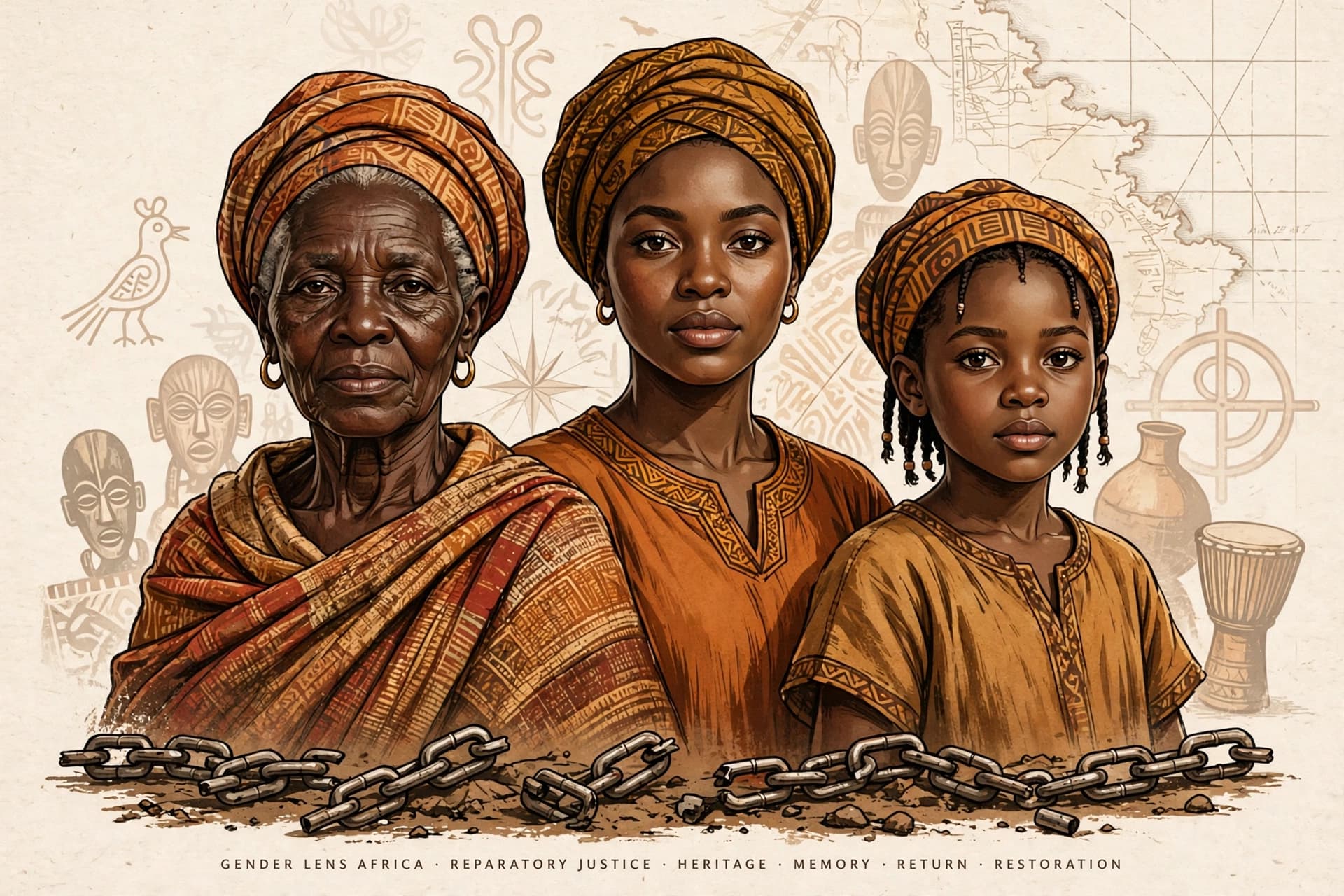
Slavery was not gender neutral
Enslaved African women experienced exploitation that extended beyond forced labour.
Their bodies were subjected to sexual violence, their reproductive capacities were exploited, and their children could be born into the same condition of enslavement.
In parts of the Americas, laws established that a child's enslaved status followed that of the mother. This meant that women's reproductive lives were incorporated into the economic machinery of slavery.
Women were exploited as agricultural workers, domestic workers and caregivers, while also facing sexual abuse and the threat of violence from enslavers.
These experiences were not separate from the economic system. They were part of how slavery maintained itself and generated wealth.
Yet the experiences of enslaved women have frequently received less attention in historical accounts and reparations discussions.
A July 2026 report by The Guardian, examining the gender dimensions of reparatory justice, highlighted renewed calls to recognise sexual violence against enslaved women as part of the reparations agenda. CARICOM's updated Ten Point Plan has also brought gender-based violence into the discussion.
The Pan African feminist framework developed by FEMNET in its 2025 background paper, Creating New Pathways to Reparative Justice, makes a related argument: reparations must address the historical and continuing harms experienced by African women and girls, rather than treating gender equality as an additional consideration.
This matters because a reparations programme that does not account for how slavery affected women risks repeating the very exclusions it seeks to correct.
Who benefits from reparatory justice?
Mahama's proposed investments in education, healthcare, science, youth empowerment and climate resilience offer opportunities to address some of the inequalities associated with historical exploitation.
But the question of who determines these priorities, who receives the benefits and how progress is measured will be just as important as the commitments themselves.
For instance, investment in education should not simply mean increasing access to schools. It should also consider inequalities that affect girls' access to quality education, the barriers facing women in higher education and the underrepresentation of women in scientific and technological fields.
Healthcare investment should recognise the specific needs of women and girls, including access to reproductive, maternal and mental healthcare.
Economic partnerships should consider women's access to land, finance, decent employment and ownership of productive assets.
Climate resilience should also account for the women whose livelihoods depend on agriculture, food production, natural resources and unpaid care work.
These are not separate women's issues. They are part of the economic and social structures that reparatory justice seeks to address.
The question is whether women, particularly those from communities affected by historical exploitation, will have meaningful influence over the design and implementation of these programmes.
Restitution must mean more than returning objects
The return of stolen African artefacts is another important part of Mahama's proposed agenda.
Cultural objects taken during slavery and colonial rule carry histories, identities, knowledge systems and spiritual significance. Their removal was not simply the loss of property. It also disrupted communities' relationships with their heritage.
But restitution must be accompanied by investments in the institutions and people responsible for preserving that heritage.
Women have played important roles in transmitting cultural knowledge, craft traditions, oral histories and community practices across generations. Their contributions should be recognised in decisions about cultural preservation, ownership and the management of returned heritage.
The return of an artefact should not be the end of the conversation. Communities must have a say in where it goes, how it is preserved and how future generations can access its history.
The people affected must shape the process
Perhaps the most important test of the reparations agenda will be whether African communities and people of African descent have a meaningful role in determining what justice looks like.
Governments can negotiate agreements, establish panels and announce development partnerships. But reparatory justice cannot be reduced to discussions between political leaders and former colonial powers.
Women-led organisations, historians, young people, community representatives, cultural institutions and descendants of enslaved Africans must have opportunities to shape the process.
This is particularly important for women and girls whose experiences of historical and contemporary discrimination may not be adequately represented in state-led negotiations.
The United Nations resolution adopted in March 2026 provides an important framework. It calls for inclusive, good-faith dialogue and recognises restitution, compensation, rehabilitation, satisfaction and guarantees of non-repetition as elements of reparatory justice.
The challenge is to translate these commitments into practical measures that affected communities can identify, access and hold institutions accountable for delivering.
From historical recognition to material change
Britain's reported openness to a formal apology creates an opportunity for dialogue, but the disagreement over financial reparations shows that the parties do not yet share the same understanding of what repair should entail.
Ghana's position, as outlined by Mahama, places the discussion within a wider framework of restitution, investment, anti-racism and reform of global economic structures.
That approach raises important questions about implementation. Which commitments will be negotiated? What resources will support them? Who will oversee delivery? And how will affected communities know whether the process is making a difference?
These questions cannot be postponed until after an agreement is reached.
For Gender Lens Africa, there is another question that deserves a place at the negotiating table: what would reparatory justice look like if African women and girls were not merely recognised as people who suffered under slavery, but also treated as decision-makers in determining what must be repaired?
An apology may acknowledge the past. Restitution may return what was taken. Investment may help address inequalities.
But meaningful reparatory justice must also confront the systems that allowed exploitation to flourish and those that continue to reproduce exclusion.
The measure of success will not be the number of statements issued or meetings held. It will be whether the process changes who has access to resources, who exercises power, whose history is recognised and whose future is given room to grow.
That is what makes reparatory justice more than an exercise in remembering history. It is a question of what kind of future can be built after confronting it.