Accra, Ghana, October 23, 2026: Studies of Ghanaian hiplife find women often cast as sexual objects or money-seekers, while women artists write back. Here is how to read the songs.
A song can praise a woman's body and still shrink her to it. A song can also say the same words and give her the power in the room. The difference lies in who speaks, who is silent and what the woman does in the story.
Ghana's popular music has been studied on exactly this question. Three peer-reviewed studies give us evidence, and they point in two directions. Two document objectification. One documents women artists who reject it. This article reports what they found, what they cannot tell us and how to listen with those findings in mind.
What the studies found
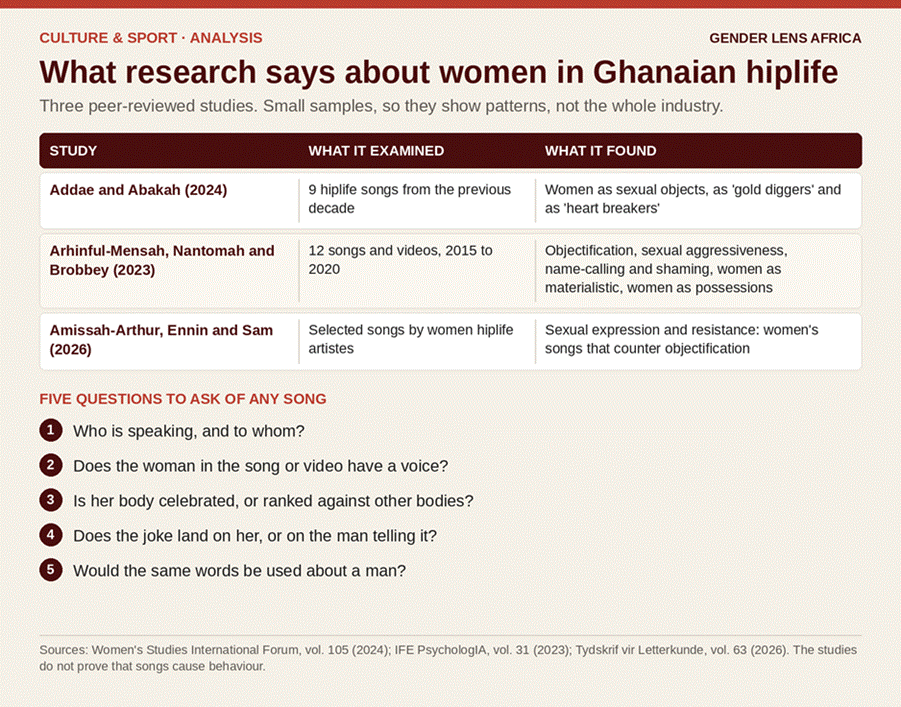
Graphic: three studies of women in Ghanaian hiplife, and five questions to ask of any song. Gender Lens Africa.
David Addae and Ellen Abakah analysed nine hiplife songs from the previous decade. Their 2024 paper, Unblurring the lines, published in Women's Studies International Forum, found three recurring portraits: women as sexual objects, as 'gold diggers' and as 'heart breakers'. The authors also point to a paradox in what hiplife teaches its growing audience.
A second study, Representation of Women in Ghanaian Hip-Life Music by the Media, examined 12 songs and videos from 2015 to 2020. It found sexual objectification, sexual aggressiveness towards women, name-calling and shaming, women portrayed as materialistic, and ownership of women by men. The authors recommended that the Music Union of Ghana (MUSIGA) set up a review board for songs and videos.
Both samples are small. The songs were chosen on purpose by the researchers. The studies show patterns in the songs they picked. They do not describe every Ghanaian song, and they do not prove that listening to a song changes behaviour.
Women are writing back
A third study looks at the other side. Hannah Woode Amissah-Arthur, Theresah Patrine Ennin and Christabel Aba Sam examined songs by Ghanaian women hiplife artists in Tydskrif vir Letterkunde in 2026. They argue that these songs counter the objectification common in the genre and show women as more than their bodies.
This matters because a woman who sings about desire is not automatically repeating a male script. She may be claiming control of her own image. The studies do not resolve every case, since a song can challenge one stereotype and repeat another. Artists of every gender also work in a commercial system that rewards certain sounds and images.
Celebration or reduction? A test
Praise for a woman's body is not the problem. Reduction is. Five questions help tell them apart.
• Who is speaking, and to whom? A woman addressing her own confidence differs from a man addressing other men about her.
• Does the woman in the song or video have a voice, a name or a motive?
• Is her body celebrated, or ranked against other bodies?
• Does the joke land on her, or on the man telling it?
• Would the same words be used about a man?
One song that frames itself as celebration
Stonebwoy released 'Your Body' in June 2024. The Ghana News Agency described the video as a celebration of African beauty, self-love and body positivity. It said the director set out to challenge narrow beauty standards. In an interview reported by Starr FM, Stonebwoy said 'your body is the beauty standard, not what they say'.
That is the artist's and the director's account of their intent. It is not a verdict. A listener can still apply the five questions, and different listeners will answer them differently. The point is to ask them of a song people love as well as of a song they dislike.
Should an industry body review songs?
The 2023 study's call for a MUSIGA review board has supporters. They argue that songs which normalise name-calling and shaming need a check. Critics would answer that a review board risks censoring artists, and that it would judge women's own songs about desire as harshly as men's songs about women.
A third route avoids both risks. Radio and television presenters can name what a lyric does rather than rank songs as clean or dirty. Entertainment reporters can interview the women in the videos. Labels can put more women in the writing room. Fans can ask the five questions before they repeat a line.
What would a stronger study look like?
• A larger sample, chosen by a stated rule such as streaming charts, rather than by the researchers' taste.
• Songs from 2023 to 2026, verified against the recording and a reliable lyric source.
• Songs by men and women, in Twi, Ga, Ewe, Pidgin and English.
• Interviews with listeners, to test what audiences take from the songs.
A song-by-song list, such as ten recent Ghanaian songs and what each says about women's bodies, needs that groundwork first. Until each song, release date and lyric is verified, any list would give opinion the look of evidence.
Sources and further reading
Addae and Abakah (2024), Unblurring the lines: Exploring the images of women in Ghanaian rap music, Women's Studies International Forum, vol. 105, article 102914. DOI link.
Arhinful-Mensah, Nantomah and Brobbey (2023), Representation of Women in Ghanaian Hip-Life Music by the Media, IFE PsychologIA, vol. 31, no. 1.
Amissah-Arthur, Ennin and Sam (2026), Re-defining Ghanaian hiplife songs by women as liberatory narratives, Tydskrif vir Letterkunde, vol. 63, no. 1.
Ghana News Agency: Stonebwoy drops visuals for 'Your Body', 20 June 2024.
Starr FM: Stonebwoy champions body positivity, July 2024.