Accra, Ghana, November, 20, 2026: When people ask why a woman stays in an abusive relationship, the answer is often framed as love, fear or family pressure. Those reasons are real. But there is a more practical question that rarely gets asked: where would she go, and how would she pay for it?
In Ghana, the answer runs straight into the rental market. The law caps rent advances at six months, yet landlords routinely demand far more. Women own less property than men, work mostly in the informal economy and have limited access to credit. Shelters for survivors remain scarce.
Together, these inequalities shape who can afford to live independently, and who has the financial means to leave an unsafe home.
The six-month rule that rarely holds
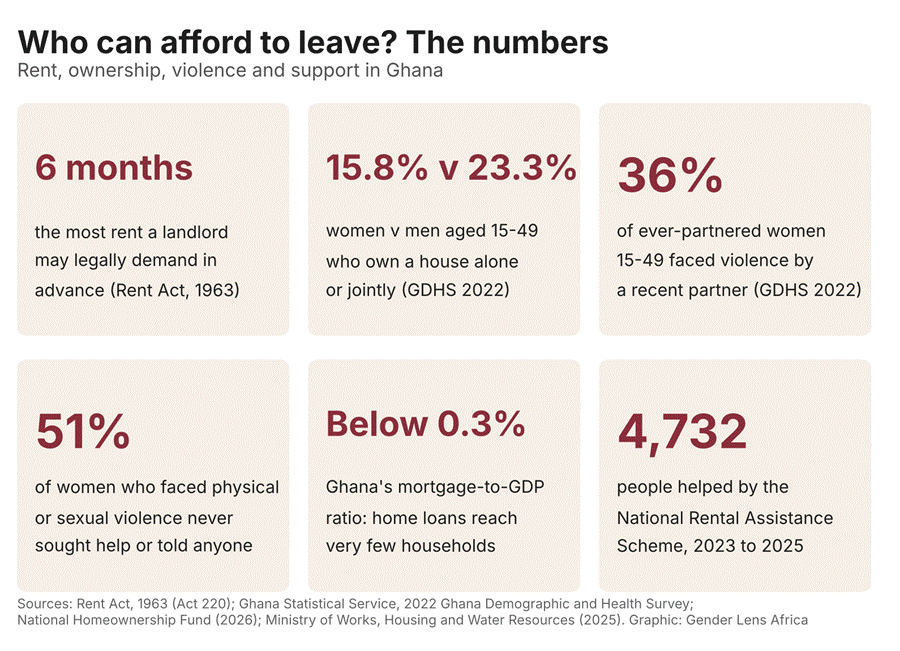
Under section 25(5) of the Rent Act, 1963 (Act 220), as amended, a landlord may not demand more than six months’ rent in advance for a tenancy longer than six months. For a monthly or shorter tenancy, the limit is one month’s rent.
In practice, the prevailing norm has been an advance of two years or more, which the law clearly prohibits. The demand for one or two years upfront remains a major concern, particularly for young workers and people moving to the big cities.
The government has moved to change that. After President John Dramani Mahama urged tenants in March 2026 to report offending landlords, the Rent Control Department said it would shift from public education to full enforcement from 1 April 2026. Offenders risk a fine of 250 penalty units, equivalent to GH¢3,000, or a prison term of three to six months.
Capacity is the problem. The Acting Rent Commissioner, Frederick Opoku, has said the department has only 185 staff across the country. In late October 2026, he said a new task force would strengthen compliance after months of public education. The government has also said it will replace Ghana’s outdated rent laws with a new consolidated Rent Act.
The Gender Lens: what a rent advance means in practice
Take a single room at GH¢800 a month, an illustrative figure. Within the law, a landlord can ask for six months upfront: GH¢4,800. A two-year advance means GH¢19,200 before a tenant gets the key.
For a woman leaving a violent partner, that sum has to be found quickly, often without access to shared savings, and sometimes while caring for children. A rent advance is not just a housing cost. It decides whether leaving is possible at all.
Women start further behind
Women are less likely than men to own the roof over their heads. The 2022 Ghana Demographic and Health Survey (GDHS) found that 15.8% of women aged 15 to 49 own a house alone or jointly, compared with 23.3% of men. For land, the figures are 12.7% for women and 24.7% for men.
Women also earn their living mostly outside formal employment. An analysis of Ghana’s 2015 Labour Force Survey by Women in Informal Employment: Globalizing and Organizing (WIEGO) found that 87% of women’s employment in Greater Accra was informal, compared with 79% of men’s. Informal work rarely comes with the payslips that lenders ask for.
Home loans offer little relief. The National Homeownership Fund has said Ghana’s mortgage-to-GDP ratio remains below 0.3%, with mortgage rates often above 30% putting formal housing finance out of reach for most low- and middle-income households. Government officials have said only about 5% of Ghanaians can afford housing without state support, and about 90% of homes are built from personal savings, bit by bit.
There are signs of change. In August 2026, the Fund announced a cut in its National Mortgage Scheme rate to 8.4%, the first single-digit rate on a cedi mortgage in more than three decades, and resumed lending in September. But Ghana’s housing deficit stands at about 1.8 million units, and most women will rent long before they can buy.
When home is not safe
Housing matters most when home becomes dangerous. Final data from the 2022 GDHS show that about 36% of ever-partnered women aged 15 to 49 had experienced emotional, physical or sexual violence from their current or most recent partner. Preliminary findings, which were widely reported, put the share who had ever experienced partner violence at 41.6%; the two figures measure slightly different things and should not be read as interchangeable.
Earning an income does not guarantee safety. Women employed for cash reported the highest rate of partner violence, at 39.5%, about 10 percentage points higher than women who were not employed or not paid in cash. Income without a safe place to go does not end the danger.
The experience of physical violence also varies by marital status. The 2022 GDHS found that 53% of divorced, separated or widowed women had experienced physical violence, compared with 34% of women who were married or living with a partner. These figures cover violence by any perpetrator, not only intimate partners.
Many women never reach help at all. More than half, 51% of women who experienced physical or sexual violence, never sought help or told anyone.
Research with survivors explains part of the reason. A University of Ghana study found survivors pointing to the lack of temporary shelter and the economic hardship that follows when a perpetrator is under investigation or in detention. A separate study of 16 survivors in Greater Accra, Ashanti and the Upper East found economic abuse was a common experience, affecting women’s jobs, businesses and food security.
Where survivors can go
The state’s answer to that question is still being built. In May 2026, the Minister for Gender, Children and Social Protection, Dr Agnes Naa Momo Lartey, commissioned a new shelter for survivors of domestic violence and acknowledged that access to safe shelters for survivors remains limited.
By September, the Ministry reported that it had also supported two additional facilities in the Upper West and Eastern Regions, while working towards a network of shelters across all 16 regions. The government also says it has operationalised the Domestic Violence Victim Support Fund to address survivors’ economic needs. The International Federation of Women Lawyers (FIDA-Ghana) has warned of critical gaps in funding for survivors in the 2026 budget.
A shelter offers weeks or months of safety. What comes after is a rented room, and that is where the rent advance returns. As Gender Lens Africa’s Desk Report 01 showed, a survivor’s journey does not end when she reports the violence.
Renting alone as a woman
Even outside violent relationships, women seeking a place of their own can face pressure that has nothing to do with rent. In March 2026, the Ashaiman Alternative Dispute Resolution Centre reported cases in which landlords and caretakers allegedly accepted sex in place of rent, taking advantage of women desperate for housing.
The Centre did not publish case numbers, and the scale of the problem is unknown. But the report shows how a tight, unregulated rental market can turn a woman’s need for shelter into a source of exploitation.
What the state offers tenants
The National Rental Assistance Scheme (NRAS), launched in January 2023, provides rent loans to formal and informal workers who can show verifiable income, with rent capped at 30% of household income. At the launch, the minister at the time called for women, especially single mothers, to be prioritised.
The scheme has expanded, although its reach remains limited relative to Ghana’s rental needs. In 2025, it paid rent advances for 2,031 people, bringing the total since launch to 4,732. Gender Lens Africa could not find a published breakdown of beneficiaries by sex, making it difficult to establish how many women have benefited, or whether the call to prioritise them was met.
In October 2026, President Mahama announced Easy Rent, under which the National Housing Fund will pay a worker’s rent advance for monthly repayment, and directed GH¢1 billion for the Fund in the 2027 budget. The budget presented on 12 November 2026 set aside GH¢500 million for the Housing Fund and GH¢103 million for the District Housing Programme.
These schemes rely on proof of steady income. That suits salaried workers. It is a harder test for a market trader, a hairdresser or a woman whose partner has controlled the household’s money.
Five questions for policymakers
The evidence leaves five questions for the Ministry of Works, Housing and Water Resources, the Rent Control Department, the National Housing Fund and the Ministry of Gender, Children and Social Protection:
• How many women have benefited from the National Rental Assistance Scheme, and will future reports break down beneficiaries by sex?
• Will Easy Rent accept proof of income that informal workers, most of them women, can realistically provide?
• How many landlords have been prosecuted for demanding more than six months’ rent since the Rent Control Department moved to enforcement in April 2026?
• Will survivors leaving shelters get priority access to rent support, so that safety does not end at the shelter door?
• Will the proposed new Rent Act include explicit protections against sexual exploitation and discrimination by landlords and caretakers?
The cost of a door key
Ghana has a law that limits rent advances, a scheme that lends rent and a promise of shelters in every region. What it does not yet have is a system that connects them for the woman who needs to leave tonight.
Until a woman can rent a room on terms she can meet, her freedom to live alone, or to walk away from violence, will depend less on her courage than on her savings. Who can afford to leave should not be a question of money. In Ghana, for now, it still is.