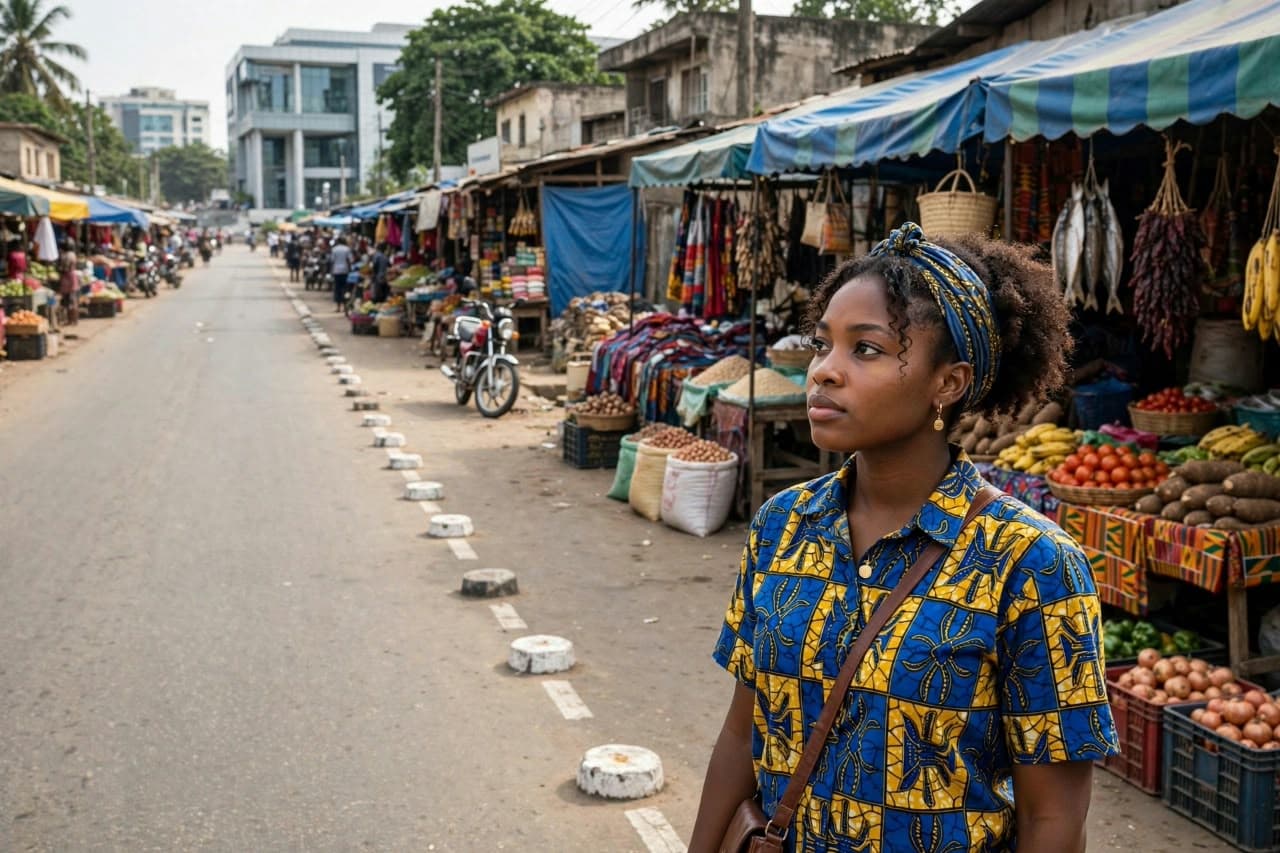
Accra, Ghana, November 19, 2026: Dzifa leaves home at 4:30am. She sells earrings, bracelets and trinkets at Makola every day except Sunday. At dawn, getting a trotro from Banana Inn to Rawlings Park is easy.
At the market, she collects her goods from the watchman and sets up her stall on part of the street. On a good day, she restocks around 4pm and closes at 5pm. She still does not get home until about 7pm.
The journey home is the hard part. In the evening, buses do not come to Rawlings Park, so Dzifa walks to the Post Office area and joins the long queue at the Banana Inn station near Salaga Market. Sometimes she takes a shared taxi to Dansoman Roundabout instead. The queue is shorter and she gets home earlier, but it costs more. On a bad sales day, she cannot afford it.
Her day raises the question at the heart of this report: when Accra’s roads, transport and markets are planned, whose day do the planners have in mind?
Greater Accra is Ghana’s most populous region, with 5,455,692 residents at the 2021 census, just over half of them women. The census covers the whole region; the transport findings in this report relate to Organisation for Economic Co-operation and Development (OECD) research on Accra’s urban area.
Women have long been central to the region’s economy. An analysis of Ghana’s 2015 Labour Force Survey by Women in Informal Employment: Globalizing and Organizing (WIEGO) found that market trade accounted for nearly 40% of women’s employment in Greater Accra, compared with about 10% of men’s.
Yet the city’s roads are shared very unequally. Cars are used by less than 1% of Accra’s population but take 60% of road space, and taxis another 15%.
The evidence points to an uncomfortable imbalance. Women who walk, travel with children and work in informal markets face barriers the city’s planning and transport systems have not addressed.
How Accra grew: planned for some, improvised for most
Accra became the capital of the British Gold Coast in 1877. Some areas were planned closely: Victoriaborg was formed as an exclusively European residential neighbourhood, and after the Second World War, Ridge and Cantonments were planned as low-density developments. Much of the rest of the city grew through trade, migration, family land and informal settlement.
Colonial history does not explain today’s city on its own, but growth has since outpaced infrastructure. The Accra city-region’s built-up area grew fourfold between 1985 and 2017, from about 105 to 468 square kilometres, according to the African Cities Research Consortium.
The Gender Lens: why planning is never neutral
Planning decides where markets, schools and roads go, how wide pavements are, and where toilets and lights are placed. A commuter driving to an office needs different things from a woman who does the school run, the market, a clinic and then work. When plans count mainly the first journey, the second disappears from the data and then from the budget.
A city that walks, but plans around cars
Research by the OECD Sahel and West Africa Club with the International Transport Forum, the University of Ghana and the Greater Accra Passenger Transport Executive (GAPTE) found that 95% of Accra’s population rely primarily on walking and trotros. The figures reveal a striking imbalance: road space goes mainly to cars and taxis, while most residents depend on walking and public transport.
Distance adds to the burden. 61% of Accra’s population live where no market can be reached within a 30-minute walk, and more than half cannot reach a primary school on foot in that time. Women make 75% of trips taking children to and from school.
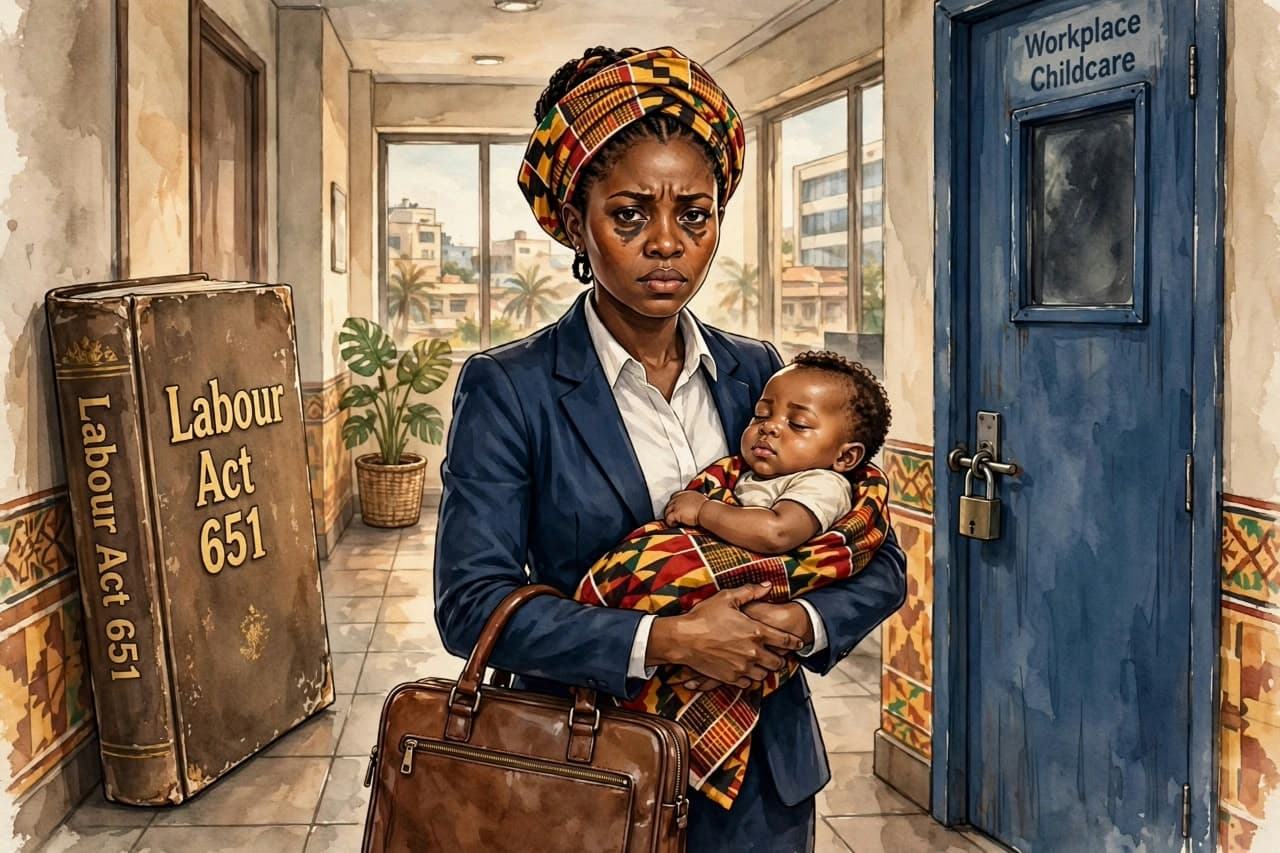
The trotro system often fails to accommodate these journeys. Drivers frequently refuse children under 12, who traditionally ride free, and among low-income residents trotro use falls from 38% when travelling without children to 3% when travelling with them. Market traders, many of them women, may be refused entry or charged extra for heavy loads.
Dzifa’s evening shows the same gap. Transport that is plentiful at dawn thins out when traders close for the day. Her choice is between a long walk and a longer queue, or a taxi fare that eats into a day’s takings. Either way, the commute costs her two hours, time she could spend with her family, resting or selling.
The Gender Lens: what is mobility of care?
Transport planning has long focused on the commute. “Mobility of care” covers everything else: school runs, household shopping, hospital visits and checking on older relatives. In Accra, a higher share of women’s daily travel goes to care trips across all income groups. When these trips go uncounted, planning overlooks much of how women use the city.
Markets: the city’s economic engine, treated as a problem
The same WIEGO analysis found that informal work made up 83% of employment in Greater Accra in 2015: 87% among employed women and 79% among employed men. Yet the streets and pavements where many of these workers earn a living are a regular target of clean-up campaigns.
In May 2025, the Accra Metropolitan Assembly (AMA) launched a decongestion exercise across the central business district, backed by the police and National Security. In February 2026, it began re-demarcating approved trading areas under its Red Line policy.
The 31st December Market at Makola shows what is at stake. In May 2026, traders protested the AMA’s plan to relocate them, saying no suitable alternative space had been provided. The Assembly rejected claims of forced eviction, saying it had consulted traders before turning the single-storey stores into a four-storey market.
In July 2026, the AMA and traders’ representatives agreed temporary relocation to Rawlings Park and the Community Centre. The Assembly said recognised shop owners and legitimate allottees would get priority when shops in the redeveloped market are allocated. In October, Mayor Michael Kpakpo Allotey warned traders that registration for the new shops was free, following reports of people demanding GH¢10,000.
The Makola dispute shows why consultation and relocation arrangements matter in market redevelopment. Traders raised concerns about their livelihoods and the lack of suitable temporary space, and the eventual agreement addressed both.
Madina offers the same lesson. In 2018, about 2,000 vendors there refused to move to a muddy field with no toilets, streetlights or storage. Once the assembly provided those amenities, they relocated willingly. The traders were not resisting order. They were asking for a workplace that worked.
Traders such as Dzifa, who set up on part of the street, sit at the centre of this debate. For the city, a street stall is a decongestion problem. For her, it is where the customers are, and her living depends on it.
Toilets, lighting and the journey home
For women who trade before dawn or travel home after dark, sanitation and street lighting are questions of access and safety. A University of Ghana study of women traders at Makola found theft to be the most common crime they faced, and called for a gender-sensitive approach to market security.
Nationally, Afrobarometer’s 2024 survey found only 26% of Ghanaians believe the police and courts are doing enough to protect women from harassment in public spaces such as markets, streets and public transport.
The residents the city still locks out
The Persons with Disability Act, 2006 (Act 715) required existing buildings to which the public has access to be made accessible within ten years. That deadline expired in August 2016, but accessibility remains a concern. In August 2026, persons with disabilities in the Volta Region threatened street protests over the failure to make public facilities accessible.
For a woman who uses a wheelchair, a stepped market entrance or an inaccessible toilet decides whether she can work, shop or use a public service on her own.
When disaster strikes, who bears the cost?
Emergencies expose the gaps fastest. The Kantamanto Market fire in January 2025 destroyed more than 7,000 shops, according to the government. Reports put the number of affected traders at around 30,000.
On 3 June 2015, floods and a fire at the GOIL station near Kwame Nkrumah Circle killed 159 people, exposing weak drainage and building along waterways.
Evictions raise the same question. After his visit to Ghana in October 2026, the UN Special Rapporteur on the right to adequate housing, Koldo Casla, urged the authorities to end forced evictions without prior consultation or proper compensation. He cited recent demolitions in Accra and continuing threats facing Old Fadama.
What Accra’s plans promise
The Land Use and Spatial Planning Act, 2016 (Act 925) provides the legal framework for spatial planning in Ghana, including national and local plans. Greater Accra has its own structure plan, GAMAPLAN 2040, and in November 2025 the government launched revised spatial planning manuals and standards promising “safe, inclusive, resilient” settlements.
Evidence on women’s travel has also informed Accra’s Sustainable Urban Mobility Plan. But a plan that promises inclusion is not proof that residents experience it. The test is wider pavements, safe crossings, toilets near markets, working street lights and transport that carries a mother with her child.
What a city designed for everyone could look like
Vienna has shown this is practical, starting small. In a single pilot district, Mariahilf, between 2003 and 2005, the city widened 1,000 metres of pavement, created 40 crossings and five barrier-free ramps, and installed 26 lighting projects to make streets safer after dark. These changes help children, older residents and people with disabilities as well as women.
The lesson for Accra is not to copy Vienna, but to plan from evidence about how different people use the city. Accra’s own transport research already recommends redesigning streets and reallocating road space towards walking, trotros and mass transit.
Five questions Accra’s planners must answer
The evidence leaves five questions for the AMA, the Land Use and Spatial Planning Authority, GAPTE and the National Development Planning Commission:
• How often do planning and transport decisions use data broken down by sex, age and disability?
• What must be in place, including toilets, storage, lighting and viable trading space, before traders are moved or a market is redeveloped?
• How much public money goes to pavements, crossings, street lighting and public toilets, compared with roads for private vehicles?
• How will transport planning serve people travelling with children and traders carrying goods?
• How will Act 715 be enforced in markets, terminals and other public facilities?
The answer, for now
Accra was not necessarily designed to shut women out. But the evidence reveals a city where road space, transport systems and decisions about public space do not adequately reflect how most residents move, work and care for others. Women carry a disproportionate share of the consequences because they undertake most school escort trips and market trading accounts for a substantial share of their employment.
A city that works for a woman travelling with a child, a trader like Dzifa walking to a bus queue at 5pm, a wheelchair user crossing a market or a worker walking home after dark works for more of its residents.
The question is whether Accra’s planners will put those journeys at the centre of how the capital grows.