Accra, Ghana, November 20, 2026: Somalia was the only country to vote against a United Nations resolution on ending violence against women and girls this week, leaving it isolated even from its closest neighbours.
The General Assembly’s Third Committee, which deals with social, humanitarian and cultural issues, approved the resolution on Tuesday 17 November 2026 by 175 votes to one, with six abstentions. The United States, Russia, Argentina, Belarus, Burkina Faso and Cameroon abstained. Afghanistan and Iran were among 11 countries that did not vote.
Somalia’s delegation did not speak during the debate, filed no reservations and has given no explanation for its vote. Neither its UN mission nor the Ministry of Foreign Affairs in Mogadishu has said who decided the position or why.
What the resolution says
The resolution, A/C.3/81/L.16/Rev.1, continues a long-running series of UN texts on violence against women and girls. This year’s focus is gender-related killings, including femicide. The resolution was presented by France and the Netherlands. Introducing it, its sponsors described such killings as a global problem, often preceded by threats, abuse and other forms of violence.
The text calls on states to take comprehensive measures to prevent violence, intimidation and attacks against women and girls and to strengthen their laws and policies. It also extends its definition of violence to online spaces, urging action on online harassment, defamation and hate speech.
The numbers behind it are stark. A UN Secretary-General’s report in August found that nearly 50,000 women and girls were killed by partners or other family members in 2024. The report also warned that GPS tracking, spyware and monitoring apps now let abusers extend coercive control into the digital sphere. The United Kingdom put it plainly: every 10 minutes, a woman is killed by her partner or a family member.
Explainer: what is the Third Committee?
The Third Committee is one of six main committees of the UN General Assembly. All 193 member states sit on it. It negotiates and votes on draft resolutions on human rights, women, children and social issues.
A Third Committee vote is not the final step. The full General Assembly will take up the resolution in plenary in December 2026, when countries vote again. UN resolutions of this kind are not legally binding, but they set global standards that governments, courts and campaigners rely on.
Where the fights were
The vote followed tense negotiations. A cross-regional group of 21 states, led by Egypt, proposed an amendment requiring the resolution to be applied in line with each country’s national laws and its religious, ethical and cultural values. France moved to take no action on it, and that motion passed by 68 votes to 54, with 30 abstentions.
Nine civil society organisations, including Amnesty International, Human Rights Watch and the International Planned Parenthood Federation, had warned that the amendment would add a general sovereignty caveat to the resolution. In their words, this is not how sovereignty has been understood in the human rights system.
Ten further amendments, four of them from Russia, sought to delete references to gender-based violence, intimate partner violence, intersecting discrimination and women and girls “in all their diversity”. All of them failed.
Several countries voted yes while distancing themselves from parts of the text. Djibouti objected to language on sexual and reproductive health and comprehensive sexuality education. Egypt disassociated itself from references to intimate partner violence and marital rape. Senegal said it would apply the text strictly in line with national law.
The United States abstained, saying it was disappointed the text kept references to sexual and reproductive health and safe abortion, and that “there is no international ‘right to abortion’”. Argentina, which cast the only vote against the 2024 version in committee, abstained this time.
Somalia’s silence
Somalia’s vote stands out because it said nothing. Countries with objections usually explain their vote, enter reservations or disassociate themselves from specific paragraphs. Somalia did none of these.
Its record that week adds to the puzzle. Somalia joined consensus on the resolution on female genital mutilation on 10 November and the one on trafficking on 17 November. On 13 November, it voted in favour of a moratorium on the death penalty.
This year’s no is also a reversal. When the General Assembly adopted the previous version in December 2024, Somalia voted yes.
The vote also comes in the final weeks of Somalia’s two-year term on the UN Security Council, its first seat since 1971 to 1972.
At home, the House of the People passed a Rape and Indecency Crimes Bill on 14 October 2026, but the final text has not been published. An earlier Sexual Offences Bill, drafted in 2018, was replaced in 2020 by a version criticised for treating the marriage of a girl as lawful after puberty. About 99% of Somali women aged 15 to 49 have undergone female genital mutilation, even though the Provisional Constitution prohibits it.
Africa’s vote
Somalia’s neighbours went the other way. Kenya, Ethiopia, Uganda, Burundi and Rwanda all supported the resolution. Burkina Faso and Cameroon were the only African countries to abstain, and Somalia was the only country anywhere to vote no.
What the vote means
In practical terms, Somalia’s vote changed nothing in the result. The resolution passed with 175 votes and goes to the General Assembly in December.
Nor did Somalia break a consensus on its own. This resolution has gone to a recorded vote in recent sessions. In 2022, it passed the Third Committee by 166 to none, with 14 abstentions. In 2024, it passed the committee by 170 votes to one, with Argentina the lone no, before the General Assembly adopted it by 174 to none, with 11 abstentions. This year, the debate had already split over amendments, and six countries abstained.
The vote can be read in two ways. Diplomatically, states often oppose UN texts over specific clauses, such as language on abortion, sexuality education or gender, while saying they support the wider goal. But they usually make that clear through an abstention, an explanation of vote or by disassociating from specific paragraphs, as Djibouti, Egypt, Senegal and the United States did. Somalia used none of these tools, so whatever it objected to remains unknown.
From a women’s rights perspective, the reading is harsher. A country where about 99% of women have undergone female genital mutilation, and where the sexual offences law is still unpublished, has put on record a no to a global call to end violence against women and girls. Without an explanation, that is the message the record carries.
The Third Committee vote is now part of the UN record. The December plenary gives Somalia a chance to change its vote or explain it.
Where Ghana stands
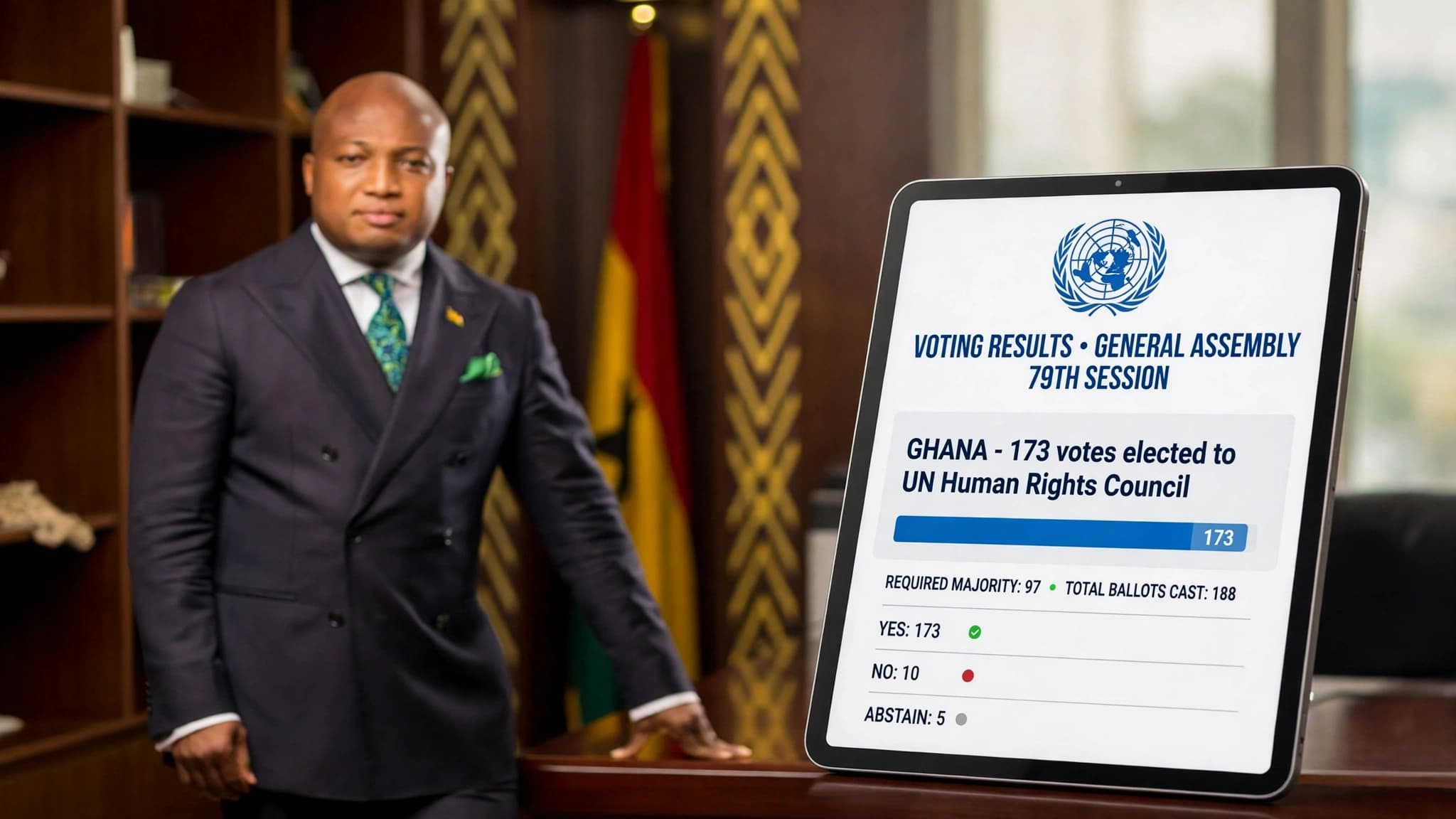
Ghana voted in favour of the resolution and was one of the 175 countries that backed it.
The vote follows a significant step at home. On 30 July 2026, Ghana’s Parliament approved the ratification of the African Union Convention on Ending Violence Against Women and Girls. The African Commission on Human and Peoples’ Rights said this made Ghana the second African Union member state to ratify the convention, after The Gambia.
The Commission also noted that the convention’s full legal effect in Ghana depends on depositing the instruments of ratification with the African Union. The convention needs 15 ratifications to enter into force.
For women and girls in Somalia, the vote sends a troubling signal from a government still writing its laws on sexual violence. For the rest of the continent, it is a reminder that commitments made at the UN only matter when they are carried home into law, budgets and courts.
What happens next
The vote came eight days before the start of the 16 Days of Activism against Gender-Based Violence, which runs from 25 November to 10 December.
The resolution now goes to the full General Assembly in December. Somalia will have a second chance to vote, or to explain its position.
Gender Lens Africa will follow the plenary vote and report on whether Somalia’s position changes.