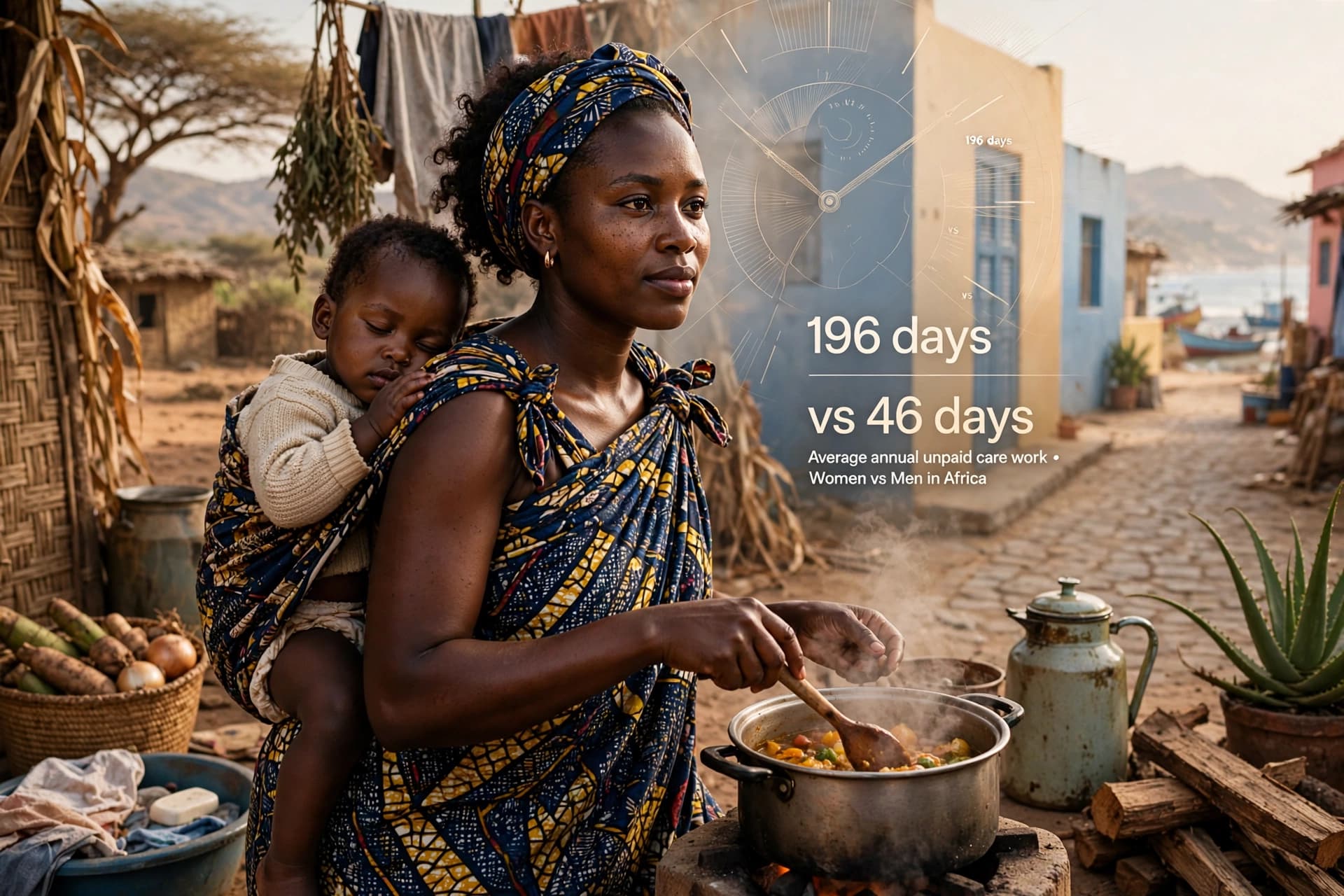
Accra, Ghana, October 29, 2026: Kenyan women spend the equivalent of 196 full-time working days a year on unpaid care, against 46 for men.
Across Africa, millions of women have already been at work before the working day begins. They have cooked, washed clothes, fetched water, and looked after children, older relatives and family members with disabilities. Many will then go on to paid work, farming or trading, and come home to a second shift.
Governments are starting to count that work. Two of them, Kenya and Cabo Verde, have put care into national policy. Their results show what a policy can change, and what it leaves untouched.
Unpaid care work in Africa: who does it and who pays
The United Nations Economic Commission for Africa (UNECA) says in a concept note for a 2025 financing event that more than 70 per cent of care work across Africa is unpaid and done by women and girls. Women and girls spend about 3.4 times as much time on care as men. In some countries, UNECA says, that work could be worth as much as 8.8 per cent of GDP.
The cost lands on women’s time. A woman without affordable childcare is not always choosing to stay out of work. Girls leave school to mind younger siblings. Paid care jobs, also mostly held by women, often come with low wages and poor conditions.
Kenya turned hours into a number: 23.1 per cent of GDP
Kenya measured first and wrote policy second. The 2021 Time Use Survey found women spending 4 hours 38 minutes a day on unpaid care and domestic work, against 1 hour 1 minute for men. UN Women says Kenya ranks third highest in the region for the time women spend on unpaid care. In Marsabit County, women spend as much as seven hours a day.
In November 2025, the Kenya National Bureau of Statistics (KNBS) put a price on that work. Using what it would cost to hire cooks, cleaners and carers, KNBS valued unpaid domestic and care work at 23.1 per cent of GDP in 2021, about Sh2.5 trillion. The State Department for Economic Planning gives the figure as Sh2.54 trillion.
Women did 25.8 billion hours of that work. Men did 4.8 billion. Women supplied 84.2 per cent of the labour input.
On 15 December 2025, the Cabinet endorsed the National Care Policy. Its aims include addressing unpaid care work, coordinating services and strengthening accountability.
Money is the test. At a UN Women event, county officials reported budget lines: Kitui Sh1.1 billion, Laikipia Sh853 million and West Pokot Sh5 million for care. The spread shows how unevenly commitments are arriving. An official who helped draft the policy had earlier named funding and social norms as the main obstacles.
Cabo Verde has had a care plan since 2017. The gaps remain
Cabo Verde has had a national care plan since 2017. ECOWAS cites it as a promising example for the region.
A World Bank analysis shows what is left to fix. Women in Cabo Verde spend nearly three times as many hours as men caring for other people, and twice as much on housework. Among economically inactive women, 36 per cent cite family responsibilities as the main reason they are not working. Among men, it is 6 per cent.
New national data came out in August. The country’s gender equality institute valued unpaid work at 9.6 per cent of GDP. It found that 88.4 per cent of women aged 10 and above do unpaid work, against 67.9 per cent of men.
The total volume of unpaid work has fallen by more than half since 2012. The gap between women and men is still above 20 percentage points. The government says it will expand childcare centres, home-based support, day centres for older people and services for people with disabilities.
That is the lesson. A plan and new services can shrink the total. They do not, on their own, close the gap between women and men.
Kenya and Cabo Verde compared
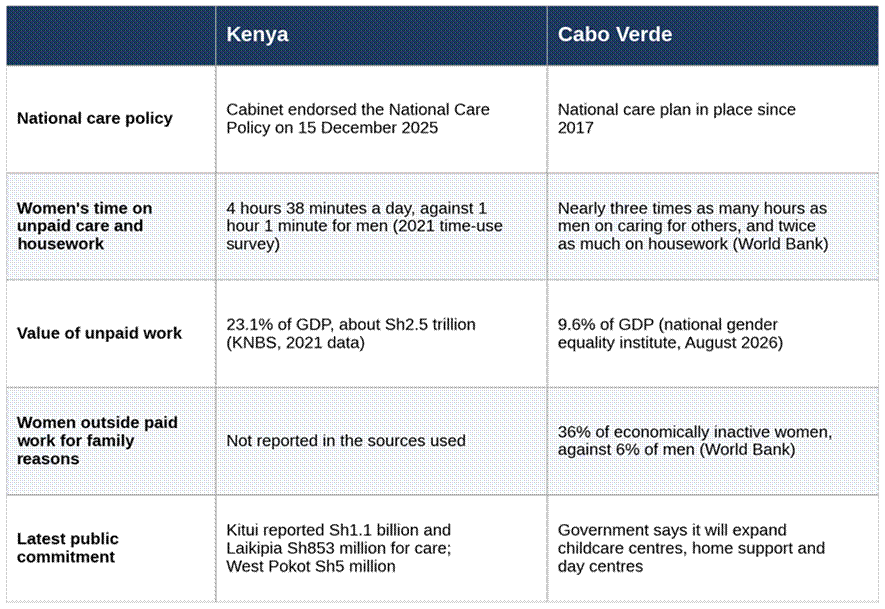
Sources linked in the text. Surveys, years and methods differ, so the figures are not directly comparable.
Read together, the two countries show different strengths. Kenya has the sharper data and a price tag. Cabo Verde has the longer record and evidence of change over time.
They share one weakness. In both, the burden still sits mainly with women, and public money for services is not yet at the scale of the need.
What the rest of Africa is doing, and not doing
UNECA argues that care spending pays back. Its concept note says each dollar invested in care creates two to three times as many jobs as traditional infrastructure, with up to 78 per cent going to women. It estimates that better childcare, clean energy and health services could raise women’s labour force participation by up to 15 per cent. It also cites Rwanda’s onsite childcare, which it says cut absenteeism among female workers by 22 per cent.
Ghana has the same pattern. A study reported by the Ghana News Agency in June used national survey data to find women spending 147 minutes a day on unpaid care, against 49 for men. In the Savannah and other northern areas, women do more than four times as much as men. Studies use different surveys and definitions, so totals vary, but the direction does not. I could not find a Ghanaian national care policy equivalent to Kenya’s.
The regional machinery is moving. On 12 October, more than 100 participants from ECOWAS member states and civil society met online to build a regional position on the care economy. A mapping study behind the meeting set seven regional priorities, including governance, data, national policy frameworks, professional status for care workers, and financing.
ECOWAS will take that position to an African Union meeting in Addis Ababa on 28 and 29 October. It will help shape the African Common Position for the 71st Commission on the Status of Women (CSW71) in New York from 8 to 19 March 2027. Ministers responsible for gender equality are due to adopt the position on the margins of the session.
Positions are cheap to write. Budgets are not.
What African governments must answer before CSW71
1. Count it. Run regular time-use surveys and value unpaid work in national accounts, as Kenya has done. Without numbers, care stays invisible in the budget.
2. Fund it. Put named lines for care in national and local budgets, and publish what is spent. A policy without a budget is a statement of intent.
3. Build services. Affordable childcare, support for older people and people with disabilities, and the water and energy that cut hours of daily labour. Reach rural and low-income households first.
4. Pay care workers fairly. Set wages, training and social protection for the women who do paid care, from nurseries to domestic work.
5. Share the work. Expect men to carry their share, and support them to do it. In Kenya, men did 4.8 billion hours of this work. Women did 25.8 billion.
Counting care is the start, not the finish
Kenya has the numbers. Cabo Verde has the longest-running plan. Neither has finished the job, and neither should be copied without asking what fits at home.
Women have long subsidised African economies with their time, without wages, pensions or recognition. They cannot be expected to keep absorbing the cost of care systems that governments have not built.
If care sustains the economy, why is the cost still being left to women?
Gender Lens Africa’s CSW Desk examines the commitments, policies and decisions shaping gender equality across Africa.