Accra, Ghana, October 16, 2026: When I visited my maternal grandmother in Blekusu as a child, the beach was never quiet. Fishing went on from Kedzi through Blekusu, Agavedzi, Adina and Adafienu, along stretches lined with coconut trees.
Women bought the catch, smoked it on locally made grills and sold it on market days in Denu, Agbozume, Aflao and across the border in Togo. The sea fed us. Today, it is destroying the livelihoods of the women who depended on it.
As the world marked the International Day of Rural Women, I thought about what women along the Ketu South coast have lost, the decisions that left them exposed, and what they are owed.
A woman’s economy between the sea and the lagoon
Blekusu sits between the sea and the lagoon, and the women worked both. They farmed mangoes on the grasslands behind the lagoon, which we call ‘Torgodo’, loosely “behind the river”. In the dry season they mined salt, and some set traps for crabs, tilapia and anything else the can catch in the lagoon .
This was not one job. It was several jobs spread across the year, so that when one failed another held. That spread was a woman’s insurance, and the sea has been taking it apart for decades.
Officials count houses lost to the sea. They rarely count ovens, nets or salt pans. Families who make salt in Ketu South lost the rubber sheeting they need to harvest it, and fish processors in Agavedzi lost their ovens and equipment. The official counts I found list households and houses, not women’s businesses.
A sea that has taken from one family twice
My grand aunt lived at Kedzi, at the estuary where the sea and the lagoon meet we call that place Azizadzi. In the 1990s a tidal wave took her home, and the homes along that side vanished into the sea. Most displaced families moved to Havedzi. She moved to Blekusu.
In 2023 the tidal waves came into her home again. One woman, one sea, two losses about thirty years apart. For years, nothing was done to help women like her sustain their families.
Her story is not rare, and it has causes. A review of the coast’s history points to the Akosombo dam, which reduced the sediment that once rebuilt this shoreline. It also names sand winning, which means digging sand off beaches for construction, and rising seas. The coast loses land faster than it can replace it.
Waves that keep returning
In the early hours of 11 June 2017, tidal waves hit Blekusu and displaced about 1,500 people. Families sheltered in classrooms, chapels and a health centre. The Works and Housing Minister at the time, Samuel Atta-Akyea, called the waves a natural phenomenon and told residents to stay out of harm’s way.
In 2019 the sea destroyed 55 homes and carried coffins out of cemeteries. In March 2021 it submerged about 100 houses across Agavedzi, Salakope, Adina, Blekusu and Amutinu, and residents marched to demand a sea defence wall. The municipal director of the National Disaster Management Organisation (NADMO) said the sea had permanently claimed those communities.
Displaced families turned to the salt lagoon island of Dzetagba, where about 200 people built shelters to fish and mine salt. They turned down offers of buckets and tents and insisted on a wall. By June 2021 the Ketu South MP, Abla Dzifa Gomashie, warned that about 1,000 residents were displaced and that the next wave could wash away the main road between Aflao and Keta.
How politicians played with the sea defence
The Blekusu sea defence project has a divided history. Phase one, covering 4.3 kilometres of coast, started in 2015 during President John Mahama’s first term. Phase two would protect Agavedzi, Salakope, Amutsinu and Adina. It did not follow.
The Presidency says phase two stalled for nearly a decade. In 2021 the Minority in Parliament pressed for money for the tidal wave communities in the 2022 budget. In a radio interview that spread widely in December 2021, the then Energy Minister, Matthew Opoku Prempeh, said he would lead a demonstration in Kumasi if the finance Minister gave in to that demand.
He later said he supports the project fully and objected only to political hostage-taking. Many Ghanaians still condemned his remarks as insensitive. The 2022 budget did not capture the project, and the Works and Housing Minister, Francis Asenso-Boakye, said he was disappointed.
The sea kept coming. By early March 2025 the waves had displaced 300 people, destroyed 51 households and washed away 800 metres of coastal land. They also desecrated 63 graves.
Then the machinery moved. President Mahama cut the sod at Agavedzi on 19 July 2025, promising that “no more will the sea consume our land”. The contractor, Amandi Holding Limited, is pre-financing the work, reported at GH¢919 million.
That scale of investment stands in stark contrast to the limited provision reported in the 2022 budget debate. For women whose livelihoods had already been damaged or destroyed, it came after years of repeated losses.
Both main parties have governed this coast, and both have made promises on it. The women did not need a winner in that argument. They needed a wall in 2017.
What the wall has and has not fixed
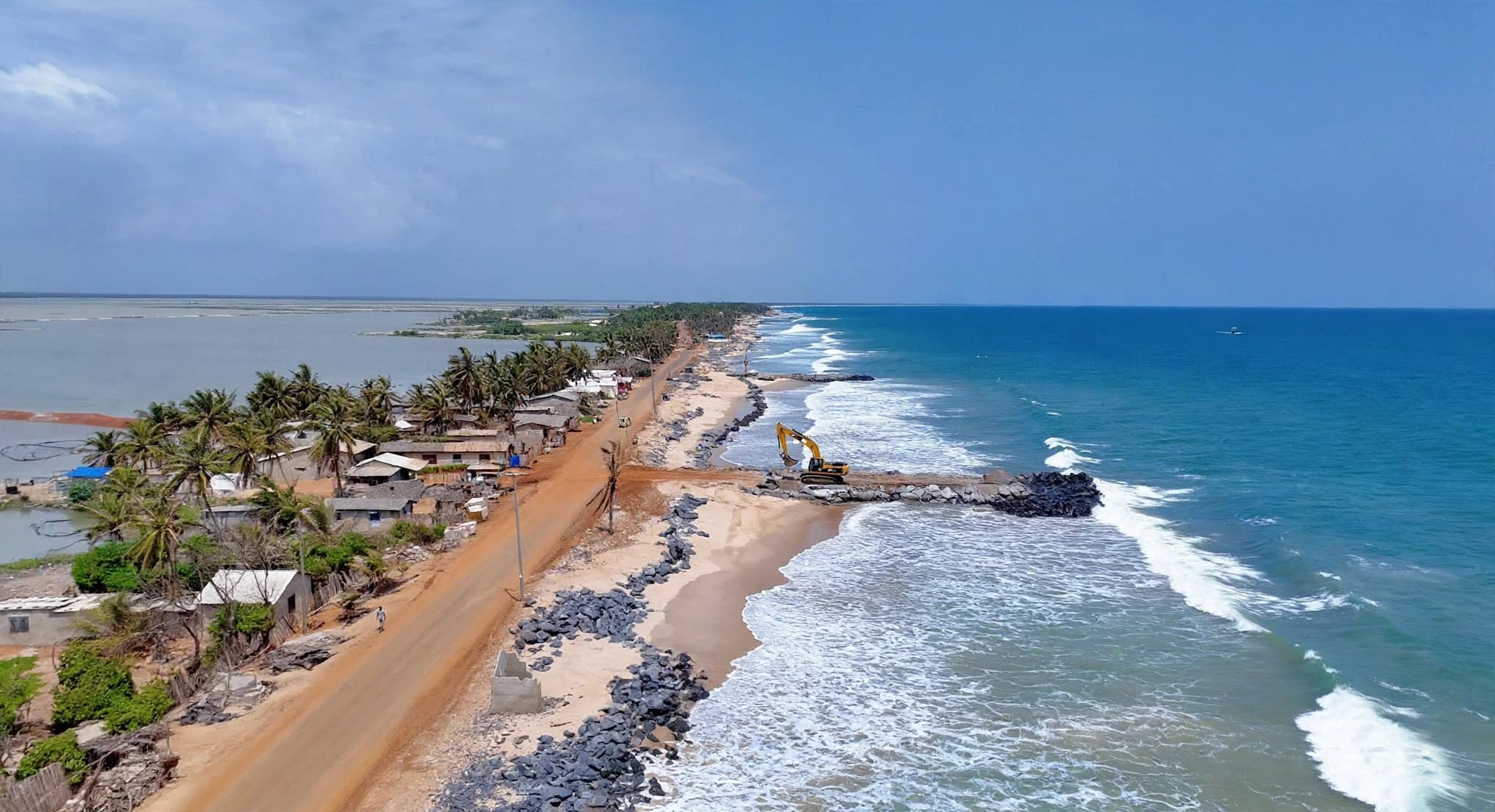
Work is under way. By November 2025 the project coordinator said construction was between 20 and 25 per cent complete. The contract covers 37 groynes, which are walls built out into the sea to slow waves and hold sand, plus dune restoration along eight kilometres of coast.
In April 2026 the Ketu South Municipal Chief Executive, Nicholas Kwabla Worclachie, said only seven groynes were built and that tidal waves still destroy communities near Amutsinu. He called on the President to deliver the dredging promised under the West Africa Coastal Areas (WACA) programme, a World Bank-supported project estimated at 155 million dollars. Dredging means lifting sand from the seabed to rebuild the beach and clear the debris.
Agavedzi’s assembly member, Eben Assah, says the wall has reduced the force of the waves. But wreckage from destroyed buildings and trees still lies in the sea and tears fishing nets. The waves often come at night, and they have swept away birth certificates, land documents and school materials.
What women lose when the shore goes
In coastal Ghana, fish processing and trading are the main livelihoods for women and girls, according to a project document from the United Nations Educational, Scientific and Cultural Organization (UNESCO). The same document warns that when homes and fishing equipment are destroyed, women and girls face greater economic insecurity and a higher risk of gender-based violence, including transactional sex for fish. It describes a risk across the coast, not a finding about Blekusu. I read it as a warning about what follows when women lose the means to earn.
When a woman loses her smoking oven, she loses the means to process and sell fish. Less income can mean difficulty paying school fees, buying food and meeting other household costs. Setor Juliet of Amutinu, a single mother raising two children and two orphans, says businesses have collapsed. A 30-year-old trader and mother of three told reporters that relief items would last only a few days.
Along Adafienu, families now farm onions, okro and tomatoes. I admire that effort. But adaptation is not compensation, and a woman who turns to vegetables because the sea took her fish is doing the state’s work of survival for it.
Help from outside has been small. One project, The Sea Works At Night, backs 50 caregiver households to return to fish mongering and salt mining. That is welcome. Hundreds of people were displaced in each of the waves above.
What these women are owed
The wall will protect land. It will not, by itself, give a woman back her trade. The Presidency has promised a modern fish market, cold storage, dedicated spaces for fish drying and smoking, a car park, a lorry station, sanitation and waste collection alongside the wall. The announcements I read do not say who gets those smoking spaces or what they will cost.
I am asking for four things. Count the women. Register displaced fish processors, salt producers and traders in Ketu South, and publish the numbers so that nobody has to guess what was lost.
Give women first claim on the new fish smoking and drying spaces at rents they can pay, and seat women processors on the committee that runs them.
Replace what the sea took, ovens, nets, sheeting for salt pans and working capital. Fund a livelihood programme, not another round of buckets and tents.
Keep the promises on the record. Fund the dredging, and publish progress on the groynes every quarter so residents can check the work against the contract.
The beach I remember had coconut trees, smoke from the grills and women who turned the sea into a living. Rebuilding the coast must mean rebuilding the economic opportunities that sustained them, not simply protecting what remains of the land.
My grand aunt has lost her home to the same sea twice. She should not lose the next thirty years to a budget line.