Accra, Ghana, November 13, 2026: Women and women-owned businesses accounted for 82.8% of registered secured-credit transactions in Ghana in the second quarter of 2026. They received GH¢3.1 billion in credit value. Men and male-owned businesses received GH¢19.4 billion.
The distinction matters. The 82.8% measures the number of transactions, not women’s share of lending value. Secured credit means loans backed by collateral registered with the Bank of Ghana’s Collateral Registry, so these figures do not cover all lending in Ghana. They show that women account for most registered transactions but receive a much smaller share of the credit value.
That gap is the test for the 2027 Budget. On 12 November, Finance Minister Dr Cassiel Ato Forson announced a GH¢30 billion injection into the New Economy, the first year of a four-year programme worth about US$10 billion. It runs on eight interconnected pillars, from agriculture and energy to textiles and tourism.
Two claims are circulating. One says the budget forgot women. The other says women are covered because they work in the sectors being funded. The evidence supports neither in full.
What the New Economy plan funds
The graphic below sets the Ministry of Finance’s pillar amounts beside what the evidence says about women in each.
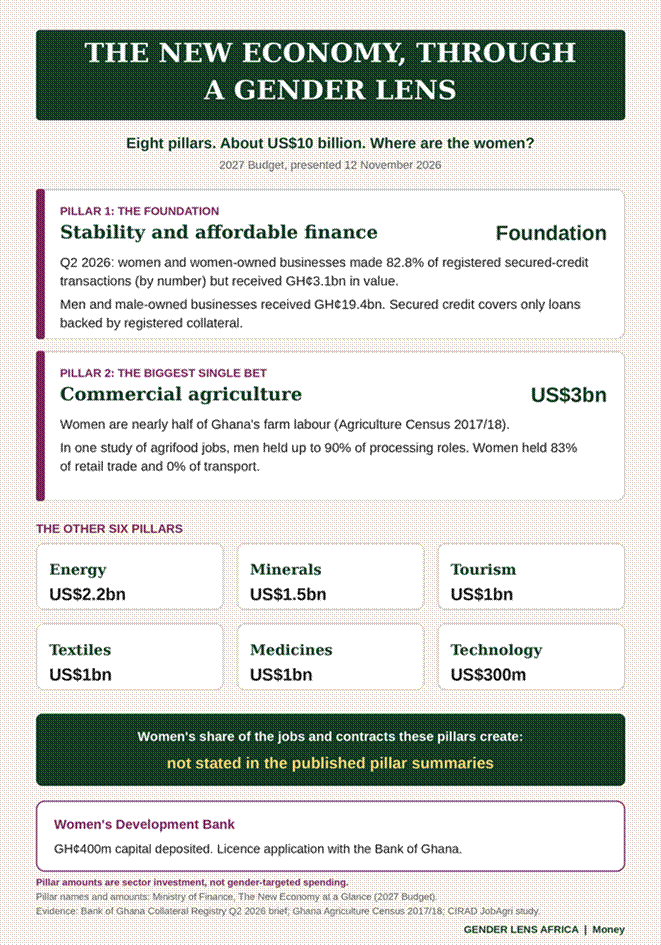
The New Economy through a gender lens. Pillar amounts: Ministry of Finance. Evidence: sources linked in this article.
Only two pillars have clearly identifiable evidence on women’s access to economic opportunities at this stage: affordable finance and agriculture. For the other six, the pillar summaries published so far do not say how many jobs or contracts women can expect.
Does the US$3 billion for agriculture reach women?
Agriculture receives the largest share, US$3 billion over four years. The money targets eight agricultural industries, among them rice, poultry, vegetables and oil palm. Forson also announced that public procurement law will require schools and hospitals to buy locally grown food.
Women have a real stake here. The 2017/18 Agriculture Census found women make up nearly half of Ghana’s agricultural labour force. Local buying rules could open steady markets for women who grow and sell food.
Position in the value chain matters as much as presence. A study of Ghana’s agrifood jobs found men hold up to 90% of processing jobs. Women hold 83% of retail trade and none of transport and logistics. The pillar’s focus on agri-industry points to the segment where women are least present.
The government’s case deserves a hearing. Ghana spends about US$3.5 billion a year on imported food, and Forson argues the country must move beyond peasant agriculture. Modern commercial farms could create jobs and cut that bill. But family farms are where women are most present, so the plan needs a clear route for them into the new value chains.
Where is the Women’s Development Bank in the 2027 Budget?
The Women’s Development Bank (WDB) is the clearest dedicated institutional measure for women’s access to finance. It is not the only measure in the budget that could benefit women. Its record is clearer than the budget debate suggests.
The 2025 Budget set aside GH¢51.3 million as seed funding. The 2026 Budget added GH¢401 million. Together, the two allocations come to GH¢452.3 million.
In July, Forson said GH¢400 million had been deposited in an escrow account at the Bank of Ghana. That is the reported capitalisation amount, not a further allocation.
On 10 November, Vice-President Prof. Naana Jane Opoku-Agyemang announced that the bank’s banking licence application had gone to the Bank of Ghana. On 12 November, Forson told Parliament that the bank had been successfully capitalised and would be operational early in 2027. This revises the earlier expectation that the bank would begin full operations before the end of 2026.
Minority Leader Alexander Afenyo-Markin criticised the budget presentation for not addressing the women’s bank. That is a political position and it stands apart from the Minister’s announcement. The real accountability question is whether the capital will turn into affordable loans for women.
The coverage reviewed for this piece shows no new 2027 allocation for the bank. Because the capital is already deposited, a new line may not be needed. A lending target is another matter. The Network for Women’s Rights in Ghana (NETRIGHT) counts the same GH¢452.3 million and wants the bank to work for rural businesses. No public document reviewed for this piece sets out how much the bank will lend, at what interest rate, or to which women first.
Four questions the Finance Ministry should answer
Neither “the budget forgot women” nor “the budget covers women” holds up. What the budget lacks is measurement. Four answers would fix that:
1. How much of the GH¢30 billion for 2027 will reach women-owned businesses, and through which pillar?
2. What share of the US$3 billion for agriculture will go to women farmers and processors?
3. What is the Women’s Development Bank’s lending target for its first year, and when will market women receive the first loans?
4. Will the Ministry publish jobs and contracts data by sex across all eight pillars, with rural women, women with disabilities and informal traders separately identified? How will it collect and publish that data?
Ghana already counts women as borrowers. The 2027 Budget will be judged on whether it counts what women receive. A sector can be full of women and still leave them out of the money.