EL DAEIN, East Darfur, Sudan, 7 November 2026 : On 1 October 2026, Sukkarah had given birth to twins by Caesarean section at Al-Tadamun Maternity Hospital in El Daein. She had not yet regained the strength to stand when she was transferred to El Daein Teaching Hospital. There, she struggled to access a bed and the facilities she needed for post-operative recovery.
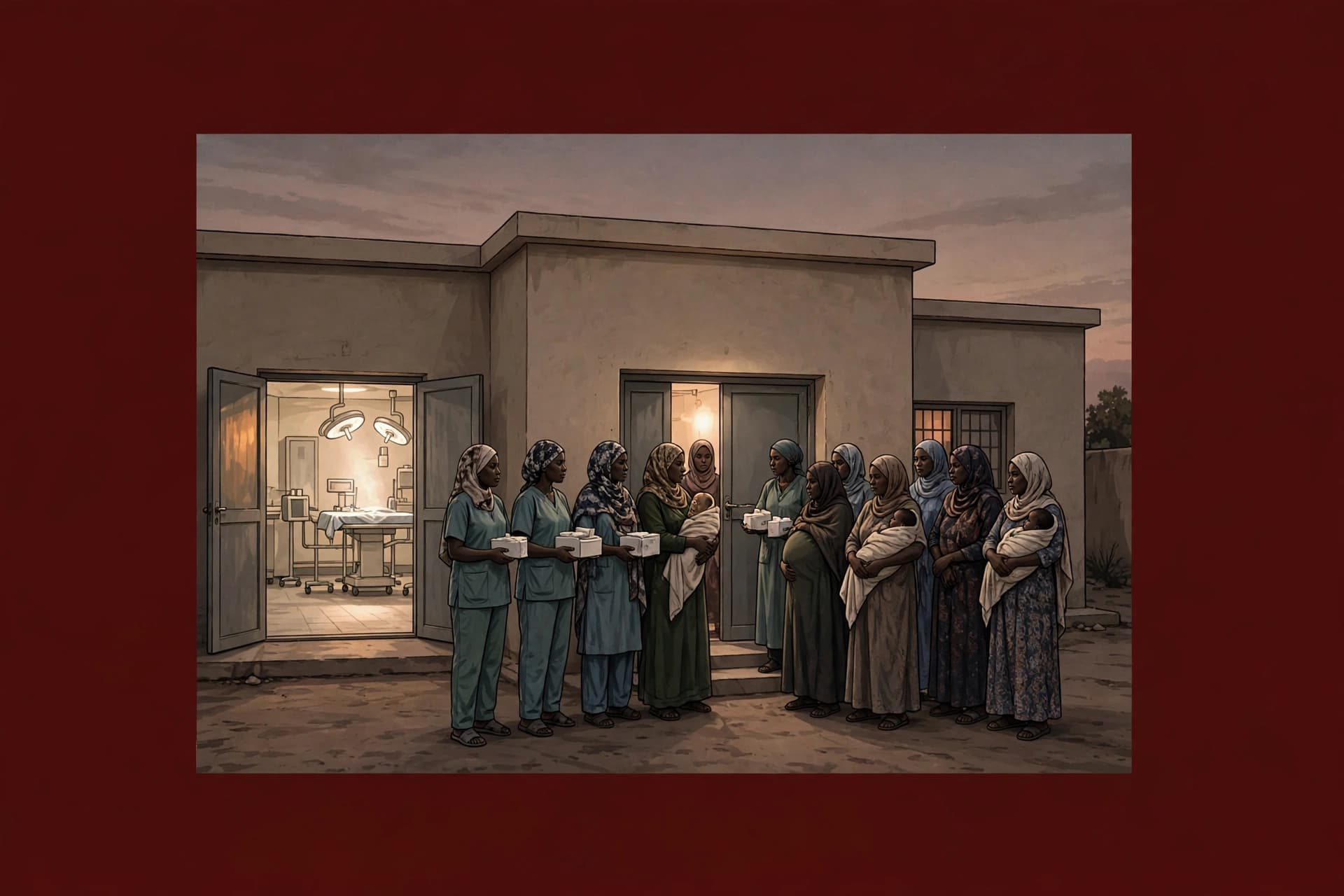
That same day, according to a hospital staff member who witnessed the incident, armed men from the Rapid Support Forces (RSF) entered Al-Tadamun and removed women from its operating rooms while they were still under anaesthesia. Some were unconscious and physically exposed. The witness said she objected to their removal but was herself forcibly taken out of the operating room and threatened.
A doctor involved in the evacuation was also beaten by an RSF member. According to the same eyewitness, the doctor subsequently experienced bleeding and suffered a miscarriage. The eyewitness said she personally treated the doctor and performed a uterine evacuation procedure.
The women had come to the hospital because they needed medical care. Some were reportedly driven out while still under anaesthesia. But the story of Al-Tadamun is not only about what happened during the raid. It is also about what happened before it: how a maternity hospital was brought back into service by people who refused to accept that women in their city should simply go without care, and how little that work counted when an armed force decided to take the hospital.
Al-Tadamun was not a service delivered by a state capable of guaranteeing its continuity. It had to be rescued from the collapse around it.
A hospital rescued through community effort
In August 2024, Dr Adam, Director of Therapeutic Medicine at El Daein Hospital, proposed moving maternity and paediatric services out of the general hospital. Al-Tadamun, which had been closed, would reopen as a specialised maternity facility, while the children's hospital would operate from separate premises. The proposal responded to a danger that had become increasingly difficult to ignore: whenever the general hospital came under attack or was forced out of service, women and children risked losing access to essential care.
The war had already made clear what happens when healthcare facilities become part of the fighting. Hospitals have been bombed, raided, looted and occupied. Places meant to protect civilians have themselves become sites of military confrontation.
A 2024 UN report to the Security Council documented 118 attacks on schools and hospitals, including 88 attacks on hospitals. It also verified the military use of 49 schools and 11 hospitals, attributing these incidents to the RSF, the Sudanese Armed Forces and other armed actors.
The pattern continued. The 2025 annual report of the Safeguarding Health in Conflict Coalition documented instances of medical facilities being seized and repurposed for military use by the RSF, as well as the occupation of hospitals by the Sudanese Armed Forces in Khartoum. In May 2026, UN experts described attacks on healthcare in Sudan as widespread, systematic and devastating.
East Darfur was not outside this pattern. Insecurity Insight recorded five attacks on healthcare in the state between 1 March 2025 and 17 August 2026. Two were attributed to the Sudanese Armed Forces and one to the RSF. Two health facilities were damaged, and El Daein Teaching Hospital was put out of service following airstrikes in March 2026.
It was against this backdrop that Al-Tadamun was brought back to life. Reopening it meant more than unlocking the doors. Some of its essential assets had to be recovered, with the involvement of several parties, including intelligence agencies. Staff and supplies had to be secured.
With little support from the Ministry of Health, the hospital relied on humanitarian organisations and community mobilisation. CARE provided midwives, while the International Committee of the Red Cross also supported the facility. The ministry's contribution was limited to essential supplies for surgical procedures.
Women and health workers helped make the hospital work again. They mobilised support, secured personnel and worked with humanitarian organisations to keep the service running. They were not simply waiting for assistance. They were part of the effort that made assistance possible and part of the labour that kept the facility open.
For years, this combination of humanitarian support and community effort sustained a specialised maternity service that the state could no longer reliably provide.
The hospital women could not afford to lose
Al-Tadamun became a vital facility for women across East Darfur, particularly those requiring emergency surgery. Darfur24 reported on 19 September 2026 that it was the only specialised facility for Caesarean sections and complicated deliveries in the state, receiving between 10 and 12 cases a day. A day later, JINHA reported on the dispute surrounding the hospital and the threat its closure posed to women's lives.
The facility offered free services and maintained an operating theatre around the clock.
The hospital had become indispensable. But the people who helped make it so had no meaningful authority over its future.
The RSF wanted the facility incorporated into its military medical department. In late December 2025, an officer arrived and demanded its handover. The director of the force's medical department subsequently wrote to the governor requesting the transfer. The governor referred the letter to the Minister of Health for action.
Al-Tadamun's administration refused to hand over the facility without a committee and clear administrative procedures. Some people involved in its management were threatened with death if they continued to resist. The dispute reached the governor and the Minister of Health, with objections raised over the letter used to justify the handover. The letter was described as forged.
The hospital was closed in late December 2025. It remained shut throughout January and February 2026 before eventually reopening.
The demand did not disappear. It returned in September 2026, when the hospital again faced pressure to be transferred to the RSF's medical administration. Eglal's reporting establishes the demand for the takeover but does not establish the precise chain of command behind the decision or independently verify the involvement of senior RSF leadership.
On 1 October 2026, the dispute escalated into an armed takeover. According to the hospital staff member who witnessed the incident, RSF gunmen entered the hospital and removed women from operating rooms while they were still under anaesthesia. The force's medical supplies department subsequently assumed control of the facility. Its maternity services came to a complete halt.
The justification given was the need to treat fighters wounded in military operations.
Wounded fighters need treatment. That is not the issue. The issue is the authority an armed force assumes when it decides that its military needs override the purpose of a civilian institution. The need to treat combatants does not give a force the right to seize a maternity hospital, remove women during surgery and stop a service on which the surrounding community depends. Nor does it answer the question of what happens to the women who needed that service.
When another hospital is not enough
There is no publicly available information about what will happen to Al-Tadamun or whether its maternity services will resume.
In seeking comment, Eglal contacted three individuals. Bilal, an RSF official responsible for wounded fighters, declined to comment during an initial telephone conversation, saying he would try to obtain a statement from another official. A subsequent call on 6 November went unanswered. Salim Al-Fadil, who has been involved in medical supplies within the RSF and previously served as administrative director of East Nile Hospital during the RSF's control of parts of Khartoum, did not respond to attempts to reach him. Alaa Naqd, Minister of Health in the Tasis government, was asked whether the ministry knew about or had any role in the decision to transfer Al-Tadamun to the RSF's medical department or medical supplies administration. He did not respond.
A 23 October 2026 report by Mada Masr provides additional context on tensions between Naqd and the RSF's medical department over the management of health facilities, medical supplies and control of health resources. The report also states that Naqd left Nyala for Nairobi following these disagreements. This background does not establish his involvement in the specific decision concerning Al-Tadamun.
The women who depended on the hospital are left without answers about whether the facility that once received critical maternity cases will be available to them again.
A women's ward at El Daein Teaching Hospital is not an equivalent replacement. It does not have the same equipment or capacity that Al-Tadamun offered. Sukkarah's experience makes that difference difficult to dismiss. After surgery, she was transferred to another hospital, but the transfer did not guarantee her a bed or the facilities she needed to recover. A service does not continue to exist simply because another hospital remains on the map.
The doctor who was beaten and miscarried also exposes the cost borne by health workers. According to the eyewitness who says she treated the doctor, the assault resulted in a miscarriage. The doctor was too afraid to speak directly to the journalist. Those who try to keep medical services running are not outside the violence surrounding them. They face shortages and institutional collapse, but they may also be physically attacked when caught between the demands of an armed force and their responsibility to patients.
The threat extends beyond maternity care. Developments are also putting the continuity of services at El Daein Children's Hospital at risk. The 2024 proposal had sought to protect both maternity and paediatric services by moving them away from the general hospital. Now, the separate facilities intended to safeguard those services are themselves under threat.
Who has the authority to decide who receives care?
This is the contradiction that the takeover of Al-Tadamun lays bare. Women and health workers helped restore a service when the state could not keep it running. They mobilised staff, found support and kept a specialised hospital open for women in a city at war. They were not asking for preferential treatment or claiming that their patients mattered more than anyone else's. They were trying to prevent women from losing access to essential care.
Yet the work that kept the hospital alive gave them no say when its future was decided. The people who had helped sustain the institution could not protect it. The women who depended on it could not prevent its closure. And the force that took it over did not have to account to either group for the consequences.
The women were not merely beneficiaries of Al-Tadamun. They were among those who had kept it standing. But when an armed force decided to take the hospital, their contribution carried no authority. The labour of keeping a civilian service alive did not translate into any power over its fate. The possession of weapons, meanwhile, was treated as sufficient authority to determine that fate.
A civilian institution does not become the property of whoever holds the guns. And a service that people have struggled to rescue does not become available for military appropriation simply because an armed force decides it has another use for it.
Who, then, has the right to decide who receives care? And when did carrying a gun become enough to claim the right to make that decision?
Editor's note:
This article is a guest contribution by Sudanese journalist Eglal Hamid Abdulgadir. It draws on interviews and eyewitness testimony concerning events at Al-Tadamun Maternity Hospital in El Daein on 1 October 2026.
The author has withheld the identity of a hospital staff member who directly witnessed the events, citing concerns for her safety. Allegations concerning the removal of women from operating rooms and the assault and subsequent miscarriage of a doctor are attributed to this source, who agreed to provide information on condition of anonymity because of fears of reprisal.
The author also interviewed Sukkarah, a patient who gave birth at the hospital that day. Her account documents her personal experience of being transferred after surgery and struggling to access a bed and post-operative care. It is presented separately from the eyewitness testimony.
The author sought comment from the Rapid Support Forces and the Minister of Health in the Tasis government regarding the takeover and the allegations in this article. Those contacted declined to comment, did not respond or could not be reached by publication time, as detailed in the article.
The chain of command behind the decision to take over the hospital could not be independently verified. This limitation is acknowledged in the article.
Gender Lens Africa has edited this guest contribution for clarity and length. The views and reporting are those of the author.