Accra, Ghana, October 23, 2026: Something predictable happens in Ghana within hours of an allegation of sexual abuse. The facts are still with investigators, but the story already belongs to everybody else.
Radio hosts open the phone lines. Television panels assemble. Politicians find a cause that lets them look concerned for children, women or the nation. People who know nothing about the case pronounce judgment, and some compete to say the most outrageous thing, as if shock measured seriousness.
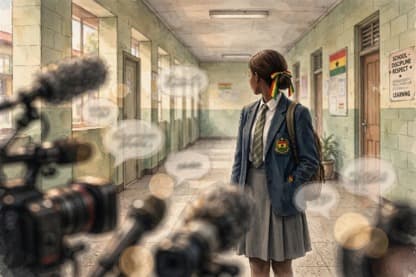
In the middle of all this are the girls whose experiences started the conversation. What happens to them while the rest of us talk?
The case of the headmaster of Obuasi Senior High Technical School has put that question in front of us again. A JoyNews investigation by Manasseh Azure Awuni, titled Inside the Dreaded Headmaster's Bungalow, examines allegations of sexual abuse against the headmaster, Zakaria Abdulai. The journalist says the number of female students alleging abuse rose to 16 as his investigation progressed.
The education minister directed his suspension and asked the police Criminal Investigations Department to investigate. The Ghana Education Service (GES) then interdicted him. The allegations remain under investigation, and he is entitled to due process.
The questions about who knew, who acted and who stayed silent are serious, and they deserve answers. But the way we have chosen to discuss this case raises a second question we are less comfortable asking: what does our noise say about us?
A girl reports abuse and the country discusses a man's body
I remember another school abuse case in which public discussion fixated on the alleged abuser's manhood. People stopped asking what he was accused of doing and started joking about the size of his anatomy.
Think about what that does to a conversation about sexual violence. A girl's alleged experience becomes the backdrop to a joke about a man's body, and the questions of power, consent and safeguarding disappear.
Now picture the girl who reported. She finds adults laughing at something that was hard enough to say out loud, and she draws her own conclusions about whether anyone else should bother speaking.
We cannot know how any particular student feels unless she tells us. We can recognise that public commentary has consequences. It makes reporting more frightening, and it teaches other girls that once they speak, their experience stops belonging to them.
Having the freedom to comment does not oblige us to comment on everything. Not every detail needs repeating, and not every rumour deserves circulation.
The test for the media and for the rest of us is simple. Does this detail help establish what happened, explain an institutional failure or show what must change? If it does none of these, we are feeding appetite, not informing anyone.
Good journalism started this story. Some of what followed did not help
The media's role in exposing abuse is not in question. Investigative journalism finds what institutions prefer to keep hidden, connects accounts that would otherwise stay separate and forces officials to answer.
The Obuasi case shows why. Reporting on 15 October indicated that students, parents and teachers raised concerns with different authorities before the headmaster was suspended. If those accounts hold up, they raise a plain question about whether safeguarding worked when it was needed.
The problem is not that the media pays attention. The problem starts when attention is organised around shock instead of understanding. The accused person's status, the most disturbing detail and the next dramatic twist crowd out questions about reporting channels, protection for complainants and the cost of ignoring warnings.
There is a difference between a headline that draws readers into a hard issue and one that invites them to consume someone else's suffering. There is also a difference between reporting an allegation and presenting it as established fact. A complainant's account, a witness statement, an investigator's finding and an unresolved claim are four different things, and readers deserve to know which one they are reading.
Caution about unproven allegations must not become cover for avoiding questions about institutional conduct. Where records or accounts suggest officials received complaints, journalists should ask what those officials did, when they did it and whether it met their duty.
And when the cameras leave, the reporting should stay. Follow-up journalism should tell us whether investigations progressed, whether recommendations were implemented and whether the students received support. Without it, a major investigation produces a week of national outrage and no lasting accountability.
Politicians have found a way to make Obuasi about themselves
Child protection should be the one issue on which party colours do not decide who deserves help. In practice, a case involving someone with political connections quickly becomes a test of loyalty.
JoyNews reported that the headmaster is the Juaben constituency secretary of the National Democratic Congress (NDC) and has been seeking the party's constituency chairmanship. Some within the party have responded as they should. A former NDC Member of Parliament, Peter Kwakye Ackah, has urged the party to disqualify him and said party membership should not shield anyone.
That is the right instinct. A party's decision about a candidate is a matter of political accountability, but it cannot replace a criminal investigation. Nor can an internal disciplinary process establish guilt or innocence.
The opposition faces its own test. Condemning the governing party while offering nothing beyond condemnation turns the suffering of students into campaign material. There is a difference between using a case to expose a failure and using it to attack opponents.
Watch for selective outrage too. If we demand an investigation when the accused belongs to the other party but question the complainants when he is close to our own, we are not defending children. We are defending our side.
A child's rights do not grow because the accused supports a party we oppose. They do not shrink because he supports ours.
Who knew, and why did nobody act?
The most important questions in a case like this are not the ones that follow the outrage. They are the ones about what happened before the story became news.
The facts so far make those questions uncomfortable. After students rioted at the school on 5 August, a GES committee recommended reposting the headmaster and other staff to different stations. That detail emerged only after the documentary led to his suspension. Moving a man to another station is not the same as investigating what his students were angry about.
An old student has also alleged that some housemistresses told a girl not to tell anybody. That claim is unverified and must be tested before anyone is blamed. But if even part of it is true, it describes a system that taught a child to stay quiet.
The African Women Lawyers Association (AWLA) has said that adults who knew and failed to act carry responsibility too. Eduwatch has made a similar point, saying that interdicting the headmaster alone is not enough. It wants an independent, external investigation that reaches every official whose actions or omissions may have enabled the abuse.
That does not make every official who received information automatically guilty. People held different responsibilities, and the evidence must show what each knew and what each was required to do. But a school cannot rely on a journalist to do the work of its safeguarding system, and no student should need national outrage before her complaint is taken seriously.
Institutions that investigate only the accused, while leaving their own omissions unexplained, are setting up the next case.
What must happen after the outrage
Statements of concern are cheap. If we want this conversation to lead anywhere, we should demand specific things.
Schools need reporting channels that students can use without approaching the person they fear. Students must know which trusted adult to speak to and what happens after they do. Suspected crimes go to the authorities, and investigations must be prompt, fair and independent where necessary.
Students who report need counselling, protection from retaliation and privacy. They must not be asked to protect an institution's reputation or settle disputes between adults.
Education authorities should be able to show how complaints are handled and what happens to officials who ignore procedure. Anonymised data on complaints, investigations and outcomes would let the public judge whether the system works without exposing a single student.
Journalists can follow up on promises, look for patterns across schools and ask whether earlier recommendations changed anything. Politicians can demand independent investigations without staging a partisan show. Parents and old students' associations can ask hard questions about the procedures that protect their children.
The rest of us can refuse to join in. No sexualised jokes, no unverified claims forwarded on WhatsApp, no pile-ons.
None of this requires us to prejudge a criminal investigation. It requires us to accept that protecting students and establishing the facts are one job.
The girls should not have to wait for us
Public outrage has a rhythm. A story breaks, the country reacts, officials make announcements, commentators argue, and a new story arrives to replace it.
The girls do not get to move on that quickly. They must still finish school, sit in classrooms with people who know their names and answer to families who have questions. The school must rebuild trust, and the authorities must show whether their own procedures were followed.
We should not assume every student wants the same thing, or that a single public statement can say what recovery looks like. We can insist that the response treats each of them as a person, not as a character in a national drama.
Silence is not the answer, because it lets institutional failure stay hidden. The answer is to talk about abuse with purpose. Investigate without declaring guilt early. Respect due process without dismissing complainants. Criticise institutions without reducing every failure to party politics. Report hard stories without making the harmed pay for our curiosity.
So when the next case breaks, ask what happened, who knew, what action was taken and what the evidence shows. Ask whether the students are safe and supported. Then ask what you are adding to the conversation.
Are you helping people understand, or feeding the spectacle? Are you demanding answers, or using someone else's suffering to win an argument? Are you making it easier for the next girl to speak, or showing her that her story might become a joke, a talking point or tomorrow's headline?
The girls should not have to compete with our outrage to be heard. They should not have to become a national scandal before the adults responsible for their safety take them seriously.
If this conversation ends in arguments about anatomy, party loyalty and the most shocking details, we will have missed the point. The measure of our response is not how loudly we condemn a case when it goes public. It is whether we build institutions that act when concerns are first raised, protect students throughout and stay accountable after the headlines have gone.
Until then, we will keep discussing the scandal. And the girls will keep waiting for the adults to get to work.