
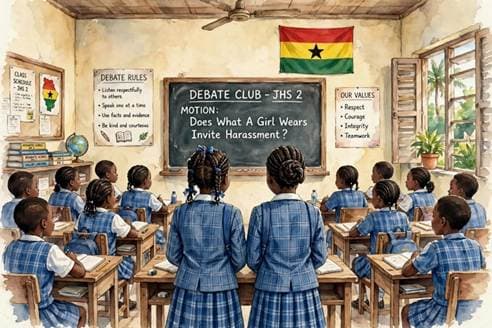
Accra, Ghana, 10 October 2026: Ghanaian children are forming their views on rape in the classroom, often before a trained adult has explained what consent means. On International Day of the Girl, that should concern every parent, teacher and policymaker.
A classroom debate that left two girls standing alone
My daughter came home recently and told me about a debate in her class. The students, aged between 12 and 14, had been discussing whether what a girl wears can invite rape.
My daughter argued that no outfit gives anyone permission to rape her. A short skirt is not an invitation. She and one other girl were almost alone in that view.
Her friend, about 13, cried after the comments from the rest of the class. She left the conversation convinced that the world is cruel to women.
I told both girls they were right. I also assumed the teacher would frame the discussion properly, by separating a school dress code from the question of who is responsible for sexual violence.
The next day, my daughter told me that the teacher had sided with the majority. She said he argued that girls who wear short clothes could be raped because they should not tempt boys.
I did not witness the lesson, and this is not about one teacher. If it happened as she described, the idea did not start with him. He most likely absorbed it, as many of us did, from the world around him.
A dress code is not a consent framework
Schools can set dress codes. They can decide what a uniform looks like and what kind of environment they want to create.
A dress code covers appearance. It says nothing about consent. A girl can break a uniform rule and still have every right not to be assaulted.
A woman in a short skirt, trousers, a hijab or a swimsuit has the same right to say no. Clothing never moves responsibility for sexual violence from the person who commits it to the person who suffers it.
The myth persists for reasons researchers have studied. One study of mock jurors examined how a victim’s clothing, alcohol use and existing stereotypes shape judgements in rape cases. The attitudes tested in that study do not emerge from nowhere. Children encounter ideas about gender, clothing and responsibility long before they are old enough to sit on a jury.
Telling children that a boy may rape a girl because of her skirt teaches boys that their conduct is somebody else’s job to manage. It teaches girls that their safety depends on managing boys’ reactions. Both lessons are wrong.
For many survivors, sexual violence starts in childhood
Ghana’s own data shows why this conversation cannot wait. The Ghana Statistical Service’s analysis of the 2022 Demographic and Health Survey found that 2.2 percent of women aged 18 to 29 had experienced forced sex. Of those women, 81.9 percent said it first happened before they turned 18.
Among those women, age 15 was the peak age of first forced sex. Six in ten perpetrators were known to the victim, according to the same GSS findings. Education. These figures cut across differences in education, wealth and religion.
The 2022 Ghana Demographic and Health Survey also found that 41.6 per cent of women aged 15 to 49 who had ever had a partner had experienced emotional, physical or sexual violence from a partner.
These figures cut across every kind of household. A hemline does not explain them.
Children are learning about gender from everywhere
Ghanaian children take in TikTok videos, music, films, memes and each other’s opinions every day. They learn about relationships and gender long before an adult sits them down for a lesson.
The question is who is teaching them, and what they are learning.
Reproductive health topics are already part of the school curriculum, and the Government of Ghana published guidelines for comprehensive sexuality and reproductive health education in 2018, with modules for every level from kindergarten to senior high school. Teachers need training to use them.
In a 2015 Guttmacher study of schools in three regions, 80 per cent of teachers said they would benefit from separate training specifically for sexual and reproductive health education. Only 14 per cent had received any in-service training on the subject in the previous three years. Eleven years on, Ghana needs fresh data on whether that gap has closed.
A teacher can be excellent at mathematics and still be unprepared to moderate a conversation about rape. Those are different skills, and no teacher should have to improvise.
A classroom debate needs a trained adult in the room
Debate has real value. Children should argue, disagree and change their minds.
But a classroom is not a comment section. When students debate whether a skirt invites rape, the teacher’s job is to give them the tools to answer. What is consent? Can clothing ever amount to consent? What does the law say? Why do societies blame victims? Who is responsible for a decision to commit sexual violence?
Those are educational questions. They are also safeguarding questions.
Boys belong in this conversation
Telling girls how to stay safe is not enough. Do not walk alone. Do not wear that. Do not attract attention. The list never ends, while boys hear that girls might tempt them.
Boys deserve a better message. They can find someone attractive without feeling entitled to them. They can feel desire without acting on it. They can hear “no” without needing a reason.
Telling boys that a short skirt can make them lose control also insults them. It describes them as unable to govern themselves. We should expect more of them, and they can meet that expectation.
What schools and parents can do now
The Ghana Education Service runs the country’s public basic and secondary schools, and strengthening teacher capacity is one of its stated objectives. Five steps would put that objective to work.
First, teacher training should cover gender, safeguarding, consent and rape myths, so that good practice does not depend on one teacher’s personal knowledge.
Second, schools need clear protocols for sensitive discussions. These should include learning objectives, age-appropriate material and a trained adult who can correct harmful claims without humiliating a child.
Third, children need the language of boundaries and consent before a crisis. They should know that their bodies belong to them, that pressure is not consent, and that they can tell a trusted adult when something feels wrong.
Fourth, boys must be part of the solution, with lessons on responsibility, empathy and respect.
Fifth, parents should ask questions. What are children taught about consent and harassment? Who handles a disclosure? How are teachers trained to moderate these discussions? These are ordinary parenting questions.
Civil society and trained facilitators can support schools. No school should hand the work over entirely, and no teacher should be left to manage it alone.
What my daughter’s friend told me
Her friend said being a feminist was becoming a difficult job. She said she would rather be a misandrist.
I did not hear a threat. I heard a tired 13-year-old who had just learned that something obvious to her was up for debate in a room full of her peers.
Her anger made sense to me. She had just learned that something she believed was obvious was being treated as a legitimate question. A 13-year-old should not have to build a political position out of one bad afternoon.
The most useful thing I have found to say is that she is right, the idea being taught in that room was wrong, and she does not have to fix it alone. Then I ask what she would like to change.
Giving every child company in the room
My daughter and her friend were two girls in a room of more than 20 children who saw the issue differently. They should not have needed that much courage to stand alone.
On this International Day of the Girl, Ghana can make a practical commitment. Train the teachers, set the protocols and teach every child, girl or boy, what consent, dignity and bodily autonomy mean.
Then the next girl who says that clothing is never consent will have company