
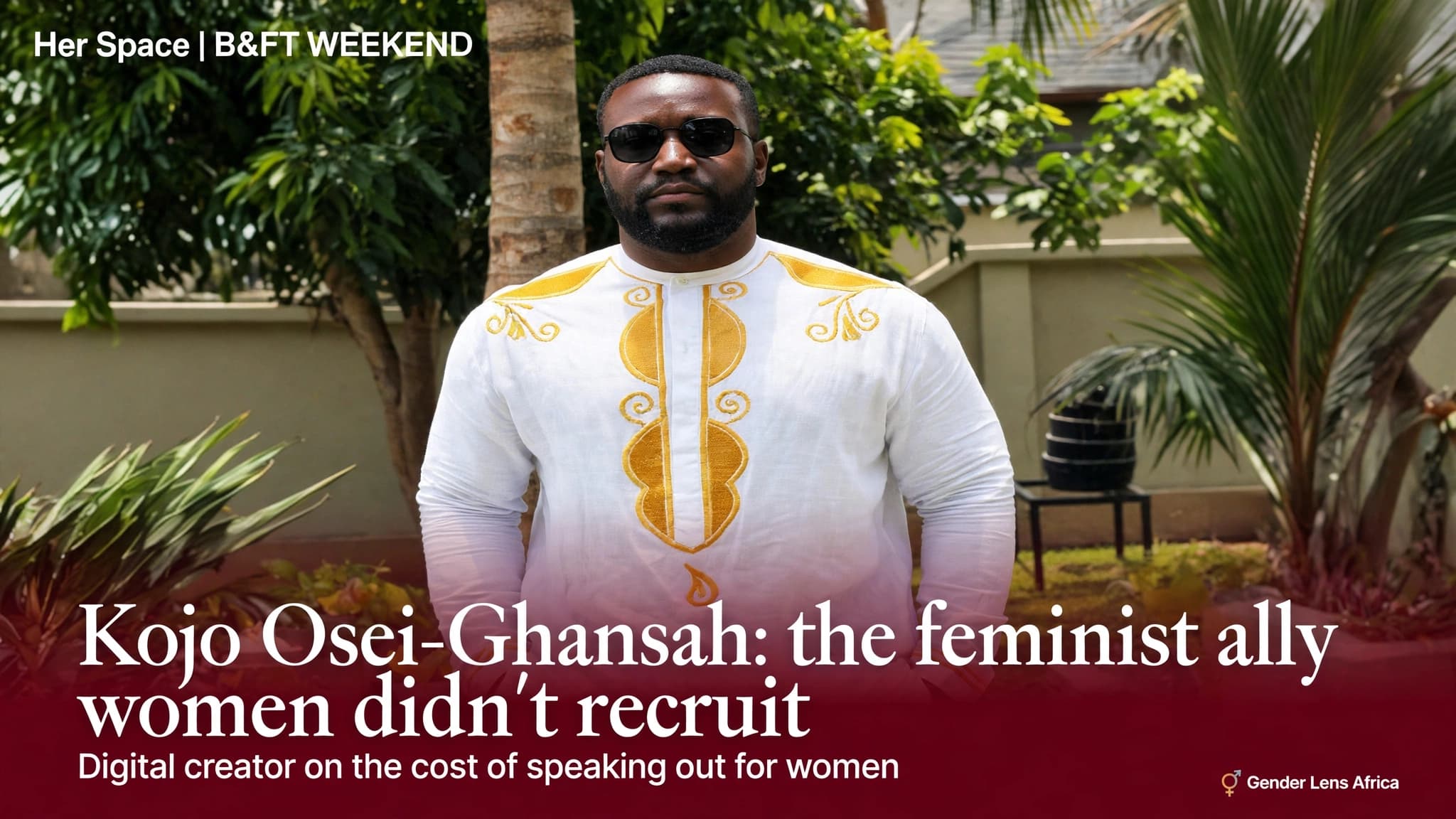
Accra, Ghana October 30, 2026: It was a blackout, and Kojo Osei-Ghansah was fourteen, maybe fifteen, attending a programme as a cadet at another school. When darkness fell over the campus, some of the older boys used it as cover to harass the girls staying there. Osei-Ghansah organised his fellow cadets into a human chain, stretching from the entertainment hall to the girls' dormitories, and stood there until every girl got home safely.
Nobody assigned him that job. Nobody has had to assign him most of what follows, either. Nearly two decades later, Osei-Ghansah is a digital creator known online as OG, a husband to Mercy, a father, and one of the men Her Space is putting under the lens this Allied November, our annual departure from our usual focus on women to profile the men who show up for them without being asked.
Why Kojo Osei-Ghansah calls himself a ‘ceremonial woman’
Osei-Ghansah's Facebook bio reads “human, husband, dad, entrepreneur, and a few other marvelous things.” “Feminist” isn't on the list, and that omission is deliberate. He has done the advocacy, he says, but chose not to lead with the label because he watched men who called themselves feminists become the centre of gravity in rooms built for women.
“Out of respect for women and what they do for themselves, I chose not to put that title in my bio so that I don't take away from the conversation and do not try to take centre stage in issues concerning women,” he says. “I am here to support and use my voice to amplify the voice of women, not to take over their movement.”
The Institute for Gender Research, Education and Development (iGRED) has already made the case for him publicly, describing him on its own page as a man who never misses a chance to help others unlearn sexism and patriarchy. The women who follow his work, he says, have lightheartedly dubbed him a “ceremonial woman.” He wears the title with pride.
How Kojo Osei-Ghansah became a feminist ally in Ghana
Osei-Ghansah traces the instinct to his mother, and to a boyhood reputation for refusing to let women be bullied in his presence. What turned instinct into vocabulary was discovering Pepper Dem Ministries, the Ghanaian digital feminist collective that has spent nearly a decade using social media to confront patriarchal double standards. He found in it, he says, an organised, concerted effort to advocate for women, and it gave his existing convictions a public language and an audience.
“I realised that I could reach more people, and that I had a natural gift for writing in a way that was funny, thought-provoking, and intriguing all at once,” he says. “I would say I have been a lifelong ally, but I became more vocal with the help of social media.”
What does online backlash cost a male feminist ally in Ghana?
This is where the piece could turn into a highlight reel, so it's worth pausing on what showing up publicly for women has cost Osei-Ghansah. He has been called a simp, a beta male, and worse, mostly by other men who, in his words, resort to name-calling because they lack the arguments to counter him.
The cost went further than name-calling in one incident he still thinks about. Unable to reach him directly, detractors circulated a photo of him and his wife and attached cruel commentary to it. He describes considering, in that moment, whether to withdraw from public advocacy altogether to protect his family.
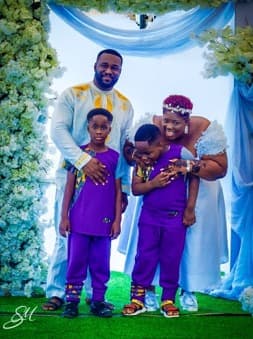
What kept him in it was the scale of the response in the other direction: people who called, messaged, and changed their profile pictures to the same image his critics had tried to use against him. “Just as much as some people secretly hate you, even more people silently follow and admire you,” he says, “and when they have to, they will come to your aid.”
How Kojo Osei-Ghansah supports women beyond social media
Asked where his advocacy shows up beyond social media, Osei-Ghansah starts at home. He describes actively supporting his wife's career goals and sharing the domestic load, and frames their marriage as two people tag-teaming provision and protection rather than one person carrying both.
As an employer, he says he gave a female staff member unlimited paid leave for her period for almost a decade while running his company, a concrete policy well ahead of where most Ghanaian workplaces sit on menstrual leave. He names three organisations he volunteers with regularly:
The Kyereh Foundation, which distributes sustainable period products to keep rural Ghanaian girls in school; the DWoSO Initiative, a Cape Coast-based feminist organisation running consent education and leadership programmes for women and girls; and iGRED, which runs gender-sensitivity and reproductive health programmes in Accra communities.
He is also, by his own account, the person several of his female friends call first if they need to escape an unsafe situation, find work, or simply vent, without having to worry about being touched or spoken to inappropriately. It is a role that depends entirely on a reputation built over years, not on a single post.
What has Kojo Osei-Ghansah said about the Obuasi SHTS case?
The clearest recent example of that reputation at work sits on his own timeline. On 27 October 2026, Osei-Ghansah posted about the Obuasi Senior High Technical School (SHTS) case, in which the school's headmaster, Zakaria Abdulai, was
interdicted by the Ghana Education Service (GES) in October 2026 over sexual misconduct allegations involving female students, following a JoyNews investigation by Manasseh Azure Awuni. Weeks later, no prosecution had followed.
Osei-Ghansah drew a pointed comparison. Back in August 2026, when male students at the same school rioted and assaulted the headmaster over unrelated allegations that he had buried a baby on campus, the response was swift: six students were arrested within a day, and two teachers accused of instigating the attack were in front of a judge inside a week.
“GES, Ghana Police and the court system in this country all work when they want to work,” he wrote. “What is happening is not the lack of evidence or information. It's a lack of will.” He closed the post with the hashtags #JusticeforObuasiSHTSgirls and #handsoffourgirls.
It is one post among thousands he has made, but it captures the pattern Her Space set out to profile this November: he doesn't only post his own opinions. He comments directly under news pages and advocacy accounts covering the case, and he actively shares and reposts comments from women naming the same institutional failure, rather than leaving that work to them alone. On a case that has largely been carried by women's voices, men willing to name GES and the police by name, in public, under their own account, have been noticeably few.
Why Kojo Osei-Ghansah stepped back from leading women's conversations
Some of Osei-Ghansah's most revealing reflections are about the ways his own advocacy has gone wrong. He admits that his voice, as a man, often overshadowed the women saying the same things, and that he became a reflexive tag whenever a feminist issue trended, ahead of the women actually doing the work.
“I felt that it was unfair to the women who do a lot of hard work to fight for their own rights to have their voices overshadowed by mine,” he says. He now waits for women to speak on their own issues before adding his voice, and deliberately fills his page with parenting, faith, and philosophy content so that allyship isn't the only thing he is known for.
Does the ‘real men provide and protect’ idea still hold up?
Osei-Ghansah is openly impatient with the idea that “real men” provide and protect by default. He argues the framing denies women agency and loads men with a burden they don't have to carry alone, and points to his own marriage, where the roles of provider, protector, nurturer, and “bankroller” rotate depending on the week.
Ghana passed its Affirmative Action (Gender Equity) Act in 2024, after roughly three decades of delay, but that kind of law changes what institutions must do. It does little to change what happens inside a living room, which is the space Osei-Ghansah is actually trying to work in.
Is male allyship actually working in Ghana?
Asked for one word on the state of allyship among Ghanaian men right now, Osei-Ghansah doesn't reach for something diplomatic. “Dire,” he says.
His message to a young man still working out what allyship means is stripped of jargon: it means understanding that an imbalance exists which was created by gender rather than merit, and using whatever privilege that imbalance affords him to help correct it. He adds a practical note, that rights are not cake, and one group having them does not mean another group runs out.
Who is Kojo Osei-Ghansah off the clock?
Away from the advocacy, Osei-Ghansah restores himself with his hands: farming, self-taught carpentry, and mechanic work. He also knits and crochets, the detail he says people are most surprised to learn. Asked to sum up his own online persona in three words, he lands on crazy, funny, brave.
Why Her Space chose Kojo Osei-Ghansah for Allied November
Her Space exists, most weeks, to name and celebrate women working in spaces historically closed to them. Allied November asks a different question: what does it look like when a man treats that work as his own responsibility rather than a favour he's doing women?
Osei-Ghansah isn't claiming Ghanaian men have arrived. He rates the current state of allyship among them as dire, and he's candid about the ways his own version of it has misfired before. He has learned, by his own account, to take up less space than he used to. He shows up anyway, this week on the Obuasi SHTS case and, going by his record, on whatever comes after it.