Accra, Ghana, October 15, 2026: Tell a Ghanaian aunty you are a feminist and watch her face. Some hear “man-hater”. Some hear “foreign”. Very few hear what the word means.
So let us start with the meaning, then ask a harder question. Whose idea is it, really, and who taught us to fear it?
Feminism in one sentence
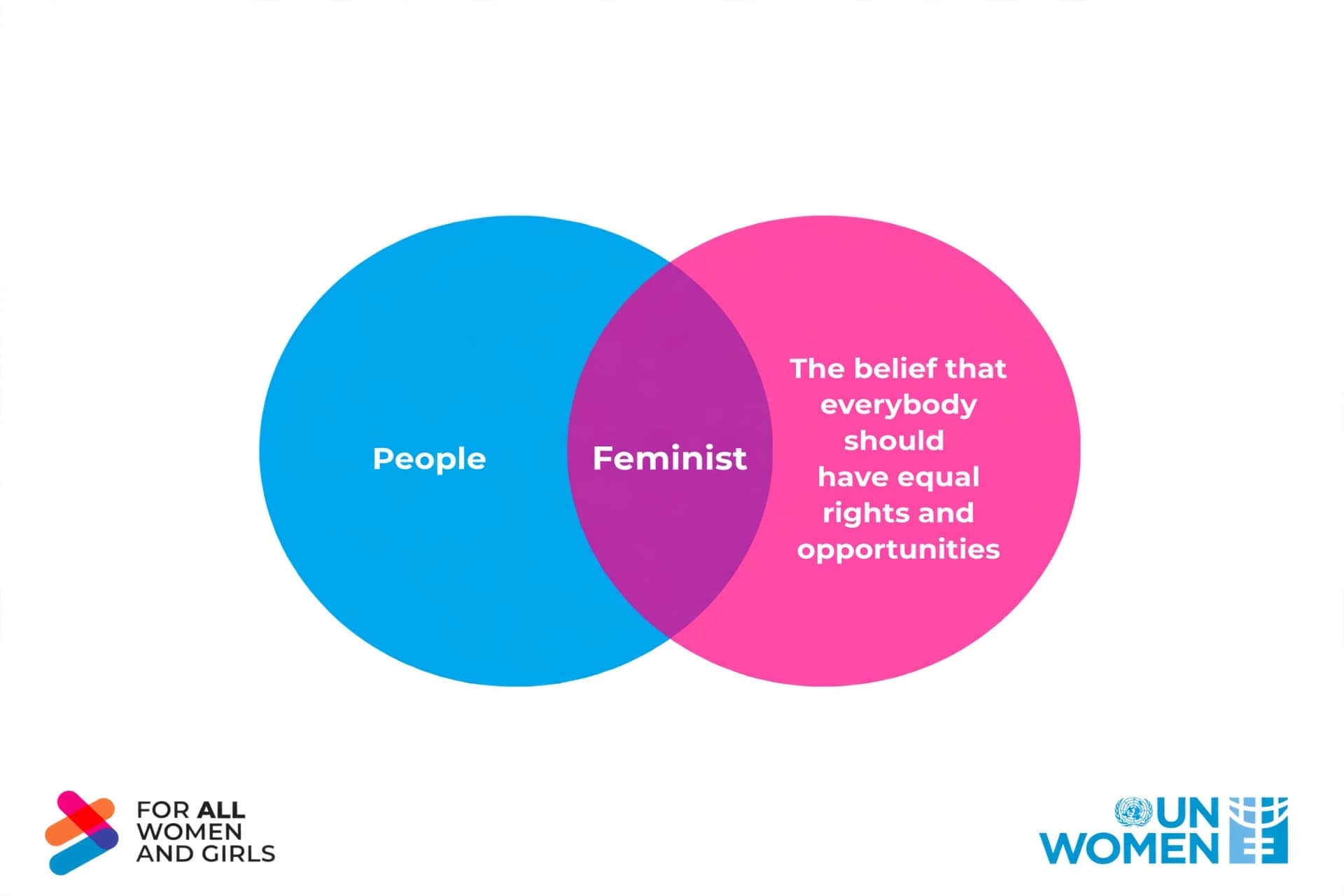
UN Women defines feminism as the belief that everyone, regardless of gender, should have equal rights and opportunities. That is the whole definition. Everything else is an argument about how to get there.
Read it again. It says everyone. It does not ask anyone to hate men, and it hands out no membership cards. The same explainer says anyone can be a feminist, and some people hold feminist values without ever using the label.
It works the other way too. Being a woman does not make you a feminist. Plenty of women defend the rules that hold them back, and plenty of men work to change those rules. What counts is what you believe and what you do about it.
Ghana has its own history of women’s power
Women here have held formal authority for centuries. None of them called herself a feminist, and we should not pretend she did. What they show is narrower and still important: our societies already knew that women could govern, fight and organise.
Take the Akan, who trace family through the mother. In Asante, the Asantehemaa nominates the next Asantehene, though the kingmakers must approve her choice. This July, the Asantehene nominated Nana Ama Bonsu as the 15th Asantehemaa. The office still carries the work of settling marriage and family disputes.
In 1900, the British governor demanded the Golden Stool, the symbol of Asante sovereignty. Yaa Asantewaa, queen mother of Ejisu, led the resistance. The British exiled her to the Seychelles, where she died in 1921.
Women across West Africa organised in the same spirit. Nigeria’s Aba Women’s Riot of 1929 won reforms on unfair taxes. In Liberia, women organised across religious lines and helped end a civil war. Leymah Gbowee shared the 2011 Nobel Peace Prize for that work.
Matrilineal does not mean protected
We should be honest about the limits. Descent through the mother is not rule by mothers. Customary inheritance practices varied, but widows could be left without secure rights to their husbands’ property, regardless of whether a family traced descent through the mother or the father. Support from relatives did not necessarily give a widow a legal claim to that property. Ghana passed the Intestate Succession Law in 1985 to address problems associated with inheritance when someone died without a will.
Economists Edward Kutsoati and Randall Morck surveyed widows and found the law little used a quarter of a century later. A stool did not guarantee safety for every woman. Women’s power here has always been uneven, and feminism exists to close that gap.
The market was always a seat of power
Walk into Makola and look at who runs it. Women have dominated the market since it was built in 1924, and market queens manage its facilities, enforce its rules and support traders in emergencies.
Power like that gets punished. In 1979 soldiers destroyed Makola, and the women who ran it were blamed for the country’s economic crisis.
Esther Ocloo built Nkulenu Industries from homemade marmalade. Her own struggle to get a bank loan helped inspire Women’s World Banking, which she co-founded and chaired. A woman who built an export business still had to fight for credit.
What we teach girls, and what we leave out of boys
If women have held power here for centuries, why does the word still make us flinch? Look at how we raise children.
We still raise many girls with marriage as the measure of their success. The training starts early. Cook well, serve well, be patient, keep the peace, do not shame the family. Marriage becomes the proof that a woman has succeeded, and a woman who leaves it becomes the failure.
Then the training gets tested. Preliminary findings from the Ghana Statistical Service’s 2022 survey found that 41.6 per cent of women aged 15 to 49 who had ever had a partner had experienced emotional, physical or sexual violence. Among women who had experienced physical violence, about three in five identified a current or former husband or partner as a perpetrator.
When women seek help, their own families and their husbands’ families are among the most common sources of support. Yet family expectations can also make it harder for a woman to leave an abusive relationship.
The belief runs deep in women too. In the 2022 Ghana Demographic and Health Survey, 19 per cent of women and 16 per cent of men said a husband is justified in beating his wife, for reasons such as burning the food, arguing or going out without telling him. More women than men. That is not a flaw in women. It is what socialisation does when it teaches endurance as a virtue.
The same data shows that change is possible. The share of women who agreed fell from 49 per cent in 2003 to 19 per cent in 2022. What we teach can be unlearned.
Now ask what we teach boys. Few are taught how to be partners: how to share the housework, manage anger and respect a refusal. We spend enormous energy teaching girls how to avoid sexual violence. Do not walk alone at night. Watch your drink. Dress carefully. We spend far less time teaching boys that consent is non-negotiable.
Feminism asks for the other half of the lesson. Teach boys about partnership with the seriousness we bring to preparing girls for marriage. Teach boys about consent and respect, rather than leaving girls to manage the risk of sexual violence. UN Women reported in March 2026 that 54 per cent of countries still do not define rape on the basis of consent, which shows how much work remains to bring laws into line with that principle.
Boys learn from what adults leave unsaid. Silence is also a lesson.
Who gets to speak on serious issues
Switch on a political show in Ghana, a morning radio programme or a late-night television panel. Count the women.
Ghana Women Experts monitored six flagship radio and television shows between February and June 2021. Of 1,476 experts featured, 128 were women, or 8.7 per cent. That is about one woman for every twelve experts. Earlier monitoring by the Media Foundation for West Africa found women were only 8 per cent of political party affiliates on public discourse programmes. Research on Accra’s morning radio shows found men dominate political discussion as hosts and as resource persons.
Look at the schedule and you see where women are placed. Lifestyle, fashion, entertainment, relationships. Those programmes matter. But the pattern teaches viewers that the budget, security and elections belong to men, and that women’s voices are for what is left over.
Producers often point to women’s reluctance to appear. Women interviewed by Ghana Women Experts have also cited programme timing, sexist backlash and hostile show formats. Broadcasters cannot remove every barrier, but they can change how they invite, accommodate and treat women experts.
The same habit runs through national leadership. The 2025 Status of Women Report, presented by the Women’s Manifesto Coalition at NETRIGHT’s end-of-year review, found that women held 41 of 276 seats in Parliament at the end of 2025, or 14.9 per cent. It put women at less than 20 per cent of substantive ministerial positions and about 4.1 per cent of local assembly seats.
A law long advocated for finally passed in 2024. The Affirmative Action (Gender Equity) Act requires at least 30 per cent women in public appointments between 2024 and 2026, with a gradual rise afterwards. The 2025 Status of Women Report says government appointments had not met that threshold at the time of its assessment.
The studio, the cabinet and the chamber share one problem. Women are invited late, if at all.
So, what is feminism?
It is the belief that a girl in Ejisu, a trader in Makola and a lawyer in Ridge deserve equal rights and opportunities. It is also the work of making that belief real in what we teach children, who we book, who we elect and what the law says.
Feminism did not arrive in Ghana in a suitcase. Our history offers plenty of evidence of women exercising authority, building economic power and organising to shape their societies, even when they did not use the word.
The work now is to make equality more than an idea. Teach your daughter that she can leave an unsafe marriage. Teach your son that consent is not negotiable. Book the woman for the budget debate. Then ask who else is missing from the room.