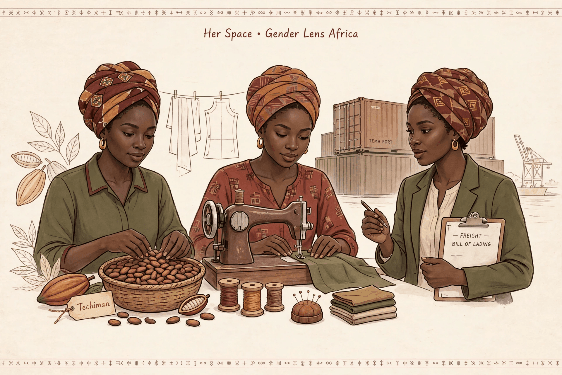
Accra, Ghana, September 17, 2026: A woman in Techiman sorts cocoa beans before they leave the farm gate. A woman in a Tema garment factory finishes seams on shirts bound for a European retailer. A woman on a trading floor negotiates freight rates for containers she will never see loaded. Between them, they represent a workforce UN Women describes as almost two hundred million women who work in global supply chains, producing, processing and delivering the goods that power the global economy. Yet almost none of them sit anywhere near the table where the rules of that economy are written.
That gap, between how many women carry global trade and how few shape its terms, is precisely what the Commission on the Status of Women has put back on the table for its seventy-first session in March 2027. The priority theme is accelerating gender equality within the 2030 Agenda for Sustainable Development, with poverty and the economic empowerment of women named as the critical area of concern. For a column that spends most weeks profiling women who have broken into rooms built without them, this is the year to ask a harder question: who is building the rooms, and who decides which women get invited in.
Regulations set the floor, not the ceiling
A new UN Women and German Agency for Business and Economic Development briefing, issued through the Global Supply Chain Coalition, makes an argument Ghanaian policymakers and corporate boards would do well to sit with. Laws matter, but laws alone cannot reach into the tiers of a supply chain that cross borders and blur into informality. Its argument is that enforcement weakens the further down a chain you travel, precisely where most women in global production sit.
What can reach that far, the briefing argues, is money. Large companies already dictate supplier behaviour through what they choose to buy and from whom. A procurement clause can travel where a labour inspector cannot. When a buyer makes gender equality a condition of doing business, that condition moves through every tier of the chain beneath it. Regulation sets a floor. Procurement decides how high above that floor anyone actually stands.
Ghana already knows this story
Ghana's cocoa sector is the clearest local proof. Women do the bulk of the unpaid and undervalued labour in cocoa, from planting to post-harvest processing, yet cocoa has long been treated in practice as a man's crop, with land, ownership and payment routed disproportionately to men. Field research from Ghana's Western and Ashanti regions has documented how business models within the cocoa industry rely on and reinforce these unequal gender arrangements, even as international chocolate brands market their commitments to ethical sourcing. An Oxfam assessment went further, examining whether the world's largest chocolate companies actually publish impact data on women in their Ghanaian supply chains or sign on to the UN's Women's Empowerment Principles, and found most fall short of their own public commitments.
The pattern is not confined to cocoa. Across global value chains, women dominate the labour-intensive, lowest-paid stages of production while men concentrate in the higher-paid, machine-operating and logistics roles above them. Global garment sector data illustrates the scale: women make up roughly 90% of garment workers in Cambodia, 85% in Bangladesh and 70% in China, almost universally at the bottom of chains that answer to buyers thousands of miles away. Ghana's garment and agro-processing exporters sit inside comparable value chains, and the cocoa evidence above points to a similar pattern, though it would take Ghana-specific data to confirm how far it extends. The women are present in overwhelming numbers. The value they generate is not returning to them in equal measure.
What a procurement-led approach would actually require
None of these shifts through goodwill alone. If Ghanaian institutions, private and public, are serious about closing this gap ahead of CSW71, three shifts matter more than another policy statement.
Buyers need to write gender equality into supplier criteria the same way they already write in quality and delivery standards. A supplier's record on women's pay, safety and advancement should carry weight in who wins a contract, not sit in a corporate social responsibility appendix nobody reads at the negotiating table.
Institutions need to collect and publish sex-disaggregated data along their own supply chains. Ghana cannot correct what it does not measure, and local supply chain data rarely tells us where women are concentrated or what they are paid relative to men doing comparable work.
Collective platforms need Ghanaian and African participation, not just observation. The Global Supply Chain Coalition explicitly frames itself as a cross-sectoral space where practices developed in one industry can transfer to another. A coalition built without African buyers, suppliers and unions at the table will keep designing solutions for African workers rather than with them.
The room every Ghanaian institution with buying power should be building toward
I write this column most weeks about women who have already forced their way into visibility. This one is about the women who never get named because they sit three or four tiers down a supply chain nobody outside their factory or farm will ever audit. CSW71's economic empowerment theme gives African institutions a year-long opening to argue, with evidence rather than sentiment, that gender equality is not a side commitment to trade and industrial policy. It is the commercial infrastructure trade runs on.
Ghana does not lack the raw material for this argument. It is already visible in cocoa, garments and the informal trading networks that move goods across our borders. What is missing is the willingness to treat procurement as seriously as we treat legislation, and to recognise that whoever controls access to markets also has the power to shape the terms on which women participate in them.
Her Space will be watching which institutions choose to lead on that before March 2027, and which ones wait to be asked.
Bridget Mensah believes the right story, told well, can change everything. A communications strategist, writer and gender equality advocate with 10+ years’ experience, she uses storytelling as a tool for accountability, visibility and change, with a particular focus on women and the systems that shape their lives and opportunities. She is General Secretary of the Network of Women in Broadcasting (NOWIB) and Head of Corporate Affairs at Ghana Digital Centres Ltd (GDCL).