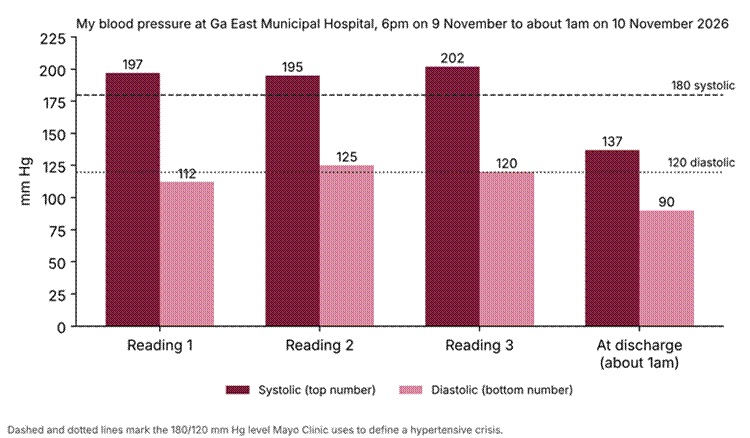
Accra, Ghana, 13 November, 2026: At 6pm on 9 November, I arrived at Ga East Municipal Hospital in Kwabenya with dangerously high blood pressure. When readings are high, the nurses check three times, and they wrote mine down: 197/112, 195/125 and 202/120.
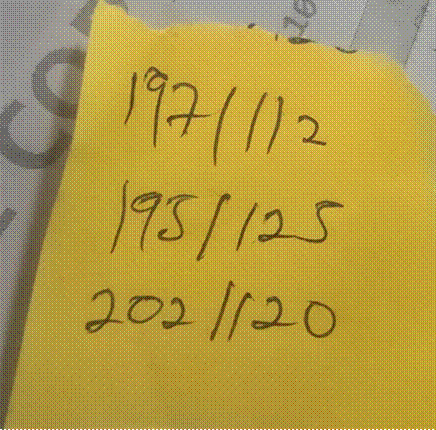
The three readings, written down by the nurses at Ga East.
For about 15 minutes, nobody attended to me. Two nurses were quarrelling in front of the patients. The night nurse had come late, and the afternoon nurse was furious about it.
They traded insults, including a taunt about one nurse’s marriage and the other’s children. I waited with readings near 200 for them to finish.
When a nurse finally fixed my cannula, the insertion was painful. She was still visibly caught up in the argument. I was given labetalol in a chair, in a triage area where staff were checking blood pressures and chatting.
The triage space has a nurses’ station, a small room for injections and infusions, and two beds. I saw one bed in use and a bench. Patients sat in chairs for infusions and treatments for hours, and I slept on a bench. I was not the only one.
I was discharged from that bench around 1am on 10 November, about seven hours after I arrived. My reading at discharge was 137/90.
I write, so I observe. I see a scoop everywhere. This time the scoop was me, on a chair, waiting.
Is a blood pressure of 202/120 an emergency?
Mayo Clinic defines a hypertensive crisis as a reading of 180/120 mm Hg or higher. It splits crises into two types. In an urgent crisis, the organs show no damage. In an emergency crisis, the organs are already being damaged.
I cannot tell you which one I was. A clinician has to decide that quickly, and deciding is the whole purpose of triage. By the time I left, my pressure was down to 137/90.
High blood pressure is not a rare visitor to Ghanaian hospitals. A meta-analysis of 85 studies found that 27% of adults in Ghana have hypertension. Only 35% of them knew it, 22% were on treatment and 6% had it controlled.
A condition this common should meet a well-run front door.
What does the Patients’ Charter promise Ghanaian patients?
The Ghana Health Service has had a Patients’ Charter since 2002. It says the patient’s dignity and interest must be paramount in all healthcare activities.
Ten years in, the Service’s own conference on clinical care quality named poor staff attitude and long waiting times among its main challenges. A 2014 survey of surgical patients at Komfo Anokye Teaching Hospital found that 84.7% had never heard of the charter.
In May 2026, the National Commission for Civic Education (NCCE) had to urge health workers to follow it. A charter that patients do not know cannot protect them.
Why are Ghana’s nurses stretched so thin?
At a nurses’ forum in Accra this year, the Greater Accra chairman of the Ghana Registered Nurses and Midwives Association (GRNMA) said the Ghana Health Service needs about 48,000 more nurses. He put the ratio at roughly one nurse to 18 patients, and said experienced emergency and critical care nurses are among those leaving.
The Ghana Human Development Report found that 24% of Ghana-trained nurses now work abroad. This month, the GRNMA again warned about the migration of experienced nurses and its toll on care.
Staffing affects temper. A study of 391 nurses and midwives at a Kumasi hospital found that too few staff predicted emotional exhaustion and depersonalisation. Depersonalisation means pulling away from patients and treating them as tasks.
Exhausted nurses are not villains. But a patient with readings near 200 should not absorb the cost of a staffing gap. A 15-minute shouting match is not a staffing problem. It is a supervision problem.
A late night nurse is a rostering and handover issue. Managers should settle it away from the patients.
What does kindness look like in cancer care?
My nephew was diagnosed with cancer at 37 Military Hospital. The whole family is on edge. He has just been admitted to university, and he will now defer his place. Our experience at the Korle Bu oncology unit included rudeness and insensitivity from some of the health workers we dealt with.
Cancer is devastating, and the treatment is debilitating. You cannot work in an oncology unit and be careless with frightened people. Ghana recorded an estimated 27,385 new cancer cases and 17,944 cancer deaths in 2022, and the country has only three radiotherapy and cancer treatment centres. The few oncology units we have carry a heavy load.
I understand why health workers detach. Watching people die is frightening. In an Ashanti Region study of nurses, 81.1% named patient deaths as an emotional stressor.
But detachment must not turn into cruelty. Fear makes patients and families behave in ways a medical professional should understand.
Training can help. A Cochrane review of 17 randomised trials found that communication skills training in cancer care probably increases empathy and makes staff less likely to give facts without responding to the patient’s feelings. It found no clear gain in patient satisfaction, so training alone will not fix this.
Kindness is also possible. A paediatrician from 37 Military Hospital follows my nephew, her patient, and supports him through a difficult journey. I am yet to meet an unkind paediatrician.
Do families know the Ghana Medical Trust Fund can help with cancer costs?
Cancer treatment is difficult, and it is expensive. At 37 Military Hospital, the paediatrician led the hospital to help us apply to the Ghana Medical Trust Fund (GMTF), popularly known as MahamaCares.
The response was swift. A representative called to explain the process and what to expect, and sounded worried and empathetic. That is not what many of us expect from a public initiative, where calls often go unanswered.
Here is how the process works. The Fund was set up under the Ghana Medical Trust Fund Act, 2025 (Act 1144), and patients cannot apply directly. A specialist clinician at an approved hospital applies for the patient through a digital platform. 37 Military Hospital is one of the 27 hospitals approved in the first phase.
To qualify, a patient must be a Ghanaian citizen with an active National Health Insurance Scheme (NHIS) card and a condition the Fund covers. The initial package covers eight cancers: five childhood cancers in patients under 18, and cervical, breast and prostate cancer in adults. Not every approved hospital provides every service, so a patient may be referred elsewhere. Support also depends on the diagnosis, and an application is not the same as an approval.
The Health Minister has said the secretariat will respond within 14 days of a specialist’s application.
So, what about families who have no health professional to guide them? Access starts with a doctor who knows the scheme exists. A family seeking treatment outside the approved hospital network, or without an active NHIS card, may never get as far as an application.
The Fund’s own Administrator admits the gap. In July, she told the National House of Chiefs that many Ghanaians battling chronic illness remain unaware of the support available. The rules are now published on the Fund’s website, but a family in crisis does not know to look for them.
Kindness has marked this journey, and so has its absence. We have learnt from both.
What does an emergency unit look like when it works?
At the University of Ghana Medical Centre (UGMC), you lie down and the staff do the running. They wheel you for labs and scans, and you leave with the drugs you need. It is a nice hospital, like something from Grey’s Anatomy.
It is expensive, and I have waited a long time there too. But the design works. The emergency department lists 24-hour pharmacy, laboratory and imaging services.
Its former chief executive, Dr Darius Osei, says the pharmacy, laboratory and radiology units were placed inside the emergency centre so patients and relatives do not cross the hospital for each service. Emergency specialists describe the alternative as an “up and down” of relatives chasing cards, drugs and payment while the patient waits.
Ga East opened in 2019 as a 100-bed hospital. Reports at the inauguration described a modern laboratory, an X-ray unit and CT scans.
In my experience, a patient needs a relative to carry samples to a laboratory, and doctors send tests to nearby labs instead of the hospital’s own. That was the gap I experienced between the facilities described at the hospital’s opening and the services available to me that night.
Ga East also carries other facilities’ weight. Staff at Ga North Municipal Hospital have complained about equipment shortages, and patients have been referred to Ga East. The road to Ga East deteriorated so badly that the area’s MP publicly pleaded for repairs. The Assembly began reshaping it in December 2025.
Is Ghana already fixing emergency care?
Partly. Charles Amissah, 29, died on 6 February 2026 after being turned away from three hospitals. A committee chaired by Prof. Agyeman Badu Akosa found his death avoidable. It recommended compulsory triage, a national electronic emergency bed system and a national emergency care fund for the first 24 hours of care.
This month, the Health Minister said the pilot of the national emergency bed management system has begun, with a command centre at Ridge Hospital. He says it will manage scarce beds, not add new ones. He has also directed facilities to stabilise emergency patients before referring them.
Compulsory triage will only work if staff treat triage as clinical work and not as a place to chat.
What should change first?
1. Enforce the Patients’ Charter. Display it, train every unit on it, name a complaints officer in each emergency and oncology unit, and publish complaints data every year.
2. Tell every family about financial support at diagnosis. Make the Ghana Medical Trust Fund’s rules easy to find, name a patient navigator in every cancer unit, and do not make access depend on luck.
3. Treat triage as a clinical post. One nurse assesses, repeats readings and escalates. Handover disputes go to a supervisor, never to the waiting area.
4. Put the laboratory, pharmacy and imaging at the point of care. Stop sending relatives with samples.
5. Keep experienced nurses. Recruit on time, pay overtime and protect rest between shifts.
6.Train staff to speak to frightened families, starting with oncology and emergency units, and audit emergency waiting times routinely.
We should not have to be grateful for basic decency
Not every health worker is unkind. My nephew’s paediatrician is a reminder that compassion and professionalism can make an enormous difference to patients and their families. I have also encountered healthcare workers who take their responsibilities seriously. These are my personal experiences, and yours may be different and equally valid.
But the quality of care, and the dignity with which patients are treated, should not depend on which hospital they can afford to access.
We should not have to be grateful for basic decency. We should expect it.
Being sick is hard enough. Must being a patient be harder?