Accra, Ghana, November 11, 2026: Her Space spends most weeks naming harm done to women, and in that time a familiar move has become common online: a man appears under a post about violence against women to say that men suffer too, as if that cancels the point rather than sitting beside it. This is not that. Nobody here is trading one set of statistics for another.
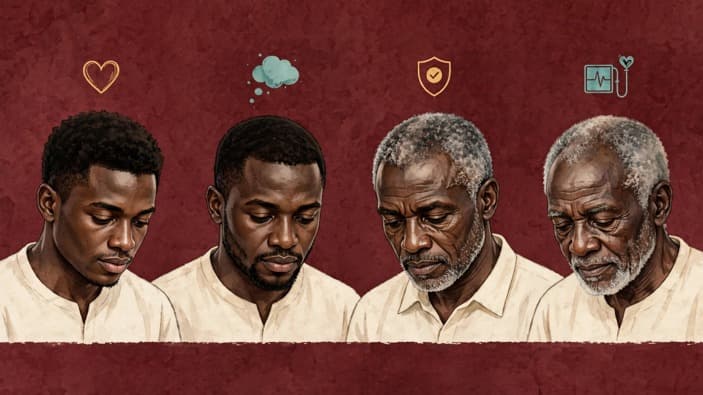
The argument is simpler and, we think, harder to dismiss. A man who will not look after his own body makes a worse partner, father and ally, whatever his politics. The same script that tells a woman her worth lies in being useful to others tells a man his worth lies in never admitting his body has failed him. Both instructions come from the same place, and both end in someone getting hurt. Four of the clearest examples sit in a Ghanaian man's chest, his mind, his prostate, his blood pressure prescription, and in what happens to him if another man forces him into sex.
Why International Men’s Day matters for Ghana in 2026
This instalment of Allied November falls in the same week as International Men's Day, marked worldwide on 19 November every year since the Trinidadian historian Dr Jerome Teelucksingh first observed it in 1999. The day exists to put men's health, wellbeing and positive social contribution on a public agenda the way International Women's Day has done for women since 1911, not to compete with it.
This year's global theme, announced as “The Future Is Everyone”, is built on the idea that men's wellbeing and women's equality move together rather than in opposite directions. That is the premise of everything below.
Can men get breast cancer? What Ghanaian men need to know
Yes. Every man carries a small amount of breast tissue behind the nipple from birth, and that tissue can turn cancerous just as it does in women, as Mayo Clinic's own explainer on male breast cancer sets out plainly. Male cases make up under 1 percent of breast cancer diagnoses worldwide, but the share recorded in Ghanaian hospital data is strikingly higher: male breast cancer accounts for roughly 2.9 percent of all breast cancer cases treated at Korle Bu and other Ghanaian centres, nearly three times the global share.
Most men still assume the disease cannot happen to them, so the usual first sign, a painless lump behind or near the nipple, gets dismissed as a boil, a cyst, or ordinary gynaecomastia rather than checked. Other symptoms include skin dimpling, a nipple pulling inward, discharge from the nipple, or a lump under the armpit. None of these need to hurt before they matter; most male breast cancer presents without pain at all.
The delay is what costs men their lives. Ghanaian breast cancer patients overall are known to present late, and case reports from Korle Bu describe men diagnosed only years after first noticing a change, by which point surgery alone is rarely enough. October's breast cancer campaigns in Ghana are built almost entirely around women, which leaves men with no public script for naming what they are feeling in their own chest.
A man does not need a mammogram to start. He needs to know the look and feel of his own chest the way he is told to encourage his wife to know hers, and to see a doctor the same week he finds something unfamiliar, not the same year.
Why Ghanaian men die quietly of depression
Ghana's most recent national data, the WHO Ghana STEPS Survey of 2023, found that 6.4 percent of men had moderate to severe depression, and that 3.1 percent of men aged 18 to 69 had seriously considered suicide in the previous year. The Mental Health Authority recorded 134 suicide deaths in 2024, a 40 percent rise on the year before, and clinicians estimate that for every death by suicide, three to five times as many people attempt it.
Men carry most of that weight. A community psychiatry nurse at Korle Bu Teaching Hospital has put the male share of Ghana's roughly 1,500 annual suicides at well over 60 percent, a pattern that national figures confirm: suicide rates have been consistently higher among men than women over the past two decades, and the gap widens fastest among older men.
The 'real men provide and protect' framing this column has already called out does more than box men into a role. It tells a man that struggling is itself the failure, so he manages it alone instead, through overwork, drink, withdrawal from his family, or anger directed at the people closest to him. None of that is strength. It is simply pain with nowhere approved to go.
Farming, carpentry, prayer, football, or an honest conversation with one trusted person are not soft hobbies set against the serious work of allyship. They are what keeps a man steady enough to be useful to anyone else. Saying 'I am not okay' out loud, before it becomes a crisis, is one of the most protective things a Ghanaian man can do, for himself and for everyone who depends on him.
Why do Ghanaian men avoid the prostate check?
Prostate cancer is now the single most diagnosed cancer among Ghanaian men, with roughly 2,129 new cases a year and a case-fatality rate of 52.5 percent, making it the deadliest cancer a Ghanaian man is likely to get. Despite that, a study of men over 40 in Accra found that 86 percent had heard of prostate cancer, yet only 23 percent had ever been screened for it.
The gap is not ignorance. It is fear. Across African studies, men who were afraid a prostate test would come back positive were roughly half as likely to go for screening as men who were not. The two screening tools, a blood test for prostate-specific antigen (PSA) and a rectal exam, carry enough stigma on their own to keep many men away entirely. The fear is, in effect, what is killing them, because prostate cancer caught at 40 is treatable in a way that prostate cancer caught at 60 often is not.
Does blood pressure medicine cause erectile dysfunction?
Sometimes, and this is where silence turns genuinely dangerous. A Ghanaian study found that roughly 64 percent of patients on hypertension treatment were not taking their medication as prescribed. Globally, erectile dysfunction (ED) is recognised as the main reason men give up on antihypertensive treatment altogether, with some reviews putting the figure as high as seven in ten men who experience any sexual side effect.
The trade-off men are making is usually the wrong one. Untreated high blood pressure damages the blood vessels an erection depends on, so stopping medication to protect sexual function tends to achieve the opposite. A 2020 study presented at the European Society of Cardiology found that men with uncontrolled high blood pressure had measurably worse blood flow than men who stayed on treatment. Not every drug carries equal risk either. Older classes such as beta-blockers and diuretics are more often linked to ED, while newer drug classes such as angiotensin receptor blockers (ARBs) have, in trials, actually improved sexual function in the men taking them. That is a conversation worth having with a doctor, not a reason to quit the prescription in silence.
Instead, many men reach for unregulated alternatives. Herbal 'bitters' are openly marketed in Ghana as virility boosters, prompting Ghana's Food and Drugs Authority to warn in 2026 that no such product has been approved as a sexual aphrodisiac. The danger is not only false promise. A laboratory study of herbal supplements sold in Accra as erectile dysfunction treatments found that roughly 90 percent contained undisclosed pharmaceutical compounds, sometimes at doses high enough to be medically significant. For a man already on blood pressure medication, mixing in an unlabelled dose of an unknown drug is not a harmless shortcut. It is a second, hidden prescription nobody approved.
Erectile dysfunction is a documented medical side effect with a documented medical fix. It is not a referendum on anyone's manhood, and treating it like one is what pushes men toward the pharmacy shelf instead of the doctor's office.
Can a man be raped? What Ghana's law actually says
Ghana's Criminal Offences Act defines rape narrowly, as carnal knowledge of a female without her consent, which means the law does not currently recognise the rape of a man under that same offence. Legal scholars reviewing the statute have called for Ghana to make its rape law gender-neutral, in line with reforms already made in the United Kingdom, Kenya and South Africa. A man assaulted today falls under other, lesser-known offences, if he reports it at all.
Few do. A situational analysis of healthcare providers in Ghana found a culture of silence around male survivorship so complete that providers themselves described male patients confronting disbelief from their own community and, at times, from the health workers meant to treat them, built on the belief that a man simply cannot experience sexual violence. The same mockery this column has already documented around men who report abuse from a partner, 'you be man or not', 'you enjoyed it', applies with equal force here.
The cost of that silence is not abstract. A man who cannot say he was assaulted does not get post-exposure HIV prophylaxis in time, does not get counselling, and does not get justice. He also learns, watching how other men who speak up get treated, that defending women in public can carry a social price too, which quietly undermines the allyship this entire November is meant to celebrate.
An ally movement that teaches men to believe women without question must extend the same instinct to men. Believing a man who says he was harmed costs nothing and changes everything for the person saying it.
What Allied November is asking Ghanaian men to do
Her Space exists, most weeks, to name what women carry. This piece asks a narrower, specific question: what happens when the same silence that keeps women unsafe also keeps men sick, afraid and unheard, and what would it cost a man to break it?
Four checks, not four burdens. Know your own chest well enough to notice a change in it. Say 'I am not okay' to one person before it becomes an emergency. Book a prostate check at 40, not 60. Talk to a doctor about a prescription instead of a bottle of bitters, and believe a man who tells you he was harmed.
Women's health outcomes in Ghana began to shift when women started talking publicly about what their bodies were going through. There is no reason men's outcomes would move any differently.