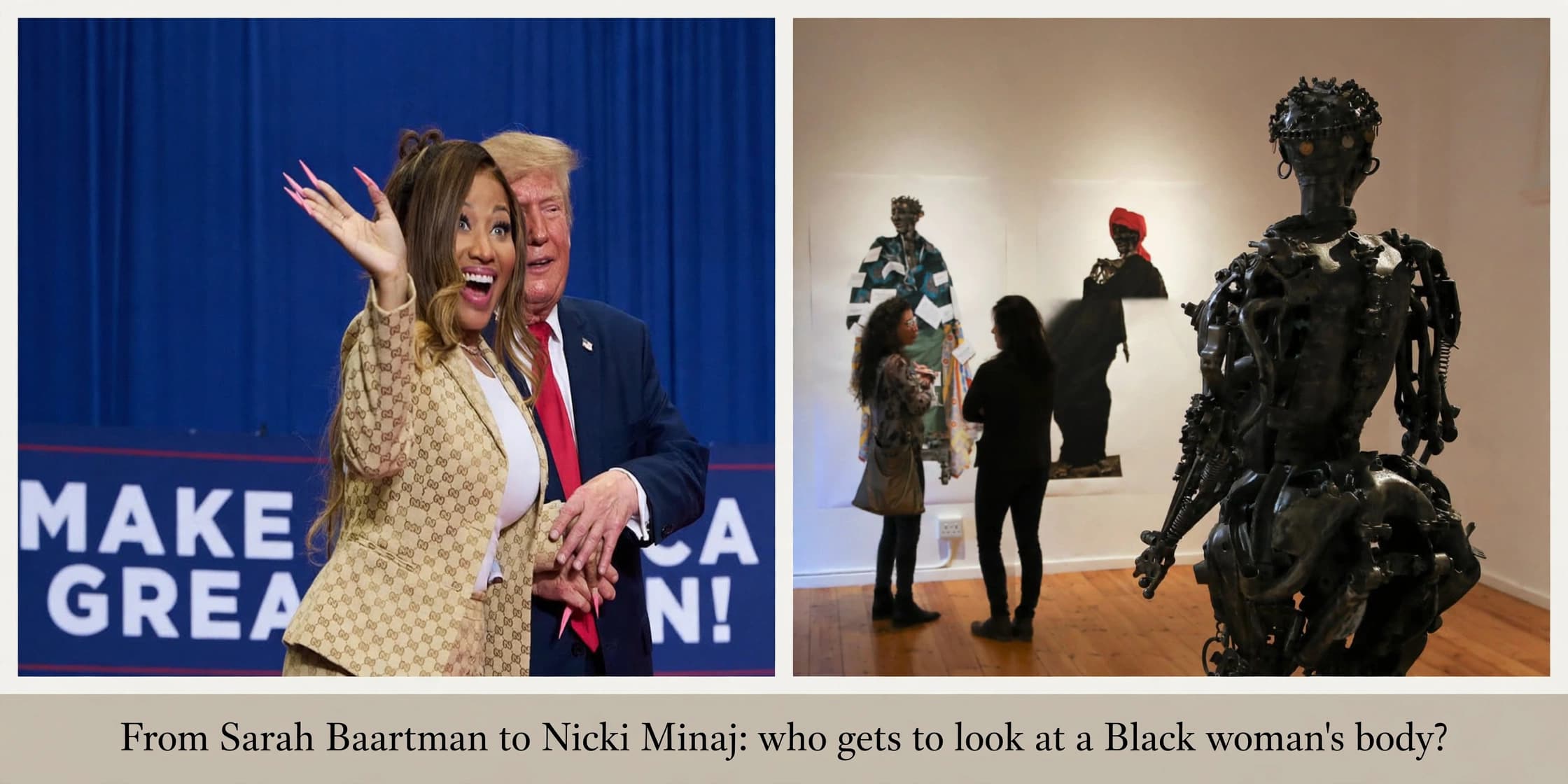
Michigan, United States, October 28, 2026: President Donald Trump made the remark on Sunday 25 October 2026 at a midterm rally at McMorran Place Arena in Port Huron, Michigan. Minaj had flown with him on Air Force One to campaign for Republican candidates Mike Rogers and John James, Rolling Stone reported.
Trump was recounting earlier remarks about Ohio Senator Jon Husted’s physique, which he said he made in fun. The New Republic quoted him saying: “By the way, I looked at one hell of a beautiful ass before: Nicki Minaj!”
He pointed to Minaj, who was seated in the audience, and told her to stand. She rose and waved, and the crowd cheered, TMZ reported. Trump then said he hoped she was not “insulted”.
Nearly an hour later Trump introduced her onstage. She led the crowd in a chant of support for him and did not mention the remark in her speech, according to a Yahoo Entertainment report.
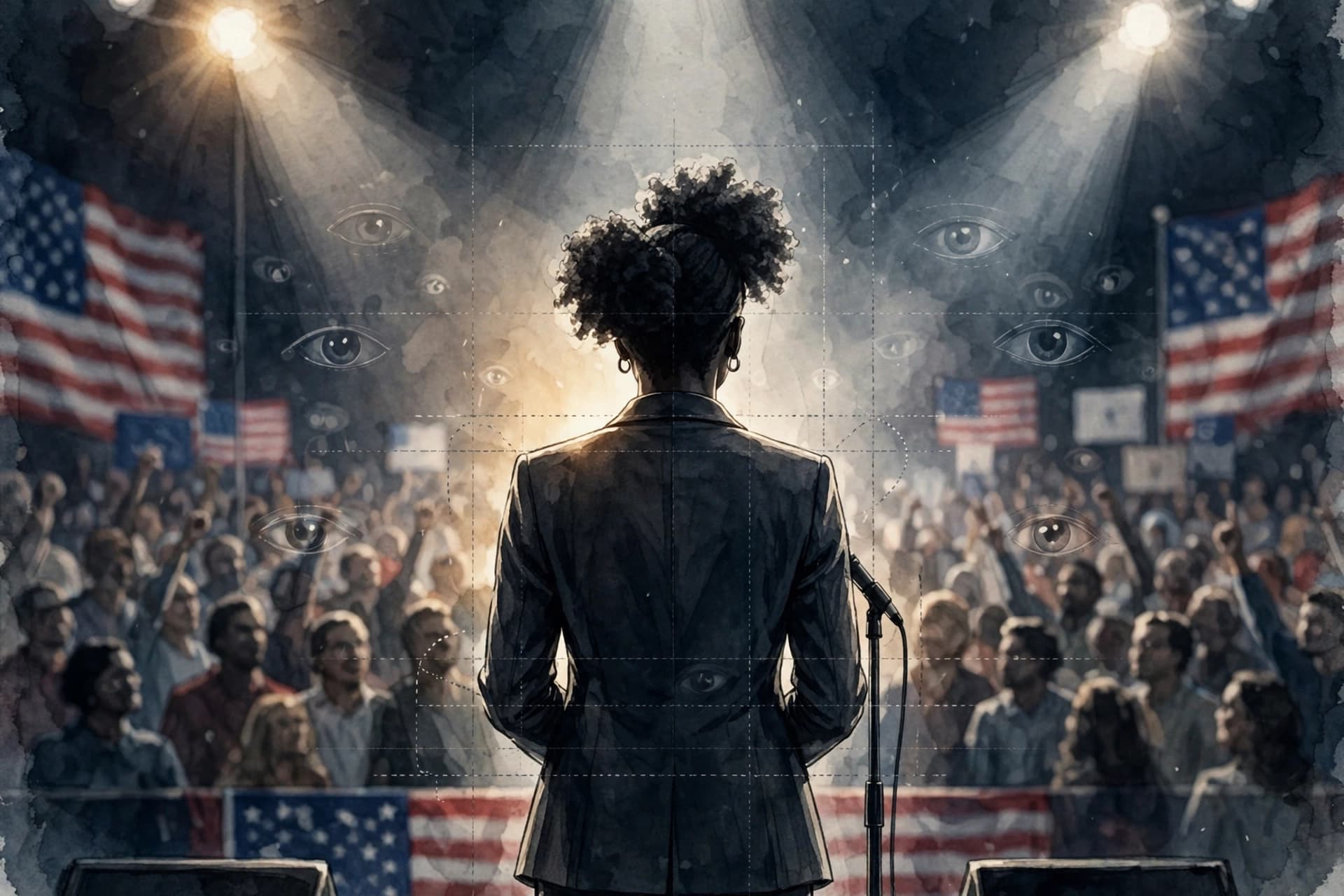
A story about one man’s physique became a moment about a Black woman’s body, and a crowd was invited to look. Trump framed it as a compliment, and nothing in the reporting shows he meant to humiliate her.
It was not his first public comment of this kind. At a White House lunch in July he called her “so respected and so hot”. On 24 July he joked at the rescheduled White House Correspondents’ Association dinner that gunshot warnings made her start twerking, Atlanta Black Star reported.
Nicki Minaj: image, agency and politics
Minaj is not a bystander who wandered onto a political stage. Born in Trinidad and Tobago, she became one of the most commercially successful women in hip-hop, building a career on technical skill, theatrical personas and an open approach to sexuality.
Her body has been part of that public conversation by her own design. When her 2014 video “Anaconda” missed a top MTV Video Music Awards category, she charged that the industry preferred women with “very slim” figures. She has said she wanted to make “a song that embraced curvy women”.
To read every reference to her body as victimhood would ignore that record of control. But control over an image in a music video is not control over how someone else describes your body from a podium. A woman can perform sexually and still not hand every audience member, interviewer or politician the right to appraise her.
Her politics have shifted sharply. She once criticised Trump’s hardline immigration policies, AFP reported, before becoming one of his most visible celebrity supporters. In January 2026 she called herself his “number one fan” and said the hate she receives only strengthens her support. In November 2025 she addressed the United Nations on faith-based persecution in Nigeria, an allegation the Nigerian government denies.
At the rally she told Trump that “it is an honor to stand with you” and pledged to support him “forever and ever”. Published reports show no public response from her to this particular remark.
She has answered Trump’s jokes before. After the July dinner she posted an image of the horror-film doll Chucky with a caption about how she would look at the president next time she saw him, according to a report on the exchange. That is a humorous reply, and it does not settle how she felt about the rally.
Her political choices are relevant because she chose to share a platform with Trump. They do not show whether she welcomed, disliked or shrugged off the comment. Nor should this piece weigh whether she deserves sympathy because of her politics. The question is whether a woman’s political choices determine what others may say about her body.
Sarah Baartman and the history of the gaze
Sarah Baartman was a Khoikhoi woman born around 1789 in South Africa’s Eastern Cape, although sources differ on the exact date. In October 1810 she allegedly signed a contract, though she was illiterate, to travel to England for shows with a British ship’s surgeon, William Dunlop, and Hendrik Cesars, in whose household she worked, BBC News Magazine records.
She was billed as the “Hottentot Venus”, a name now seen as derogatory. Crowds were invited to look at her body, and wealthy customers could pay for private demonstrations where guests were allowed to touch her. The people who displayed her profited from her.
How far she consented is disputed. Campaigners were appalled and her employers were prosecuted, but not convicted, and Baartman testified in their favour. Historian Christer Petley told the BBC the truth may never be known, though the relationship was clearly unequal. The University of Cape Town (UCT) timeline describes consent given under coercion and without real freedom.
Two questions must stay apart. Whether she chose to leave South Africa is uncertain. Even if she agreed to travel, that cannot be read as agreement to every exhibition, touch or study that followed. She also resisted: she agreed to be studied by scientists in Paris but refused to appear fully naked, arguing it was beneath her dignity.
She died on 29 December 1815, aged 26. The naturalist Georges Cuvier dissected her body, and parts of her remains stayed on display in a Paris museum until 1974. President Nelson Mandela asked France to return them in 1994. She was buried in Hankey, Eastern Cape, on 9 August 2002, South Africa’s National Women’s Day, the UCT timeline records.
Writer Natasha Gordon-Chipembere argues that amid all the books and films about her, Baartman “the woman, remains invisible”. That is the history’s lasting lesson: a life reduced to what others did with her body.
What the comparison reveals, and what it cannot tell us
The parallel lies in the pattern, not the circumstances. It is not enough that both women are Black and that attention fell on their bodies. The shared question is who controls the meaning of a Black woman’s body once it becomes a public spectacle.
For Baartman, the answer was brutal. Others displayed, studied and profited from her body, and decided what it meant. For Minaj, the circumstances are far gentler. She is wealthy, internationally famous and chose to be at the rally. The comparison asks about a pattern of looking, not about equal suffering.
Three things can be separated: the act, its historical associations and its effect. The act was a powerful man naming a Black woman’s body before a crowd and asking her to stand. The association is a long tradition of treating Black women’s bodies as public property to be assessed. The effect, whatever Trump intended, was an audience invited to look.
Researcher Rokeshia Renné Ashley of Florida International University (FIU) names that tradition. By the white gaze she means a way of looking that treated Baartman’s body as exotic and overtly sexual and then spread the stereotype that Black women are hypersexual. The term works here only in that narrow sense, not as shorthand for every comment on a Black woman’s appearance.
The crowd deserves as much attention as the speaker. Trump did not make the remark in private. He pointed at her, told her to stand, and the arena responded with cheers. Baartman’s exhibitions also depended on audiences who paid to look and shared in the spectacle. The mechanisms differ, but in both cases a woman’s body became something a crowd looked at together.
That changes the question from whether Trump meant to offend Minaj to what the applause made possible. When a comment about a woman’s body becomes shared entertainment, the audience takes part in the act of looking.
The limits are real. The history does not show that Trump meant to invoke Baartman, or that Minaj felt degraded. Trump also commented on a man’s body in the same speech, though Husted was the subject of an anecdote about his football background, while Minaj was singled out in the room and told to stand.
Minaj’s image has long been part of her art, but that does not settle how she experienced this moment. Ashley’s research also records differing views among Black women on whether reclaiming the features once used to degrade Baartman is empowerment or repeats the same objectification.
The question that remains
Consent to attend is not consent to be appraised. A woman can choose her politics, her platform and her place on a stage without agreeing that her body belongs to the audience.
Baartman’s burial on National Women’s Day was an act of return after nearly two centuries of bodily appropriation. Minaj’s experience at the rally was not the same, and the comparison should not erase that difference.
So who gets to look at a Black woman’s body? Anyone can look. What the history shows is the danger of looking turning into entitlement, with those holding power over the stage deciding what a woman’s body means and a crowd cheering them on.
The answer to how Minaj saw the moment cannot be supplied on her behalf. The wider question is whether a woman’s willingness to be visible, sexually expressive or politically outspoken should allow an audience to treat her body as something it collectively owns.